The New York Yankees paid $100,000 for Babe Ruth on January 3, 1920. For that sum, the Yankees got the most famous athlete in America, the foundation of a dynasty that would produce 27 World Series titles, and the defining transaction in the history of professional sports. The Red Sox got a check and 86 years of regret.
The Deal
George Herman Ruth was 24 years old and already the biggest name in baseball. His 1919 season in Boston had produced 29 home runs -- shattering Ned Williamson's 1884 record of 27 (a mark most historians consider inflated by Chicago's absurdly short left-field fence that year) -- a .322 batting average, and an OPS north of 1.100. He'd already won two World Series titles as a pitcher, in 1916 and 1918. Ed Barrow, Boston's manager, had converted him from a dominant left-hander into a full-time outfielder because his bat was too good to sit on the bench four days out of five.
Red Sox owner Harry Frazee didn't care. Frazee was a Broadway theatrical producer who'd bought the team in 1916 largely with borrowed money. By the winter of 1919, he was drowning in debt and facing a star player who wanted his salary doubled from $10,000 to $20,000 a year.
Jacob Ruppert, the meticulous beer baron who co-owned the Yankees with Cap Huston, saw the opening. His club had never won an American League pennant. They played as tenants at the Polo Grounds, overshadowed by the Giants, drawing modest crowds in the biggest city in the country. Ruppert didn't just want a good team. He wanted the best franchise in baseball. Ruth was the lever.
| Purchase Price | $100,000 |
| Additional Loan to Frazee | ~$300,000 |
| Loan Collateral | Fenway Park |
| Ruth's Age at Sale | 24 |
| Ruth's 1919 Home Runs | 29 (MLB record) |
| Previous Record Sale Price | $50,000 + two players (Tris Speaker, 1916) |
The Moment
The agreement came together around December 26, 1919, in conversations between Frazee and Ruppert. No players changed hands. No prospects went the other way. This wasn't a trade -- it was a straight cash sale, the kind of transaction that treated a ballplayer the way you'd treat a racehorse. Ruth had no say. He learned the news from reporters while spending the offseason in California (nobody even called him).
The public announcement landed on January 3, 1920, and the reaction split cleanly along geographic lines. New York's sportswriters celebrated. Boston's press treated it like a funeral.
Frazee tried to spin it as a baseball decision. He told reporters Ruth had become "simply impossible" and that the Red Sox "could no longer put up with his eccentricities." He predicted the money would allow him to build a better team.
The price was something enormous, but I do not care to name it. Suffice to say that the sum paid will enable us to put Boston on top.
Nobody believed him. They were right not to. The full financial picture told a bleaker story: beyond the $100,000 cash payment, Ruppert loaned Frazee a reported $300,000 -- secured by a mortgage on Fenway Park itself. The owner of the Yankees literally held a lien on the Red Sox's home ballpark. Frazee wasn't just selling his best player. He was handing Ruppert the keys to his entire operation.
The Aftermath
Ruth's first season in pinstripes erased any lingering debate about the wisdom of Ruppert's investment.
| 1920 Home Runs | 54 |
| Batting Average | .376 |
| OPS | 1.379 |
| RBI | 137 |
| Yankees Attendance | ~1.29 million (MLB record) |
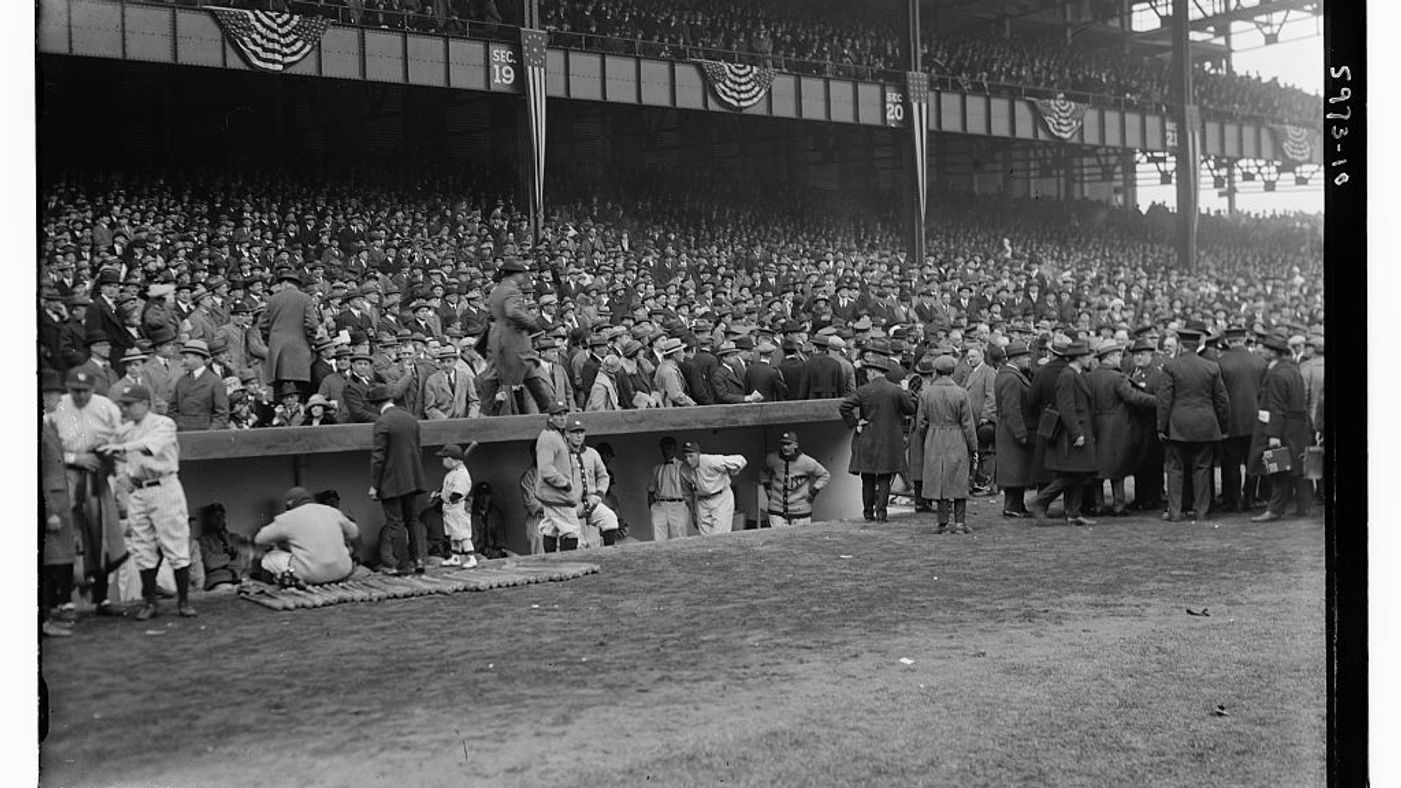
Those 54 home runs topped every other American League team's club total that year. The Yankees drew a record 1.29 million fans to the Polo Grounds -- so many that the Giants eventually told them to find their own ballpark (the eviction came after the 1922 season, but the tension started the moment Ruth showed up). Ruppert's response was to build Yankee Stadium, which opened in 1923 and fans immediately dubbed "The House That Ruth Built."
The dynasty came fast. The Yankees won their first pennant in 1921, their first World Series in 1923, and by the time the 1927 Murderers' Row squad ran away with the American League at 110-44 and swept the Pirates in the World Series, Ruth and the Bombers had become the standard against which every franchise in professional sports measured itself.
Boston went the other direction. Frazee kept selling stars to the Yankees -- Waite Hoyt, Herb Pennock, Joe Dugan -- stripping the roster down to nothing. The Red Sox finished last nine times between 1922 and 1932. Barrow, the man who'd begged Frazee not to sell Ruth, crossed enemy lines and became the Yankees' general manager in October 1920. He built the dynasty using the blueprint he'd drawn up in Boston.
The Red Sox didn't win another World Series until 2004. Eighty-six years.
Sale Announced
The Red Sox sell Ruth to the Yankees for $100,000 -- the largest sum ever paid for a ballplayer.
Ruth Hits 54 Home Runs
Ruth nearly doubles his own single-season record in his first year in pinstripes, drawing record crowds to the Polo Grounds.
First Pennant
The Yankees win the American League pennant for the first time in franchise history.
First World Series Title
The Yankees win their first championship, beating the Giants at the brand-new Yankee Stadium.
The Drought Ends
The Red Sox win the World Series -- 86 years after the Ruth sale -- after coming back from 3-0 down against the Yankees in the ALCS, then sweeping the Cardinals.
And about that Broadway musical: the popular story that Frazee sold Ruth to finance "No, No, Nanette" makes a good punchline, but it's wrong. That show didn't open until September 1925 -- more than five years after the sale. Frazee did pour money from player sales into his theater ventures, starting with "My Lady Friends" in 1921 (which later got adapted into "Nanette"). But the causation runs the other way. He sold Ruth because he was broke, then spent the money on shows. Boston fans flipped the timeline because it made for a better grudge.
Dan Shaughnessy popularized the grudge's official name in 1990 when he published "The Curse of the Bambino." Before that book, Boston's championship drought was just a drought. After it, the drought had a villain, a narrative, and a supernatural edge. Ruth never spoke of a curse. Frazee didn't either. The "Curse" was a sportswriter's construction, applied backward -- and it stuck for 14 more years until the 2004 Red Sox finally buried it.
Frequently Asked Questions
How much did the Yankees pay for Babe Ruth?
The Yankees paid $100,000 in cash to the Boston Red Sox -- the largest sum ever paid for a baseball player at the time. Separately, Yankees owner Jacob Ruppert loaned Red Sox owner Harry Frazee a reported $300,000, secured by a mortgage on Fenway Park. The total financial benefit to Frazee came to roughly $400,000 in 1920 dollars. Some sources incorrectly cite $125,000 as the sale price; the verified cash figure is $100,000.
Why did the Red Sox sell Babe Ruth?
Red Sox owner Harry Frazee sold Ruth primarily because he was broke. He'd bought the team with borrowed money in 1916, was financing Broadway productions, and couldn't cover his debts. The $100,000 from the Yankees plus the $300,000 loan solved his financial crisis. Ruth's demand for a salary increase -- from $10,000 to roughly $20,000 per year -- added pressure. The popular story that Frazee sold Ruth to fund the musical "No, No, Nanette" is a myth; that show didn't premiere until 1925.
Was Babe Ruth traded or sold to the Yankees?
Ruth was sold, not traded. No players changed hands in the transaction. The Red Sox received $100,000 in cash and a separate loan from Yankees owner Jacob Ruppert. Ruth had no say in the deal -- he learned about it through the press -- and baseball's reserve clause treated him as property to be bought and sold.