
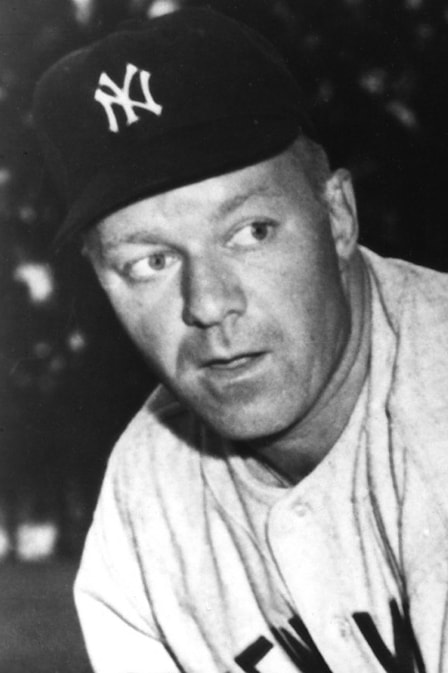
Ed Lopat was a pitcher who played for the New York Yankees from 1948 to 1955. Played during The DiMaggio Era (1936–1951).
Ed Lopat never threw a pitch anyone would call hard. He worked in the high 70s, low 80s on a good day, mixing a curve, a slider, and a changeup that all looked the same coming out of his hand and arrived at three different speeds. Hitters hated him for it. Ted Williams, who saw every kind of pitcher the American League could throw at him, named Lopat among the toughest he ever faced -- and was reportedly overheard grumbling about "that bleeping Lopat" after another afternoon of guessing wrong. The nickname stuck for a reason: "The Junkman" beat you with what he didn't throw.
From First Base to the Mound
Lopat didn't start as a pitcher. He signed with the Brooklyn Dodgers organization in 1937 as a first baseman, playing for the Class D Greensburg Green Sox on a $50-a-month contract. A year later, warming up before a game for the Jeanerette Blues in the Evangeline League, he put a little extra on a throw and his manager noticed. Told to throw a curve, he did, and that was that -- Lopat spent the next seven years working his way through the minors as a pitcher before the Chicago White Sox brought him up in 1944.
He was solid in Chicago and largely invisible to the rest of baseball, pitching four seasons for teams that gave him little support and less attention. Then, on February 24, 1948, the New York Yankees traded for him, sending catcher Aaron Robinson and pitchers Fred Bradley and Bill Wight to the White Sox for a 29-year-old soft-tosser nobody outside Chicago much cared about. It's one of the most lopsided trades in franchise history, and it completed a rotation that would define an era.
Completing the Big Three
Vic Raschi threw hard and dared hitters to catch up. Allie Reynolds threw hard from the right side and struck people out. Lopat threw nothing straight and changed speeds like he was playing a different sport. Together, under Casey Stengel, the three of them anchored a Yankees rotation that won five consecutive World Series titles from 1949 through 1953 -- a run nobody has matched before or since.
| Yankees Record | 113-59 (.657) |
| Yankees ERA | 3.19 |
| Career MLB Record | 166-112 (.597), 3.21 ERA |
| 1953 AL ERA Title | 2.42 (led AL) |
| 1953 Record | 16-4, .800 (led AL in win pct.) |
| World Series Titles | 5 (1949-1953) |
| World Series Record | 4-1, 2.60 ERA (7 starts) |
| All-Star Selections | 1 (1951) |
Lopat won at least 10 games in every full season he pitched. He went 15-10 in 1949, 18-8 in 1950, 21-9 in 1951, 10-5 in 1952, and 16-4 in 1953 -- five years, five rings, and a rotation spot he never lost despite never touching 85 miles an hour. His career record against the Cleveland Indians, the Yankees' toughest rival for most of that stretch, was a staggering 40-13. SABR later wrote an entire study trying to explain how a junkballer owned a contending club that thoroughly. Nobody fully cracked it. Lopat just knew where hitters didn't want the ball, and he put it there.
1953: The Best Year
At 35 years old, in what should have been the back half of his decline, Lopat had his finest season. He led the American League in ERA at 2.42 and in winning percentage at .800, going 16-4 in 24 starts. The strikeout totals were modest -- 50 punchouts in 178.1 innings -- because Lopat never needed the strikeout. He needed weak contact, and 1953 hitters gave him plenty of it. That October, the Yankees beat the Dodgers to complete the five-peat, and Lopat closed out a career year on the sport's biggest stage.
He couldn't outrun age forever. By July 1955, at 37, Lopat was 4-8 with a 3.74 ERA, and the Yankees -- already building around Whitey Ford and a younger staff -- traded him to the Baltimore Orioles for pitcher Jim McDonald and cash on July 30. He pitched out the string in Baltimore and retired at season's end, the only year of his career he didn't reach double-digit wins.
Traded to the Yankees
The Yankees acquire Lopat from the White Sox for Aaron Robinson, Fred Bradley, and Bill Wight, completing the Big Three rotation.
Only All-Star Selection
Lopat goes 21-9 and earns his lone All-Star nod, the best regular-season win total of his career.
AL ERA Champion
At age 35, Lopat leads the American League with a 2.42 ERA and .800 winning percentage (16-4) as the Yankees win their fifth straight title.
Traded to Baltimore
The Yankees deal the 37-year-old Lopat to the Orioles for pitcher Jim McDonald and cash. He retires after the season.
Death
Lopat dies in Darien, Connecticut, at 73, after a private battle with pancreatic cancer.
After the Mound
Lopat stayed in the game. Former teammate Hank Bauer brought him on as pitching coach for the Kansas City Athletics, and when Bauer was let go in 1963, Lopat took over as manager. It didn't go well by the record book -- 90-124 over parts of two seasons -- but Charlie Finley kept him around as a front-office aide through the club's final years in Kansas City before the move to Oakland.
Lopat never made the Hall of Fame, and his career numbers -- 166 wins, a 3.21 ERA, modest strikeout totals -- don't jump off the page the way Raschi's power arm or Reynolds's strikeout rate might suggest a Hall case should. But box scores don't measure deception, and deception was the whole act. He beat hitters who were faster, stronger, and better than he was by making sure they never knew what was coming next. Steady Eddie earned both nicknames the same way -- by doing the unglamorous thing, over and over, for as long as it took to win five rings.
Frequently Asked Questions
What was Ed Lopat's record with the Yankees?
Lopat went 113-59 with a 3.19 ERA over eight seasons with the Yankees (1948-1955), a .657 winning percentage. He won five consecutive World Series titles (1949-1953) and posted a 4-1 record in seven career World Series starts.
Why was Ed Lopat nicknamed 'The Junkman'?
Lopat rarely threw hard, relying instead on a curveball, slider, and changeup thrown from the same motion at different speeds to disrupt hitters' timing. The soft-tossing style, a contrast to power arms like Vic Raschi and Allie Reynolds, earned him the nicknames "The Junkman" and "Steady Eddie."
Did Ed Lopat lead the league in ERA?
Yes. In 1953, at age 35, Lopat led the American League with a 2.42 ERA and a .800 winning percentage, going 16-4 in 24 starts as the Yankees won their fifth consecutive World Series title.
Is Ed Lopat in the Baseball Hall of Fame?
No. Despite his 113-59 Yankees record, five championships, and a career .597 winning percentage, Lopat was never inducted into the National Baseball Hall of Fame.