
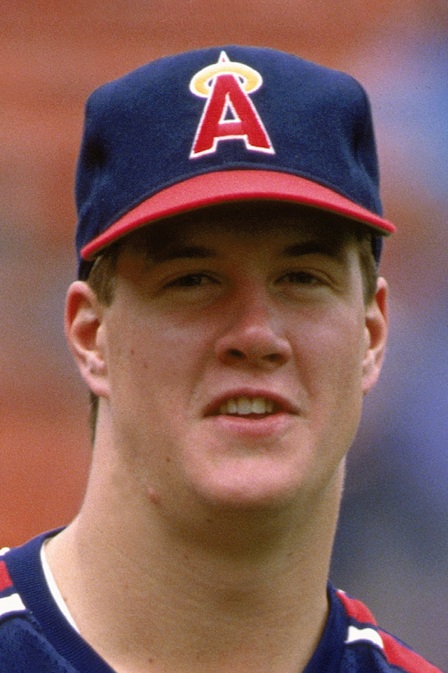
Career Stats
Regular Season
| Year | G | GS | W | L | SV | IP | H | ER | K | BB | ERA | WHIP |
|---|---|---|---|---|---|---|---|---|---|---|---|---|
| 1993 | 32 | 32 | 11 | 14 | 0 | 214.0 | 221 | 104 | 95 | 73 | 4.37 | 1.37 |
| 1994 | 24 | 24 | 9 | 8 | 0 | 160.1 | 167 | 81 | 90 | 64 | 4.55 | 1.44 |
| Career | 56 | 56 | 20 | 22 | 0 | 374.1 | 388 | 185 | 185 | 137 | 4.45 | 1.40 |
Career-best seasons highlighted in gold. Stats via Retrosheet.
Jim Abbott was a pitcher who played for the New York Yankees from 1993 to 1994. Career stats: 20-22 record, 4.45 ERA, 185 strikeouts.
Jim Abbott pitched ten seasons in the majors, and he did it with one hand. Not "mostly one hand" or "one good hand and a helper" -- Abbott was born without a right hand, and he still made an Opening Day rotation as a rookie, won an Olympic gold medal before he ever threw a professional pitch, and no-hit the Cleveland Indians in a Yankees uniform. Two years in the Bronx (1993-1994) is a short chapter in a longer story, but it's the chapter with the no-hitter in it, so it's the one most people remember.
I'll say this up front: Abbott's overall numbers as a Yankee weren't great. 20-22, a 4.45 ERA, a losing record on some genuinely good Yankees teams. If you only look at the stat line, you'd wonder why he gets a page. Then you remember the stat line isn't the point.
Path to the Bronx
Abbott grew up in Flint, Michigan, and by the time he got to the University of Michigan he was already the best amateur pitcher in the country -- good enough that in 1987 he won the James E. Sullivan Award as the nation's top amateur athlete, the only baseball player ever to win it. The Angels drafted him 8th overall in 1988. That September, before he'd signed a professional contract or thrown a single inning for pay, he started and won the gold-medal game for Team USA at the Seoul Olympics, a complete-game 5-3 win over Japan.
Then he did something almost nobody does: he skipped the minors entirely. Straight from the draft to the Angels' 1989 Opening Day rotation, no rehab assignment, no Double-A, no warmup lap. (Try pitching that development plan to a modern front office. They'd want three years of Triple-A data first.) He pitched his whole career using a technique people came to call the Abbott Switch -- glove balanced on his right wrist through the windup, bare hand sliding into it the instant the ball left his fingers, ready to field. He'd drilled it for years before a big-league hitter ever tested it.
His best individual season came with the Angels in 1991: 18-11, a 2.89 ERA over 243 innings, third in the AL Cy Young voting behind Roger Clemens. (Clemens won it. Somebody usually did, in those years.) The Angels traded him to New York on December 6, 1992, sending J.T. Snow, Jerry Nielsen, and Russ Springer to California -- Gene Michael liked a lefty with a 2.83 ERA over the previous two seasons pitching in front of the short porch, and he wasn't wrong about the fit even if the record didn't always show it.
Yankees Career
1993 was uneven -- 11-14, a 4.37 ERA across 32 starts -- but it had one afternoon that made the whole season worth it. On September 4, 1993, Abbott no-hit the Cleveland Indians at Yankee Stadium, 4-0, six days after that same Indians lineup had rocked him for seven runs in under four innings. Baseball doesn't usually hand out redemption that fast. It did that day.
1994 was the strike year, cut short in August -- Abbott went 9-8 with a 4.55 ERA across 24 starts before the season just stopped. He left as a free agent afterward, and his time in pinstripes ended there: two years, one no-hitter, a bunch of hard-luck losses in between.
| Yankees Record | 20-22 |
| Yankees ERA | 4.45 |
| Yankees Innings | 374.1 |
| Career Record | 87-108 |
| Career ERA | 4.25 |
| Career Strikeouts | 888 |
| Career WAR | 19.6 |
| 1988 Olympics | Gold Medal (Team USA) |
The Rest of the Career
Abbott's road after New York wasn't a straight line, and I think that's part of what makes him worth remembering beyond just the no-hitter. He signed with the White Sox for 1995, got traded to the Angels at the deadline when Chicago fell out of the race, and put together a solid combined season (11-8, 3.70 ERA). Then came 1996, and it was brutal -- 2-18, a 7.48 ERA (a .100 winning percentage, which is a genuinely hard number to post as a full-time starter and not get demoted somewhere), released before Opening Day 1997. He didn't pitch in the majors at all that year.
Most guys don't come back from a season like that. Abbott did. The White Sox signed him again in 1998, called him up in September, and he went 5-0 in five starts to close out the year -- against, among others, his old team in New York. One more season followed with Milwaukee in 1999, a rough one, and he was released that July. Ten seasons, four teams, 263 games -- 254 of them starts -- by a guy who wasn't supposed to be able to field his position.
Born in Flint, Michigan
Abbott is born without a right hand.
Sullivan Award
Wins the James E. Sullivan Award as the nation's top amateur athlete while pitching at the University of Michigan -- still the only baseball player to win it.
Olympic Gold
Starts and wins the gold-medal game for Team USA at the Seoul Olympics, a complete-game 5-3 win over Japan.
MLB Debut
Opens the season in the Angels' rotation, never having pitched a minor-league inning.
Traded to New York
The Angels send Abbott to the Yankees for J.T. Snow, Jerry Nielsen, and Russ Springer.
No-Hitter
Abbott no-hits the Cleveland Indians 4-0 at Yankee Stadium, the franchise's first no-hitter since 1983.
Rock Bottom, and a Release
Goes 2-18 with a 7.48 ERA for the Angels and is released before the following season.
Final MLB Season Ends
Released by the Milwaukee Brewers, closing out a ten-season career.
Legacy
Abbott finished with a losing career record, 87-108, and I don't think that number tells you anything true about him. A pitcher who never had a minor-league inning to hide in, who fielded his position with a technique he built from nothing, who won a gold medal before he was old enough to rent a car, and who -- on one September afternoon in the Bronx -- did something Yankees pitchers had done exactly once in the previous decade. He wrote a memoir about it, "Imperfect: An Improbable Life," in 2012, and the framing device he picked for the whole book was the no-hitter. Makes sense. It's the same reason this page exists.
He's not in Cooperstown, and the career numbers say he shouldn't be. But ask anyone who was at the Stadium on September 4, 1993, and the Hall of Fame isn't really the point they're making.
Frequently Asked Questions
How many years did Jim Abbott play for the Yankees?
Abbott pitched for the Yankees in 1993 and 1994, going 20-22 with a 4.45 ERA across 374.1 innings. He arrived via a December 1992 trade with the Angels and left as a free agent after the strike-shortened 1994 season.
Did Jim Abbott really pitch with only one hand?
Yes. Abbott was born without a right hand and pitched his entire career using a technique known as the Abbott Switch -- resting his glove on his right wrist during the delivery, then sliding his bare hand into the glove the instant he released the ball so he could field balls hit back at him.
What is Jim Abbott's career record?
Abbott finished his ten-season MLB career (1989-1999, playing for the Angels, Yankees, White Sox, and Brewers) with an 87-108 record, a 4.25 ERA, and 888 strikeouts across 263 games.
Did Jim Abbott win an Olympic gold medal?
Yes. Abbott started and won the gold-medal game for Team USA at the 1988 Seoul Olympics, a complete-game 5-3 win over Japan, before he'd ever thrown a professional pitch.
What is Jim Abbott's most famous moment with the Yankees?
Abbott no-hit the Cleveland Indians 4-0 at Yankee Stadium on September 4, 1993 -- the Yankees' first no-hitter since 1983, and it came just six days after that same Indians lineup had scored seven runs off him in under four innings.