
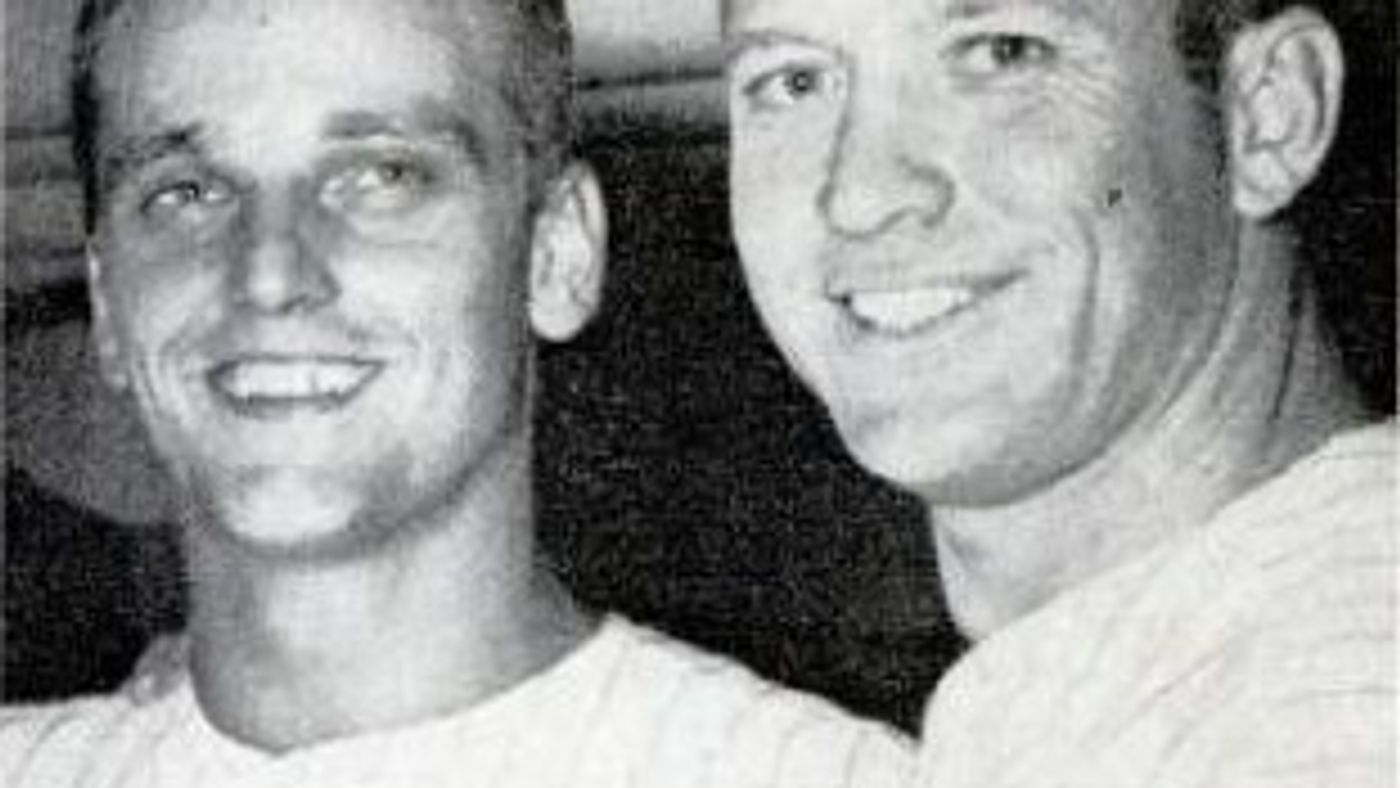
October 1, 1961. The last game of the regular season. Yankee Stadium. Only 23,154 people showed up -- less than a third of capacity -- to watch a man break the most famous record in American sports. Two-thirds of the seats sat empty. Roger Maris stepped into the batter's box in the fourth inning against Boston's Tracy Stallard, a young right-hander with nothing at stake except his own competitive pride, and drove a fastball into the lower right field stands. Home run number 61. The record that had belonged to Babe Ruth for 34 years was gone. And the man who took it looked like he'd just survived something.
The Weight
The 1961 season had been an endurance test disguised as a home run chase. It was also the first year of the expanded 162-game schedule -- the American League had added two franchises that winter, and eight extra games came with them. That detail matters, because it became the weapon used against Roger Maris before he ever touched the record.
Maris and Mickey Mantle -- the M&M Boys -- spent the summer chasing Ruth's 60 together, rooming in a rented apartment in Queens with outfielder Bob Cerv, three guys from outside New York trying to make sense of a city that was making a spectacle out of their at-bats.
The fans wanted Mantle. That was never a secret. Mantle was 29, a two-time MVP, the golden boy of the Bronx -- charismatic, handsome, the rightful heir to DiMaggio. Maris was from Fargo, North Dakota (born in Hibbing, Minnesota, but Fargo raised him). He was blunt with reporters. He didn't perform his enthusiasm. He gave honest answers to loaded questions and the press treated him like a hostile witness.
By September, Maris's hair was falling out in clumps. Actual patches of baldness on his scalp, visible under his cap. The stress of chasing Ruth's record while half of New York rooted against him was breaking his body down in real time. Teammates saw it. Reporters wrote about it. Nobody did anything about it.
Then Mantle went down. A hip abscess -- caused by an infected injection in late September -- hospitalized him and ended his chase at 54 home runs. A total that would've been the American League record in any other year. The man the fans wanted couldn't finish. The man they didn't want kept going.
And that July, Commissioner Ford Frick -- Ruth's former ghostwriter, a detail that tells you everything you need to know -- had ruled that any record set after 154 games would require "some distinguishing mark" in the record books. He never said "asterisk." Dick Young of the Daily News gave it that name, and it stuck to Maris like a brand. Through game 154, Maris had 59 home runs. One short. The asterisk applied before he ever hit number 61.
The Swing
Fourth inning. The 162nd and final game of the season. Stallard had pitched carefully to Maris earlier in the game, walking him once. But Stallard wasn't going to duck the moment. He came right at him with a fastball. No grooved pitch. No gift. Stallard wanted to get him out.
Maris connected clean. The ball sailed into the lower right field stands -- about ten rows deep. The 23,154 fans in the building erupted. Maris circled the bases with the same flat expression he'd carried all year, like a man completing an assignment he'd been given against his will.
I wasn't going to walk him. He hit 61 home runs off 61 different pitches. There's nothing to be ashamed about.
Maris retreated to the dugout. The crowd wanted a curtain call. Maris didn't move. He'd spent six months being told he wasn't the right man for this record, and now they wanted him to come out and celebrate? His teammates -- Cerv chief among them -- shoved him back up the steps and out of the dugout. Maris tipped his cap. It was the most reluctant curtain call in the history of the Stadium, and it captured everything about his 1961 in a single image: a quiet man dragged into the spotlight by people who cared about him more than he cared about the attention.
| Home Runs | 61 (American League record) |
| Batting Average | .269 |
| On-Base Percentage | .372 |
| Slugging Percentage | .620 |
| RBI | 141 |
| Pitcher of HR #61 | Tracy Stallard, Boston Red Sox |
| Date of HR #61 | October 1, 1961 (final game of season) |
| Attendance | 23,154 (stadium capacity ~67,000) |
| Ruth's Previous Record | 60 HR (1927) -- stood 34 years |
The Aftermath
Sal Durante -- a 19-year-old kid from Coney Island, Brooklyn -- caught the ball in the right field stands. He sold it to a California restaurateur named Sam Gordon for $5,000 (a small fortune for a teenager in 1961). Gordon returned it to Maris. Maris, characteristically, gave it back to Durante. The kid had earned it.
The M&M Boys Chase Begins
Maris and Mantle pace the Yankees from the opening weeks. By Memorial Day both are ahead of Ruth's 1927 pace and the press starts doing arithmetic.
Frick's Ruling
Commissioner Ford Frick -- Ruth's former ghostwriter -- declares that any record set after 154 games needs "a distinguishing mark." The press coins the word "asterisk." It sticks to Maris like a brand before he's even broken anything.
Mantle Falls Out
A hip abscess ends Mantle's chase at 54 home runs. The man the fans wanted can't finish. Maris carries on alone, his hair falling out in patches from the stress.
Through Game 154 -- 59 Home Runs
Maris reaches the 154-game mark with 59 home runs -- one short of Ruth. The asterisk applies. He has eight games left to break the record and no goodwill from half the city.
Home Run #61
Fourth inning of the season's final game. Tracy Stallard throws a fastball. Maris drives it into the lower right field stands. The record that stood 34 years is gone. Maris circles the bases looking like a man completing an assignment he'd been given against his will.
Maris won his second consecutive AL MVP -- he'd hit 39 homers and driven in 112 runs in 1960, so this wasn't a one-year accident. He hit .269/.372/.620 with 61 home runs and 141 RBI. The Yankees won 109 games and beat Cincinnati in five in the World Series. By any rational measure, it was a triumph. It didn't feel like one.
The asterisk followed Maris everywhere. He played five more years in New York, increasingly beaten down by the media and a fan base that never fully embraced him. A hand injury in 1965 robbed him of his power stroke. After 1966, the Yankees traded him to St. Louis, where the fans and teammates treated him like a human being for the first time in years. He helped the Cardinals win the 1967 World Series and hit .385 in the Fall Classic. He called his time in St. Louis the happiest of his baseball career. That sentence alone tells you what New York did to him.
Maris retired after 1968. He went home -- not to New York, but to Fargo, where he'd always belonged. He ran a Budweiser distributorship in Gainesville, Florida with his family. He lived quietly, the way he'd always wanted to.
Non-Hodgkin's lymphoma took him. On December 14, 1985, Roger Maris died in Houston, Texas. He was 51 years old.
Maybe I'm not a great man, but I damn well want to break the record.
In 1991 -- six years after they buried Maris at Holy Cross Cemetery in Fargo -- baseball's Committee for Statistical Accuracy removed the asterisk. The thing is, no actual asterisk had ever appeared in any official record book (Frick's "distinguishing mark" existed as a bureaucratic footnote, not the scarlet letter the public imagined). His 61 stood as the unqualified American League single-season record. He never knew. The vindication came to an empty chair.
Maris's record lasted 61 years. On October 4, 2022, Aaron Judge hit his 62nd home run in Arlington, Texas. Judge was gracious about Maris, respectful of the history, aware of what the man had endured. The Maris family was there. They'd been invited. It was the kind of moment Roger Maris deserved in 1961 and never got -- a celebration without conditions, without qualifications, without an asterisk that never existed in the first place.
He's still buried in Fargo. The seats at the Stadium are still empty.
Frequently Asked Questions
When did Roger Maris hit his 61st home run?
Roger Maris hit his 61st home run on October 1, 1961, the final game of the regular season, at Yankee Stadium against Boston Red Sox pitcher Tracy Stallard. He drove a fastball into the lower right field stands in the fourth inning, breaking Babe Ruth's single-season record of 60 set in 1927. Only 23,154 fans were in attendance.
What was the asterisk on Roger Maris's home run record?
Commissioner Ford Frick ruled in July 1961 that any player who broke Ruth's record in more than 154 games would need "some distinguishing mark" in the record books. Frick never said "asterisk" -- the press coined that term, most often attributed to Dick Young of the New York Daily News. Maris had 59 home runs through game 154 and hit his 61st in game 162. No actual asterisk ever appeared in any official record book. Baseball's Committee for Statistical Accuracy removed the distinction in 1991, six years after Maris's death.
Who broke Roger Maris's home run record?
Aaron Judge hit 62 home runs in 2022, breaking Maris's American League single-season record of 61 that had stood for 61 years. The overall MLB single-season record is Barry Bonds's 73 in 2001, though that mark was set during the steroid era and carries its own historical baggage.