
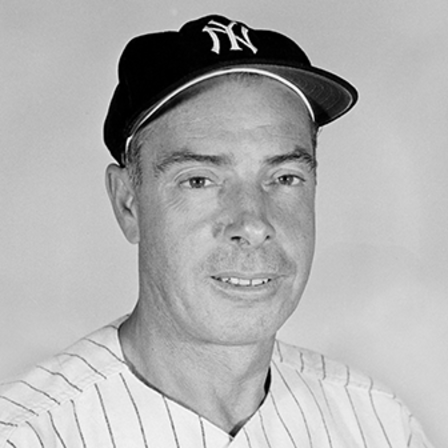
Career Stats
Regular Season
| Year | G | AB | R | H | 2B | 3B | HR | RBI | BB | SO | SB | AVG | OBP | SLG | OPS |
|---|---|---|---|---|---|---|---|---|---|---|---|---|---|---|---|
| 1947 | 141 | 534 | 97 | 168 | 31 | 10 | 20 | 97 | 64 | 32 | 3 | .315 | .391 | .522 | .913 |
| 1948 | 153 | 594 | 110 | 190 | 26 | 11 | 39 | 155 | 67 | 30 | 1 | .320 | .396 | .598 | .994 |
| 1949 | 76 | 272 | 58 | 94 | 14 | 6 | 14 | 67 | 55 | 18 | 0 | .346 | .459 | .596 | 1.055 |
| 1950 | 140 | 529 | 116 | 161 | 34 | 10 | 32 | 123 | 80 | 34 | 0 | .304 | .397 | .588 | .985 |
| 1951 | 118 | 423 | 75 | 111 | 22 | 4 | 12 | 74 | 63 | 39 | 0 | .262 | .366 | .418 | .784 |
| Career | 1753 | 6896 | 1413 | 2241 | 398 | 131 | 363 | 1562 | 796 | 374 | 31 | .325 | .395 | .579 | .973 |
Career-best seasons highlighted in gold. Stats via Retrosheet.
Postseason
| Year | G | AB | R | H | 2B | 3B | HR | RBI | BB | SO | SB | AVG | OBP | SLG | OPS |
|---|---|---|---|---|---|---|---|---|---|---|---|---|---|---|---|
| 1936 | 6 | 26 | -- | 9 | -- | -- | 0 | 3 | -- | -- | -- | .346 | -- | -- | -- |
| 1937 | 5 | 22 | -- | 6 | -- | -- | 1 | 4 | -- | -- | -- | .273 | -- | -- | -- |
| 1938 | 4 | 15 | -- | 4 | -- | -- | 1 | 2 | -- | -- | -- | .267 | -- | -- | -- |
| 1939 | 4 | 16 | -- | 5 | -- | -- | 1 | 3 | -- | -- | -- | .313 | -- | -- | -- |
| 1941 | 5 | 19 | -- | 5 | -- | -- | 0 | 1 | -- | -- | -- | .263 | -- | -- | -- |
| 1942 | 5 | 21 | -- | 7 | -- | -- | 0 | 3 | -- | -- | -- | .333 | -- | -- | -- |
| 1947 | 7 | 26 | -- | 6 | -- | -- | 2 | 5 | -- | -- | -- | .231 | -- | -- | -- |
| 1949 | 5 | 18 | -- | 2 | -- | -- | 1 | 2 | -- | -- | -- | .111 | -- | -- | -- |
| 1950 | 4 | 13 | -- | 4 | -- | -- | 1 | 2 | -- | -- | -- | .308 | -- | -- | -- |
| 1951 | 6 | 23 | -- | 6 | -- | -- | 1 | 5 | -- | -- | -- | .261 | -- | -- | -- |
| Career | 51 | 199 | 0 | 54 | 0 | 0 | 8 | 30 | 0 | 0 | 0 | .271 | .271 | .392 | .663 |
Joe DiMaggio was an outfielder who played for the New York Yankees in 1936-1942, 1946-1951. Career stats: .325 batting average, 363 home runs, 1562 RBI.
Joe DiMaggio was the New York Yankees' center fielder from 1936 to 1951 -- a three-time MVP, 13-time All-Star, and the man who hit in 56 consecutive games, the most untouchable record in American sports. The Yankees paid $25,000 for him. Twenty-five grand and five minor leaguers -- a quarter of what they'd spent on Babe Ruth. He arrived with a bum knee, a 61-game hitting streak in the Pacific Coast League, and the quiet confidence of a kid who'd grown up hating the smell of his father's fishing boats on San Francisco Bay. He'd go on to win nine World Series rings, three MVP awards, and own the most untouchable record in American sports -- all while striking out fewer times than he walked.
That's not a typo. In 1,736 games with the Yankees, Giuseppe Paolo DiMaggio Jr. struck out 369 times and walked 790. The man simply didn't miss.
The Fisherman's Son
DiMaggio didn't come from baseball money -- he came from crab boats. His father Giuseppe Sr. fished the waters off North Beach, and young Joe was supposed to follow him onto the Pacific. He refused. The eighth of nine children (three of whom played professional ball), DiMaggio joined the San Francisco Seals at seventeen and hit .340 in his first partial season.
Then came 1934 -- and the moment that almost erased everything. DiMaggio tore cartilage in his left knee stepping out of a taxi. Every major league scout backed off. Every scout except Bill Essick, the Yankees' man on the West Coast, who watched DiMaggio move on the bad knee and reported back that the kid still moved like a center fielder. Essick later called it the best evaluation he ever made. He wasn't wrong.
In Pinstripes
DiMaggio's 1936 debut set the tone -- a triple and two singles against the Browns, and the Yankees didn't stop winning for four straight Octobers. He hit .381 in 1939 (the highest mark of his career), clubbed a career-high 46 home runs in 1937, and carried himself with a composure that made the dugout feel calmer just because he was in it.
| Career Batting Average | .325 |
| Home Runs | 361 |
| RBI | 1,537 |
| OPS | .977 |
| World Series Titles | 9 |
| AL MVP Awards | 3 (1939, 1941, 1947) |
| All-Star Selections | 13 |
| Career WAR | 78.1 |
| Hall of Fame | Inducted 1955 |
What the numbers don't capture is the defense. DiMaggio patrolled a center field at the old Stadium that stretched nearly 490 feet at its deepest -- a distance that would make modern outfielders file a grievance -- and he covered it without ever appearing to hurry. Thirteen seasons, 30 outfield errors. He made the impossible look administrative.
He's the best I've ever had, with the possible exception of Gehrig. He's very shy and he don't want much.
The Streak
On May 15, 1941, DiMaggio singled off Edgar Smith of the White Sox. Nobody wrote it down as the beginning of anything. Fifty-six games later, he'd produced the most unbreakable record in baseball -- a streak so consuming that Les Brown's band wrote a song about it while it was still happening (one of the few times a pop song tracked a sporting event in real time).
The streak died on July 17 in Cleveland. Third baseman Ken Keltner -- who'd set up deeper than usual, specifically to counter DiMaggio's line drives -- made two backhanded grabs that belong in a time capsule, and shortstop Lou Boudreau fielded a bad-hop grounder in the eighth to kill the last chance. 67,468 fans watched the stadium go quiet. DiMaggio then hit safely in the next 16 straight games, because of course he did.
The Years He Lost
DiMaggio enlisted in the Army Air Forces in February 1943. He could've taken a cushy Navy assignment and kept playing ball. He didn't. He missed three full seasons -- ages 28, 29, and 30 -- the years every hitter would trade almost anything to get back. Conservative projections add roughly 75-100 home runs and push his career WAR past 100. He also developed a stomach ulcer that followed him for the rest of his playing days.
The return wasn't smooth. Doctors missed a heel spur for nearly two full seasons (DiMaggio later said his vision went blurry when he put weight on the foot). But when he came back from surgery in June 1949, he came back swinging -- 4 home runs and 9 RBI in a three-game sweep at Fenway against Ted Williams and the Red Sox. The beat writers couldn't stop writing about it for weeks.
Key Moments
Major League Debut
A 21-year-old DiMaggio triples and singles twice in a 14-5 win over the Browns at the Stadium.
The 56-Game Hitting Streak
DiMaggio hits .408 across 56 consecutive games -- a record no one has seriously threatened in 80-plus years.
Enlists in the Army Air Forces
Chooses genuine military service over a safer assignment, sacrificing three prime seasons.
The Fenway Return
Returns from heel surgery directly into a series at Fenway Park: 5-for-11, 4 HR, 9 RBI. Yankees sweep.
Retirement
Walks away at 37, declining a $100,000 offer to return. "I no longer have it."
Walking Away
By 1951, DiMaggio couldn't get to inside fastballs anymore. He hit .263 -- the only time he dropped below .290 -- and a 19-year-old named Mickey Mantle was already roaming center field. DiMaggio recognized his successor, though the two were never close. (DiMaggio was famously cold to young players, and Mantle found the Clipper intimidating -- which, frankly, seems appropriate.)
He retired that December with a line that was pure DiMaggio: "When baseball is no longer fun, it's no longer a game." He walked away on his terms, with nine rings and his dignity intact.
In later years, DiMaggio insisted on being introduced at every public appearance as "The Greatest Living Player" -- a clause he actually negotiated into his contracts. It drove Willie Mays's supporters crazy. But DiMaggio didn't care about consensus. He cared about the standard he'd set, and the kid in the bleachers who might be seeing him for the first time.
Frequently Asked Questions
How long was Joe DiMaggio's hitting streak?
DiMaggio hit safely in 56 consecutive games from May 15 to July 16, 1941 -- the longest hitting streak in Major League Baseball history. He batted .408 during the streak with 15 home runs and 55 RBI. The streak ended on July 17 in Cleveland, where third baseman Ken Keltner made two spectacular defensive plays and shortstop Lou Boudreau fielded a bad-hop grounder to deny DiMaggio hits.
How many World Series did Joe DiMaggio win?
DiMaggio won nine World Series championships with the Yankees -- in 1936, 1937, 1938, 1939, 1941, 1947, 1949, 1950, and 1951. He never played in a World Series that the Yankees lost.
What was Joe DiMaggio's career batting average?
DiMaggio hit .325 over 13 seasons with the Yankees (1936-1942, 1946-1951), missing three years to military service during World War II. He also posted a .977 OPS and struck out only 369 times in 1,736 career games -- fewer strikeouts than walks (790).
Why did Joe DiMaggio retire?
DiMaggio retired after the 1951 season at age 37, saying he could no longer play at the level he demanded of himself. The Yankees offered him $100,000 to return, but he declined. His .263 batting average that final season -- his only year below .290 -- convinced him it was time.
When was Joe DiMaggio inducted into the Hall of Fame?
DiMaggio was elected to the Baseball Hall of Fame in 1955, four years after his retirement, and inducted that July in Cooperstown alongside Home Run Baker, Gabby Hartnett, Ted Lyons, Ray Schalk, and Dazzy Vance.