
Career Stats
Regular Season
| Year | G | AB | R | H | 2B | 3B | HR | RBI | BB | SO | SB | AVG | OBP | SLG | OPS |
|---|---|---|---|---|---|---|---|---|---|---|---|---|---|---|---|
| 1964 | 144 | 468 | 92 | 142 | 25 | 2 | 35 | 112 | 100 | 103 | 6 | .303 | .424 | .590 | 1.014 |
| 1965 | 125 | 371 | 45 | 94 | 12 | 1 | 19 | 48 | 74 | 79 | 4 | .253 | .377 | .445 | .822 |
| 1966 | 108 | 333 | 40 | 96 | 12 | 1 | 23 | 56 | 57 | 76 | 1 | .288 | .389 | .538 | .927 |
| 1967 | 147 | 450 | 64 | 112 | 17 | 0 | 23 | 56 | 109 | 116 | 1 | .249 | .393 | .440 | .833 |
| 1968 | 146 | 441 | 58 | 106 | 14 | 1 | 18 | 55 | 108 | 100 | 6 | .240 | .388 | .399 | .787 |
| Career | 2426 | 8192 | 1694 | 2442 | 348 | 72 | 540 | 1527 | 1752 | 1734 | 154 | .298 | .422 | .556 | .978 |
Career-best seasons highlighted in gold. Stats via Retrosheet.
Postseason
| Year | G | AB | R | H | 2B | 3B | HR | RBI | BB | SO | SB | AVG | OBP | SLG | OPS |
|---|---|---|---|---|---|---|---|---|---|---|---|---|---|---|---|
| 1951 | 2 | 5 | -- | 1 | -- | -- | 0 | 0 | -- | -- | -- | .200 | -- | -- | -- |
| 1952 | 7 | 29 | -- | 10 | -- | -- | 2 | 3 | -- | -- | -- | .345 | -- | -- | -- |
| 1953 | 6 | 24 | -- | 5 | -- | -- | 2 | 7 | -- | -- | -- | .208 | -- | -- | -- |
| 1955 | 3 | 10 | -- | 2 | -- | -- | 1 | 1 | -- | -- | -- | .200 | -- | -- | -- |
| 1956 | 7 | 24 | -- | 6 | -- | -- | 3 | 4 | -- | -- | -- | .250 | -- | -- | -- |
| 1957 | 6 | 19 | -- | 5 | -- | -- | 1 | 2 | -- | -- | -- | .263 | -- | -- | -- |
| 1958 | 7 | 24 | -- | 6 | -- | -- | 2 | 3 | -- | -- | -- | .250 | -- | -- | -- |
| 1960 | 7 | 25 | -- | 10 | -- | -- | 3 | 11 | -- | -- | -- | .400 | -- | -- | -- |
| 1961 | 2 | 6 | -- | 1 | -- | -- | 0 | 0 | -- | -- | -- | .167 | -- | -- | -- |
| 1962 | 7 | 25 | -- | 3 | -- | -- | 0 | 0 | -- | -- | -- | .120 | -- | -- | -- |
| 1963 | 4 | 15 | -- | 2 | -- | -- | 1 | 1 | -- | -- | -- | .133 | -- | -- | -- |
| 1964 | 7 | 24 | -- | 8 | -- | -- | 3 | 8 | -- | -- | -- | .333 | -- | -- | -- |
| Career | 65 | 230 | 0 | 59 | 0 | 0 | 18 | 40 | 0 | 0 | 0 | .257 | .257 | .491 | .748 |
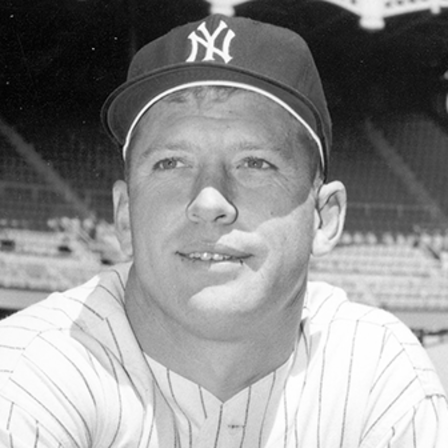
Mickey Mantle was an outfielder who played for the New York Yankees from 1951 to 1968. Career stats: .298 batting average, 540 home runs, 1527 RBI.
Mickey Mantle was one of the most talented and beloved players in New York Yankees history, a switch-hitting center fielder whose combination of raw power and blazing speed made him one of the most complete players the game has ever seen. Despite playing his entire 18-year career (1951--1968) on damaged knees, Mantle won three MVP awards, seven World Series championships, and hit 536 career home runs for the Yankees.
Oklahoma to the Bronx
Born in Spavinaw, Oklahoma, and raised in the mining town of Commerce, Mantle was named after Hall of Fame catcher Mickey Cochrane by his baseball-obsessed father, Mutt Mantle. Mutt taught his son to switch-hit from a young age, creating the foundation for Mantle's unique ability to hit with power from both sides of the plate.
Signed by the Yankees as a 17-year-old in 1949, Mantle arrived in the major leagues in 1951 as Joe DiMaggio's heir apparent in center field. The transition was rocky -- Mantle was briefly sent back to the minors -- but when he returned, he became one of the most feared hitters in the game.
The Center Field Succession
The Yankees didn't just hand Mantle a position. They handed him a dynasty's center field throne -- a direct line from Earle Combs to DiMaggio to the kid from Commerce. No franchise in any sport has produced a succession like that at a single position. Three generations of fans watched a Hall of Famer patrol the same patch of grass in the Bronx, and Mantle carried the weight of that lineage on surgically repaired knees.
Bill Dickey, the great catcher turned coach, worked with Mantle on the finer points during those early years. Yogi Berra batted behind him in the lineup for over a decade. And Whitey Ford -- his best friend on the club and the ace of the staff -- was his running mate off the field, too. The Mantle-Ford friendship became the stuff of Yankee lore, two kids from different worlds who found common ground in competition and mischief.
Yankees Career
Mantle's Yankees career was marked by extraordinary talent undermined by devastating injuries. A knee injury suffered during the 1951 World Series plagued him for the rest of his career, and he played most of his seasons in significant pain. Yet even diminished, Mantle was a dominant force.
| Games | 2,401 |
| Batting Average | .298 |
| Home Runs | 536 |
| RBI | 1,509 |
| OPS | .977 |
| WAR | 110.3 |
| MVP Awards | 3 |
| World Series Titles | 7 |
| All-Star Selections | 20 |
| Triple Crown | 1956 |
His 1956 season stands as one of the greatest individual seasons in baseball history. Mantle won the Triple Crown, batting .353 with 52 home runs and 130 RBI. He was named AL MVP for the first time and led the Yankees to the World Series title. What makes the Triple Crown even more staggering is the competition -- Ted Williams hit .345 that year and still finished second in batting average. Mantle didn't just lead the league. He ran away from it.
His 1957 MVP campaign was nearly as dominant -- a .365 average, 34 homers, and a league-leading .512 on-base percentage. Then came 1961, when Mantle and Roger Maris chased Ruth's single-season home run record together. Mantle hit 54 that year before a hip abscess shut him down in September. Maris finished with 61, but the two sluggers combined for 115 home runs -- still the most by any pair of teammates in a single season.
That boy hits balls over buildings.
By the Numbers: The "What If" Career
The gap between what Mantle accomplished and what he could have done remains the great thought experiment in baseball history. He played his first full healthy season at age 19, ran to first base in 3.1 seconds from the left side (the fastest time ever recorded in the majors), and could hit a baseball over 500 feet from either side of the plate. No one before or since has matched that combination of speed and switch-hitting power.
But the injuries piled up. The 1951 knee tear was just the beginning -- he needed his first knee surgery in November 1953, played through chronic osteomyelitis in his left shin, and endured shoulder, hip, and hamstring problems that would've put most players on the disabled list for months. Mantle didn't sit. He taped himself together and played through it, finishing with a career OPS of .977.
Here's what the numbers tell you: from 1954 to 1962, Mantle averaged a .311 batting average, 37 home runs, and a 1.040 OPS per season. He led the American League in OPS six times, in home runs four times, and in runs scored six times. Those nine years represent one of the greatest sustained peaks by any position player in history -- and he did it while limping.
If Mickey Mantle had had two good legs, nobody would have been able to touch him. Nobody.
Key Moments
Major League Debut
A 19-year-old Mantle makes his MLB debut as a right fielder alongside Joe DiMaggio in center.
World Series Knee Injury
Mantle catches his spikes on a drainage grate in right-center field during the World Series, tearing his knee. The injury alters the trajectory of his career.
The 565-Foot Home Run
Mantle hits a mammoth home run at Griffith Stadium in Washington, D.C. The ball is measured at an estimated 565 feet -- one of the longest home runs in baseball history.
Triple Crown Season
Mantle leads the American League in batting average (.353), home runs (52), and RBI (130), winning the Triple Crown and his first of three MVP awards.
Final Career Home Run
Mantle hits his 536th and final home run -- a memorable blast in his last season that was greeted by a thunderous ovation from the Yankee Stadium crowd.
Number 7 Retired
The Yankees retire Mantle's iconic #7 in a ceremony at Yankee Stadium, making him the fourth Yankee to receive the honor.
Legacy
Mickey Mantle's legacy is one of extraordinary talent, painful "what ifs," and enduring love from Yankees fans. Teammates and opponents alike believed he was the most talented player they ever saw -- a switch-hitter who could run, throw, and hit for power from both sides of the plate at a level no one had ever matched.
His #7 remains one of the most iconic numbers in sports, and his combination of All-American charm and vulnerability made him one of the most beloved figures in Yankees history. Mantle was inducted into the Baseball Hall of Fame in 1974. Decades later, Aaron Judge would take over center field in the Bronx and chase home run records of his own -- but every Yankees slugger who steps into that batter's box still lives in the shadow of Number 7.
Frequently Asked Questions
How many home runs did Mickey Mantle hit?
Mickey Mantle hit 536 home runs during his 18-year career with the New York Yankees (1951--1968). He hit 372 home runs left-handed and 164 right-handed, making him one of the most prolific switch-hitters in baseball history.
Did Mickey Mantle win the Triple Crown?
Yes, Mickey Mantle won the Triple Crown in 1956, leading the American League in batting average (.353), home runs (52), and RBI (130). He was named AL MVP that season and led the Yankees to the World Series championship.
How many World Series did Mickey Mantle win?
Mickey Mantle won seven World Series championships with the Yankees: 1951, 1952, 1953, 1956, 1958, 1961, and 1962. He appeared in 12 World Series total -- more than almost any player in baseball history.
What happened to Mickey Mantle's knees?
Mantle tore his right knee during the 1951 World Series when he caught his spikes on a drainage grate in right-center field at Yankee Stadium. The injury never fully healed and plagued him for the rest of his 18-year career. He played most seasons in significant pain, and teammates believed a healthy Mantle would've been the greatest player who ever lived.
What was Mickey Mantle's best season?
Most historians consider Mantle's 1956 Triple Crown season his best -- he batted .353 with 52 home runs, 130 RBI, and a 1.169 OPS. But his 1957 season has a strong case too: a .365 batting average, .512 on-base percentage, and 146 walks. By OPS+, his 1957 season (221) actually edges out 1956 (210), making it one of the highest single-season marks in the modern era.