
Career Stats
Regular Season
| Year | G | AB | R | H | 2B | 3B | HR | RBI | BB | SO | SB | AVG | OBP | SLG | OPS |
|---|---|---|---|---|---|---|---|---|---|---|---|---|---|---|---|
| 1962 | 158 | 595 | 93 | 152 | 34 | 1 | 34 | 102 | 87 | 79 | 1 | .255 | .355 | .487 | .842 |
| 1963 | 91 | 315 | 53 | 85 | 14 | 1 | 23 | 55 | 35 | 40 | 1 | .270 | .346 | .540 | .886 |
| 1964 | 143 | 519 | 87 | 144 | 12 | 2 | 26 | 71 | 66 | 80 | 3 | .277 | .364 | .459 | .823 |
| 1965 | 46 | 155 | 22 | 37 | 7 | 0 | 8 | 27 | 29 | 29 | 0 | .239 | .357 | .439 | .796 |
| 1966 | 119 | 348 | 37 | 81 | 9 | 2 | 13 | 43 | 36 | 60 | 0 | .233 | .307 | .382 | .689 |
| Career | 856 | 3030 | 522 | 799 | 110 | 17 | 204 | 552 | 417 | 420 | 7 | .264 | .353 | .513 | .866 |
Career-best seasons highlighted in gold. Stats via Retrosheet.
Postseason
| Year | G | AB | R | H | 2B | 3B | HR | RBI | BB | SO | SB | AVG | OBP | SLG | OPS |
|---|---|---|---|---|---|---|---|---|---|---|---|---|---|---|---|
| 1960 | 7 | 30 | -- | 8 | -- | -- | 2 | 2 | -- | -- | -- | .267 | -- | -- | -- |
| 1961 | 5 | 19 | -- | 2 | -- | -- | 1 | 2 | -- | -- | -- | .105 | -- | -- | -- |
| 1962 | 7 | 23 | -- | 4 | -- | -- | 1 | 5 | -- | -- | -- | .174 | -- | -- | -- |
| 1963 | 2 | 5 | -- | 0 | -- | -- | 0 | 0 | -- | -- | -- | .000 | -- | -- | -- |
| 1964 | 7 | 30 | -- | 6 | -- | -- | 1 | 1 | -- | -- | -- | .200 | -- | -- | -- |
| Career | 28 | 107 | 0 | 20 | 0 | 0 | 5 | 10 | 0 | 0 | 0 | .187 | .187 | .327 | .514 |
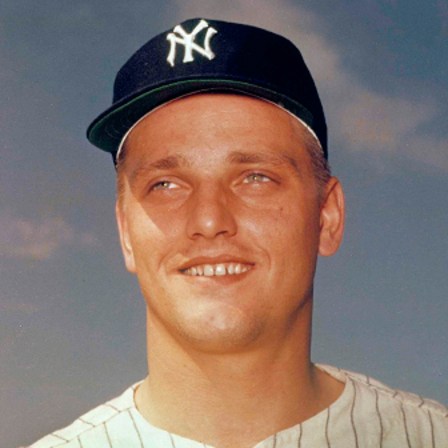
Roger Maris was an outfielder who played for the New York Yankees from 1960 to 1966. Career stats: .264 batting average, 204 home runs, 552 RBI.
October 1, 1961. Fourth inning at Yankee Stadium. Only 23,154 fans in the seats -- a Sunday afternoon crowd that felt thin even by late-season standards. The New York Yankees' Roger Maris dug in against Boston's Tracy Stallard, a 23-year-old right-hander who'd been pitching in the majors for barely two seasons. Stallard threw a fastball. Maris turned on it and drove it into the right-field stands for home run number 61, breaking Babe Ruth's most sacred record in baseball. A 19-year-old Brooklyn kid named Sal Durante caught the ball. The Yankees won 1-0. And Maris, the quiet outfielder from Fargo who never asked for any of it, stepped into a curtain call he'd later describe as the longest moment of his life.
Roger Maris played seven seasons for the Yankees, won back-to-back MVP awards, and hit more home runs in a single season than any player before him. The city never fully understood him, rarely appreciated him, and treated him with a suspicion that had nothing to do with his ability and everything to do with the fact that he wasn't the guy New York wanted to break Babe Ruth's record.
Path to the Bronx
Maris grew up in Fargo, North Dakota -- born in Hibbing, Minnesota, but Fargo raised him. He was a three-sport athlete at Shanley High School, good enough at football to draw recruiting interest from Oklahoma (under Bud Wilkinson, no less). He chose baseball instead, signing with the Cleveland Indians out of high school in 1952 at seventeen years old.
He worked through the minor league system for four years -- Fargo-Moorhead, Keokuk, Reading, Indianapolis -- before making his big league debut with Cleveland on April 16, 1957. The Indians didn't commit to playing him, and a mid-1958 trade sent him to the Kansas City Athletics, where he got regular at-bats and started to show what he could do. In 1959, he hit .273 with 16 home runs and caught the eye of Yankees general manager George Weiss.
On December 11, 1959, Weiss pulled the trigger. The Yankees shipped Don Larsen (the perfect game guy, no less), Hank Bauer, Norm Siebern, and Marv Throneberry to Kansas City for Maris, Kent Hadley, and Joe DeMaestri. It was one of those Kansas City-to-New York deals that made everyone suspicious -- and rightfully so, given the cozy relationship between the two franchises during the Arnold Johnson era. But Weiss didn't care about optics. He'd watched Maris's left-handed swing and saw a bat built for the short right-field porch at the Stadium.
He wasn't wrong.
Yankees Career
Maris hit 39 home runs in his first season in pinstripes, drove in 112 runs, and won the 1960 AL MVP over Mickey Mantle. He added a Gold Glove in right field. The club lost the World Series to Pittsburgh on Mazeroski's walk-off, but Maris had announced himself as one of the best players in the league.
Then came 1961.
| Yankees Seasons | 7 (1960-1966) |
| Games | 850 |
| Home Runs | 203 |
| RBI | 547 |
| Batting Average | .265 |
| OPS | .871 |
| MVP Awards | 2 (1960, 1961) |
| Gold Gloves | 1 (1960) |
| WAR (NYY) | 26.4 |
The "M&M Boys" home run chase consumed all of baseball that summer. Maris and Mantle -- who shared a Queens apartment with Bob Cerv, which tends to surprise people who think of them as rivals -- tracked ahead of Ruth's 1927 pace through July and August. Commissioner Ford Frick, Ruth's former ghostwriter (a detail that tells you everything about the conflict of interest), ruled in July that any record set after game 154 would need a "distinctive mark" in the books. The press called it the asterisk. No asterisk ever appeared in any official record. But the stigma stuck to Maris like pine tar.
Roger was the most straightforward guy I ever knew. There was nothing phony about him. He didn't care about the spotlight -- he just came to play.
Mantle's hip abscess slowed him in September, and he finished with 54. Maris kept grinding. His hair started falling out from the stress -- clumps in his cap, visible patches that teammates noticed and that doctors attributed to the relentless media pressure. He reached 58 by game 154, hit number 60 off Jack Fisher on September 26, and then waited five more days for number 61.
After 1961, injuries chipped away at him. A hand fracture in 1965 limited him to 46 games. By 1966 he was hitting .233, the team had cratered to last place for the first time since 1912, and both sides wanted out. The Yankees traded him to St. Louis in December for Charley Smith -- a deal that worked out about as well for New York as it sounds.
Key Moments
Traded to the Yankees
The Yankees acquire Maris from Kansas City in a seven-player deal. George Weiss bets on that left-handed swing and the short porch. The bet pays off immediately.
Home Run Number 61
Maris breaks Ruth's single-season record with a fourth-inning blast off Tracy Stallard at Yankee Stadium. Only 23,154 fans witness it. Sal Durante catches the ball and eventually receives $5,000 for it.
Second Consecutive MVP
Maris wins his second straight AL MVP -- 61 HR, 141 RBI, a .620 slugging percentage. The full offensive line (.269/.372/.620) shows this wasn't a one-trick season.
Traded to St. Louis
The Yankees send Maris to the Cardinals for Charley Smith. In St. Louis, Maris rediscovers his comfort with the game -- he hits .385 in the 1967 World Series and helps the Cardinals win the championship.
Number 9 Retired
The Yankees retire Maris's number in a long-overdue ceremony at the Stadium. He attends. For many in the crowd, it feels like the organization is finally saying what it should have said years earlier.
The Man Who Didn't Fit
The core problem with Maris in New York was simple: he was a Midwestern kid who treated baseball as a job, not a performance. He didn't charm the writers. He didn't cultivate the columnists who shaped public opinion. He answered questions directly, which in New York's media culture came off as curt or uncooperative (in Fargo they'd have called that honest). The press preferred Mantle -- the established star, the guy who'd learned to manage the room. When Maris started pulling ahead in the home run race, certain writers didn't just cover the story. They rooted against him.
He won back-to-back MVPs -- hitting .283 in 1960 and .269 in 1961 -- without the gaudy batting averages the writers of his era expected from a franchise player. By modern metrics, his game reads far better than his contemporaries gave him credit for. His defense was legitimate Gold Glove quality. His on-base numbers were strong. The 61 home runs weren't a fluke from a one-dimensional hitter -- they were the peak of a complete ballplayer.
The Hall of Fame voters didn't see it that way. Maris appeared on the BBWAA ballot from 1974 through 1988 and never got close. The Veterans Committee hasn't inducted him either. His 275 career home runs and .260 average look thin on the surface. But that surface hides a peak few players have matched and a record that stood for 37 years -- the longest any single-season home run record held in the modern era.
Frequently Asked Questions
How many home runs did Roger Maris hit in 1961?
Maris hit 61 home runs during the 1961 season, breaking Babe Ruth's record of 60 set in 1927. He hit number 61 on October 1, 1961, the final game of the regular season, off Boston's Tracy Stallard at Yankee Stadium.
Was there really an asterisk on Roger Maris's record?
No. Commissioner Ford Frick ruled that any record set after game 154 of a 162-game schedule would require a separate notation, but no literal asterisk ever appeared in the official record books. Sportswriter Dick Young popularized the term, and it stuck. Commissioner Fay Vincent's office formally dropped the distinction in 1991.
Is Roger Maris in the Baseball Hall of Fame?
No. Maris appeared on the BBWAA ballot from 1974 through 1988 and never got the votes. The Veterans Committee hasn't inducted him either. His case still sparks debate -- his career totals look modest, but his peak seasons and defensive value make a credible argument by modern analytical standards.
How did Roger Maris die?
Doctors diagnosed Maris with lymphatic cancer in 1983. He died on December 14, 1985, in Houston, Texas, at age 51. He's buried in Holy Cross Cemetery in Fargo, North Dakota -- the town where he grew up.
Where is the Roger Maris Museum?
The Roger Maris Museum sits inside the West Acres Shopping Center in Fargo, North Dakota. Fargo also has a statue honoring him. The city has always claimed Maris as its own -- born in Hibbing, Minnesota, but Fargo through and through.