August 2, 1979. A Thursday afternoon in northeast Ohio, the sky clear over Akron-Canton Regional Airport. Thurman Munson -- the New York Yankees' captain, their catcher, the first man to hold that title since Lou Gehrig -- was practicing touch-and-go landings in his Cessna Citation jet. He'd bought the plane so he could fly home to Canton on off-days and see his wife Diana and their three kids. Shortly after 3 p.m., on approach to Runway 19, the Citation dropped below the glide path, clipped a tree line about a thousand feet short of the runway, and hit the ground. Munson was thirty-two years old.
Munson Earns His Pilot's License
Munson becomes a licensed pilot on March 7, 1978. He starts with a propeller-driven Beechcraft Duke, drawn to flying as the fastest way back to his family in Canton on off-days.
Purchases the Cessna Citation
Munson buys a Cessna Citation 501 jet -- registration N15NY, for his jersey number and his state -- on July 6, 1979. He accumulates about 34 total hours in the aircraft over the next four weeks.
Receives Jet Type Rating
Eleven days after buying the Citation, Munson completes transition training and receives his CE-501 type rating on July 17, 1979. Everyone around him knows 34 hours in a jet isn't much time.
The Crash at Akron-Canton
On a Yankees off-day, Munson brings two friends -- Jerry Anderson and David Hall -- to Akron-Canton Regional Airport for touch-and-go landing practice. On approach to Runway 19, the Citation stalls short of the runway and strikes trees. Anderson and Hall escape. Munson, pinned in the cockpit with a broken neck, doesn't. He's 32 years old.
Empty Catcher's Box
Less than 24 hours after Munson's death, the Yankees play their first game without him. Every starter takes his position for the pre-game tribute except one -- the catcher's box stays empty. Baltimore wins 1-0.
Funeral in Canton, Then Murcer's Night
The entire Yankees roster flies to Canton for the funeral at the Canton Civic Center. Bobby Murcer and Lou Piniella deliver eulogies. The team flies back to New York and plays that night -- Murcer, Munson's closest friend on the team, drives in all five runs in a 5-4 walk-off win. Three-run homer and a two-run single in the ninth. Munson would've understood the team playing that night better than anyone.
Monument Park Plaque Dedicated
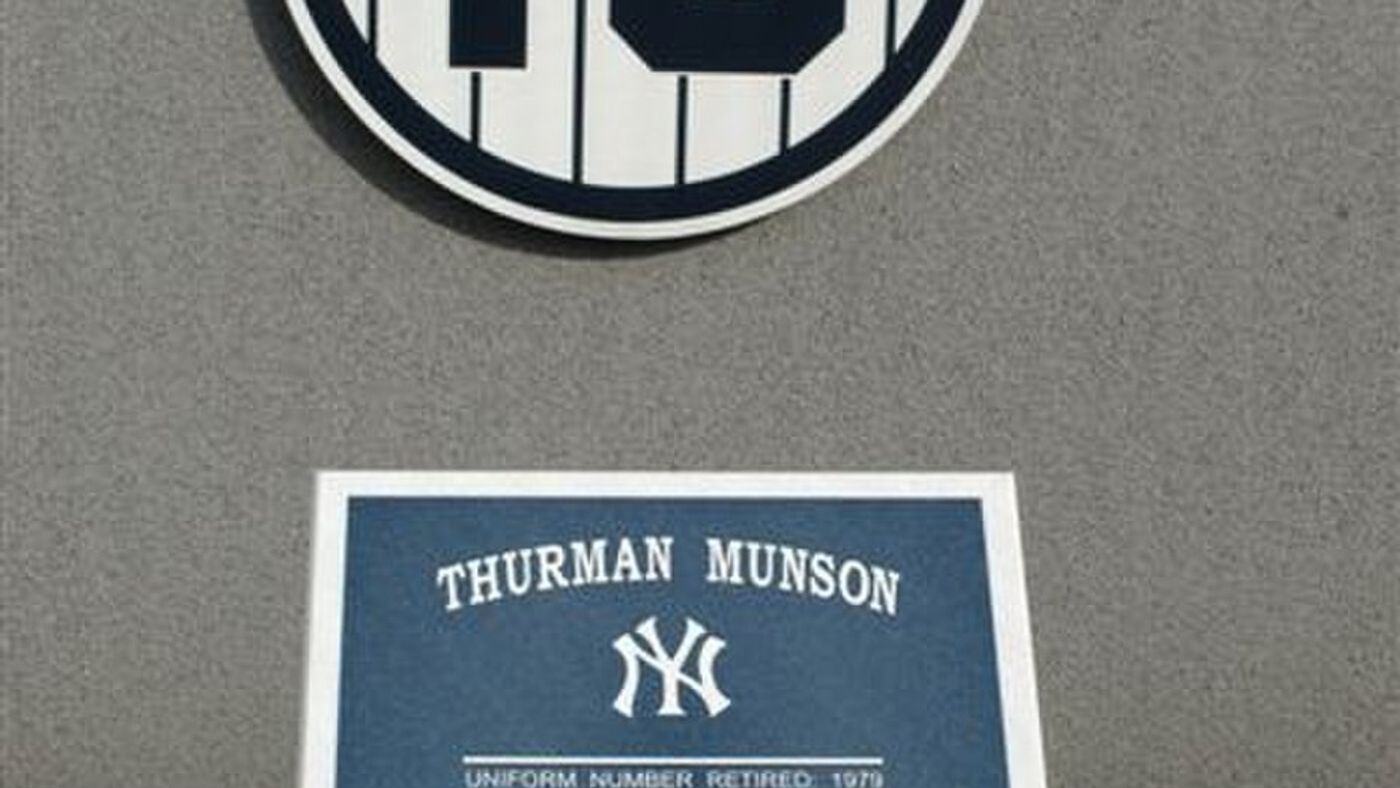
The Yankees dedicate a plaque to Munson in Monument Park on September 20, 1980 -- his number 15 having been pulled from circulation immediately after his death. The inscription reads: "Our captain and leader has not left us, today, tomorrow, this year, next."
| Career Batting Average | .292 |
| Career OBP / SLG / OPS | .346 / .410 / .756 |
| Home Runs | 113 |
| RBI | 701 |
| Seasons | 1969-1979 (11 seasons, all with Yankees) |
| All-Star Selections | 7 |
| Gold Gloves | 3 (1973, 1974, 1975) |
| 1976 AL MVP | .302 / 17 HR / 105 RBI |
| 1970 AL Rookie of the Year | .302 BA in 132 games |
| Date of Crash | August 2, 1979 -- Akron-Canton Regional Airport, Ohio |
The Captain
Munson wasn't the kind of player you had to explain. Seven All-Star selections, the 1970 AL Rookie of the Year, the 1976 AL MVP, a .292 career average, three Gold Gloves, two World Series rings with the 1977 and 1978 clubs. He'd hit .529 against the Reds in the '76 Series -- a number that still looks like a typo -- and the Yankees got swept anyway (four games, none of them close enough to blame the catcher). A catcher who called his own game, handled a pitching staff full of egos, and showed up injured more often than he showed up healthy.
The captaincy came on April 17, 1976. The franchise hadn't given that title to anyone in thirty-seven years -- not since Gehrig. Billy Martin and George Steinbrenner both pushed for the designation, which tells you something about Munson's standing: those two agreed on almost nothing. Munson earned the armband the way catchers earn everything -- by being the one guy in the clubhouse nobody questioned.
He was difficult. He'd tell you that himself. He cussed at umpires, threw bats, and treated the press like an inconvenience (the press returned the favor). But he ran those late-'70s Yankees teams -- the ones with Reggie Jackson, Martin, Steinbrenner, and all the gasoline that came with them -- because everyone in that clubhouse trusted the man behind the plate.
The Crash
The Cessna Citation I/SP was registered N15NY -- 15 for his jersey number, NY for New York. Munson picked the registration himself. He'd earned his pilot's license roughly two years earlier, starting with a propeller-driven Beechcraft Duke before upgrading to the Citation jet. It was a faster way home. A 162-game schedule didn't leave much room for commercial flights to Canton, and Munson hated being away from his family.
On August 2, the Yankees had a day off. Munson was at Akron-Canton with two friends -- Jerry Anderson and David Hall -- practicing approaches. He had about thirty-four hours of total flight time in the Citation. That's not much time in a jet (and everyone around him knew it).
The plane came in too low and too slow on approach to Runway 19. It struck trees short of the runway, hit the ground, and a fire broke out after impact. Anderson and Hall, seated in the rear cabin, escaped through the emergency exits with serious injuries. Munson, at the controls, couldn't get out. The impact broke his neck and pinned him in the cockpit. He didn't die from the crash itself. He died from the smoke and fire -- asphyxiation -- while trapped in his seat. Anderson and Hall tried to reach him. They couldn't.
The NTSB ruled it pilot error -- Munson failed to maintain adequate airspeed on the approach, which caused the aircraft to stall short of the runway. No mechanical failure. The plane was fine. The pilot didn't have enough hours in it.
The Next Night
The Yankees played the Baltimore Orioles at the Stadium on August 3 -- less than twenty-four hours after Munson died. The starters took their positions for a pre-game tribute, every spot filled except one: the catcher's box stayed empty. 51,151 fans gave it a ten-minute standing ovation. Then they played the game anyway. Luis Tiant took the loss, eight strong innings wasted in a 1-0 defeat that had nothing to do with the score.
Three days later, on August 6, the entire Yankees roster -- players, coaches, front office, Steinbrenner -- flew to Canton for the funeral. Bobby Murcer and Lou Piniella delivered eulogies. Murcer had been Munson's closest friend on the team. They'd come from the same kind of background -- working-class, Midwestern, private -- and their families spent time together. Murcer had just returned to the Yankees in a June trade from the Cubs. He'd been back about two months. That was all the time they got.
Then the team flew back to New York and played that night. Murcer hadn't slept much in days. He'd spent the trip to Canton and back with the kind of grief that doesn't organize itself into stages, and then he put on the uniform and went to work.
Baltimore led late. Murcer hit a three-run homer earlier in the game to keep the Yankees close. In the bottom of the ninth, trailing 4-3, he came up with runners on and lined a two-run single to win it. Final score: 5-4. Murcer drove in all five runs.
The Stadium wasn't loud afterward. It was something else -- a sound closer to release than celebration. Murcer could barely talk. Teammates who'd held it together through the funeral and the flight home broke in the clubhouse. The game had been played for one reason, and everyone in the building knew what it was. Munson would've understood the team playing that night better than anyone.
The Empty Locker
The Yankees retired number 15 right away. No waiting period -- the number just stopped being available. A plaque went up in Monument Park with the inscription that's become part of the franchise's liturgy: "Our captain and leader has not left us, today, tomorrow, this year, next -- our endeavors will reflect our love and admiration for him."
But the detail that stayed with people wasn't the plaque or the number on the wall. It was the locker. Munson's locker in the Yankee Stadium clubhouse sat untouched -- his catcher's gear, personal belongings, all of it -- from August 1979 until the old Stadium closed after the 2008 season. Players who wore pinstripes in the '80s, the '90s, the 2000s all walked past it. Twenty-nine years of silence where the captain used to sit.
| Career Batting Average | .292 |
| Career Home Runs | 113 |
| Career RBI | 701 |
| Career Games | 1,423 (1969--1979) |
| All-Star Selections | 7 |
| Gold Glove Awards | 3 (1973, 1974, 1975) |
| AL MVP | 1976 (.302 BA, 17 HR, 105 RBI) |
| World Series Rings | 2 (1977, 1978) |
MLB Debut
Munson debuted for the Yankees at age 22, the beginning of an 11-year career spent entirely in pinstripes.
AL Rookie of the Year
Munson earned 23 of 24 possible votes from the BBWAA, announcing himself as the Yankees' catcher for the next decade.
Named Yankees Captain
Billy Martin and George Steinbrenner designated Munson team captain -- the first Yankee to hold that title since Lou Gehrig in 1939, thirty-seven years earlier.
AL MVP Award
Munson won the American League MVP after hitting .302 with 17 home runs and 105 RBI, leading the Yankees to their first pennant in twelve years.
Dies in Plane Crash in Canton, Ohio
Munson's Cessna Citation stalled on approach to Runway 19 at Akron-Canton Regional Airport during practice touch-and-go landings. He was 32 years old.
Funeral, Then Murcer's Five RBI
Hours after burying Munson in Canton, his closest friend on the team hit a three-run homer and a walk-off two-run single to beat the Orioles 5-4 at the Stadium.
Monument Park Plaque Unveiled
A plaque dedicated to Munson was placed in Monument Park at Yankee Stadium, with the inscription: "Our captain and leader has not left us, today, tomorrow, this year, next -- our endeavors will reflect our love and admiration for him."
Frequently Asked Questions
How did Thurman Munson die?
Munson died on August 2, 1979, when his Cessna Citation I/SP jet crashed during practice touch-and-go landings at Akron-Canton Regional Airport in Ohio. The aircraft stalled on approach to Runway 19 after Munson failed to maintain adequate airspeed, striking trees approximately 1,000 feet short of the runway. Two passengers, Jerry Anderson and David Hall, escaped with serious injuries. Munson was pinned in the cockpit with a broken neck and died of asphyxiation from the post-crash fire. He was 32 years old. The NTSB attributed the accident to pilot error.
What happened the game after Thurman Munson died?
The Yankees' first game back, on August 3, 1979 -- less than 24 hours after Munson's death -- was a quiet 1-0 loss to Baltimore, with the catcher's box left empty during the pre-game tribute. The famous game came three days later: on August 6, hours after Munson's funeral in Canton, Bobby Murcer drove in all five Yankees runs in a 5-4 walk-off win over the Orioles at Yankee Stadium. Murcer, Munson's closest friend on the team, hit a three-run homer and a walk-off two-run single in the ninth inning.
Is Thurman Munson in the Hall of Fame?
No. Munson hasn't been inducted into the National Baseball Hall of Fame. His case -- seven All-Star selections, 1970 AL Rookie of the Year, 1976 AL MVP, two World Series rings, the Yankees captaincy, three Gold Gloves, a .292 career average -- is strong. The counterargument points to the catchers already enshrined from his era (Johnny Bench, Carlton Fisk, Gary Carter) and the difficulty of projecting a career cut short at 32. The Classic Baseball Era Committee, which covers players whose careers ended before 1980, has considered his candidacy but hasn't voted him in. The debate continues.