Career Stats
Regular Season
| Year | G | AB | R | H | 2B | 3B | HR | RBI | BB | SO | SB | AVG | OBP | SLG | OPS |
|---|---|---|---|---|---|---|---|---|---|---|---|---|---|---|---|
| 1952 | 109 | 363 | 32 | 97 | 13 | 3 | 3 | 33 | 22 | 31 | 3 | .267 | .323 | .344 | .667 |
| 1953 | 150 | 591 | 72 | 152 | 25 | 6 | 15 | 76 | 43 | 56 | 6 | .257 | .314 | .396 | .710 |
| 1955 | 20 | 70 | 8 | 21 | 2 | 0 | 1 | 9 | 7 | 9 | 1 | .300 | .354 | .371 | .725 |
| 1956 | 122 | 462 | 76 | 122 | 24 | 5 | 9 | 49 | 30 | 56 | 7 | .264 | .310 | .396 | .706 |
| 1957 | 44 | 150 | 13 | 37 | 5 | 2 | 1 | 12 | 3 | 14 | 2 | .247 | .261 | .327 | .588 |
| Career | 532 | 1730 | 221 | 453 | 71 | 18 | 30 | 189 | 112 | 178 | 19 | .262 | .307 | .376 | .682 |
Career-best seasons highlighted in gold. Stats via Retrosheet.
Postseason
| Year | G | AB | R | H | 2B | 3B | HR | RBI | BB | SO | SB | AVG | OBP | SLG | OPS |
|---|---|---|---|---|---|---|---|---|---|---|---|---|---|---|---|
| 1951 | 1 | 0 | -- | 0 | -- | -- | 0 | 0 | -- | -- | -- | -- | -- | -- | -- |
| 1952 | 7 | 23 | -- | 5 | -- | -- | 1 | 4 | -- | -- | -- | .217 | -- | -- | -- |
| 1953 | 6 | 24 | -- | 12 | -- | -- | 2 | 8 | -- | -- | -- | .500 | -- | -- | -- |
| 1955 | 7 | 25 | -- | 8 | -- | -- | 0 | 4 | -- | -- | -- | .320 | -- | -- | -- |
| 1956 | 7 | 27 | -- | 8 | -- | -- | 2 | 3 | -- | -- | -- | .296 | -- | -- | -- |
| Career | 28 | 99 | 0 | 33 | 0 | 0 | 5 | 19 | 0 | 0 | 0 | .333 | .333 | .485 | .818 |
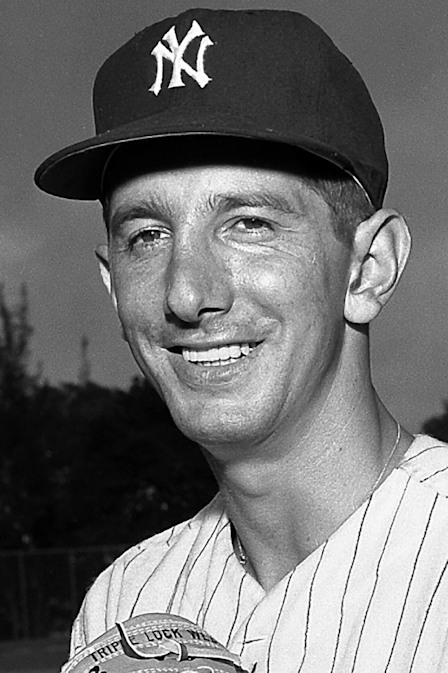
Billy Martin was a second baseman who played for the New York Yankees in 1950-1953, 1955-1957. Career stats: .262 batting average, 30 home runs, 189 RBI.
October 7, 1952. Ebbets Field. Game 7 of the World Series. Bottom of the seventh inning, Dodgers threatening, bases loaded, two outs, and Bob Kuzava on the mound for the Yankees looking like he'd rather be anywhere else. Jackie Robinson lofted a short popup toward the right side of the infield. The wind grabbed it. First baseman Joe Collins lost it in the sun and froze. Catcher Yogi Berra screamed. Three runners were breaking for home.
Billy Martin didn't hesitate.
He charged in from second base at a dead sprint, lunged, and caught the ball off his shoetops ten feet from the pitcher's mound -- one of the most improbable plays in World Series history. Kuzava got the next six outs. Yankees won their fourth straight championship. Martin, twenty-four years old and built like a middleweight who'd lost some fights, jogged back to the dugout like he'd just snagged a routine grounder.
He was always doing things like that.
The Kid from Berkeley
Alfred Manuel Pesano grew up tough in Berkeley, California -- depression-era poor, quick with his fists, skinny in a way that made people underestimate him and regret it. His Italian grandmother could never quite manage English, so she'd lean over the baby and say bello (beautiful) until it stuck. He learned his actual name only when a schoolteacher called it out in class.
The nickname "Billy the Kid" fit better anyway.
He signed with Idaho Falls in the Pioneer League in 1946 and worked his way up to the New York Yankees by 1950. He wasn't much to look at statistically -- a .257 hitter with 64 home runs over an 11-season career. But baseball has always had room for players whose value doesn't show up cleanly in the box score, and Martin's value showed up everywhere else: in the dugout, in the field, in October, in the willingness to fight literally anybody who gave him a reason.
(The list of people Billy Martin fought would take up its own article. Jim Piersall in a tunnel under the stands at Fenway. Jim Brewer on the mound in Cincinnati -- that one cost him a $10,000 settlement after Brewer's $1,000,000 lawsuit. A marshmallow salesman in a Minneapolis hotel bar. That last one was after he'd already been fired and rehired once by George Steinbrenner, which should tell you something about how Billy Martin processed stress.)
| Career Batting Average | .257 |
| Home Runs | 64 |
| RBI | 333 |
| Career OPS | .669 |
| Games Played | 1,021 |
| World Series Rings (Player) | 5 (1950, 1951, 1952, 1953, 1956) |
| 1953 World Series | Babe Ruth Award (.500 BA, 12 hits) |
| All-Star Selections | 1 (1956) |
| World Series Rings (Manager) | 1 (1977) |
| Yankees Manager Record | 556-385 combined (five stints, .591) |
October Was His Month
The regular season was fine. October was where Martin lived.
In the 1952 World Series, he saved Game 7 with that catch. In the 1953 World Series, he turned into a force of nature -- .500 batting average, 12 hits (tying the Series record), 23 total bases (breaking Babe Ruth's six-game Series record of 19), and the walk-off RBI single in the ninth inning of Game 6 that finished the Dodgers. The Yankees won five straight. Berra had three AL MVP awards, DiMaggio was DiMaggio, Whitey Ford would become Whitey Ford -- and Billy Martin quietly went .333 across all his Fall Classic appearances.
He won the Babe Ruth Award as the 1953 Series MVP. Not Mantle. Not Ford. Martin.
The Yankees also appeared in the 1955 World Series, and Martin played all seven games. The Dodgers won that one -- their first and only title in Brooklyn -- so Martin went home empty-handed. He got his fifth ring in 1956 when the Yankees beat Brooklyn again, this time in seven.
Casey Stengel, who managed Martin for all those championship runs, treated him like a son. Stengel thought Martin read the game better than almost anyone he'd managed. That relationship -- loyal, paternal, the coach who believed in you when nobody else did -- was the thing Martin spent the rest of his life looking for in every dugout he occupied.
The Copa Cabana and the Trade
On May 16, 1957 -- Martin's 29th birthday -- a group of Yankees went to the Copacabana nightclub in Manhattan to see Sammy Davis Jr. perform. Martin, Mickey Mantle, Yogi Berra, Whitey Ford, Hank Bauer, and a few others. A group of drunk bowlers from the Bronx started heckling Davis. Things escalated. One of those bowlers ended up in the hospital with a broken nose and jaw.
Nobody could prove who threw the punch. Hank Bauer took the public heat and later won his lawsuit against the guy. But Yankees GM George Weiss had been looking for an excuse to get rid of Martin for years -- he thought Martin was a bad influence on Mantle, too wild, too combustible for the franchise's image. The Copa gave him the opening.
On June 15, 1957, the Yankees traded Billy Martin to the Kansas City Athletics.
Stengel reportedly took it hard. Martin didn't see it coming, and the hurt never fully left him. He'd spend the rest of his playing days bouncing between six teams over four years, never finding what he'd had in the Bronx, and he retired in 1961 with numbers that don't capture who he was or what he could do in October.
Managing: "Billy I Through Billy V"
After the playing career ended, Martin found the thing he was born to do: managing. He was combative with umpires (who called this a surprise?), brilliant at in-game tactics, and genuinely excellent at turning struggling teams into winners in a hurry. He managed the Minnesota Twins to a division title in 1969, then Detroit in 1972, then Texas -- where he was fired mid-season for badmouthing ownership, which became a recurring theme.
The Yankees brought him home in 1975. George Steinbrenner, who had purchased the club in 1973 and was still figuring out what kind of owner he wanted to be, hired Martin to manage.
What followed was the most chaotic, successful, and entertainingly dysfunctional manager-owner relationship in baseball history.
Martin took over a 53-51 team in August 1975 and finished 83-77. In 1976 the club went 97-62 and won the AL pennant -- the Yankees' first pennant in twelve years. They got swept by the Cincinnati Reds in the World Series, but just getting there felt like coming out of the wilderness.
Then 1977.
Most people remember the 1977 Yankees for Reggie Jackson, who hit three home runs on three consecutive pitches in Game 6 of the World Series against the Dodgers and secured his "Mr. October" nickname for eternity. But the 1977 team also featured Martin and Jackson nearly coming to blows in the dugout on national television during a June game at Fenway (Martin pulled Jackson for a defensive substitution mid-inning; Jackson took exception to this in a very public way), Martin and Steinbrenner arguing constantly about the roster, and a clubhouse atmosphere that New York Post columnist Dick Young memorably labeled "the Bronx Zoo."
The Yankees won 100 games. They beat the Dodgers in six. Billy Martin had his World Series ring as a manager to go with his five as a player.
It lasted one more season.
"One's a Born Liar, the Other's Convicted"
The 1978 season was more of the same -- magnificent baseball wrapped in constant chaos -- until July 23, when Martin made a comment to reporters about Jackson and Steinbrenner. The quote: "One's a born liar, the other's convicted." (Steinbrenner had pleaded guilty to illegal campaign contributions to Nixon's 1972 re-election campaign. Martin was referring to both of them.) He resigned the next day at a tearful press conference.
Steinbrenner rehired him just five days later, announced at the Old-Timers Game. The Stadium erupted. Steinbrenner had apparently decided that being a beloved villain in a Miller Lite commercial was more fun than holding a grudge.
Martin came back in 1979, went 55-40 in his partial season with the club, then got into a freakin' bar fight with a marshmallow salesman (yes, there was a marshmallow salesman) and was fired again before the year was out.
Then he came back in 1983 (91-71 record, fired after the season). Then 1985 -- the Ed Whitson era, which ended with Martin's arm broken in a Baltimore hotel bar brawl with his own pitcher, followed by his firing. Then 1988, where the Yankees went 40-28 under Martin before Steinbrenner pulled the plug again.
Five stints. Five firings. The Yankees' combined record under Martin across all five stints was 556-385 -- a .591 winning percentage. He won consistently wherever they sent him, then made it impossible not to fire him.
Born in Berkeley, California
Alfred Manuel Pesano is born in Berkeley, CA. His Italian grandmother's repeated use of "bello" (beautiful) gives him the name Billy. He grows up poor, scrappy, and with hands that know how to work.
Yankees Debut
Martin makes his major league debut with the Yankees. He's twenty-one, plays sparingly that year, and earns his first World Series ring as a roster player when the Yankees beat the Philadelphia Phillies.
The Catch -- Game 7, World Series
With the bases loaded, two outs in the seventh inning, Billy Martin sprints in from second base and catches Jackie Robinson's popup off his shoetops near the pitcher's mound -- saving the inning and the Series. Yankees win their fourth consecutive championship.
Babe Ruth Award
Martin bats .500 in the World Series against Brooklyn, collecting 12 hits and 23 total bases -- a record-tying hit total and a six-game Series record for total bases. His walk-off RBI single in the ninth inning of Game 6 ends it. He wins the Babe Ruth Award as Series MVP.
Traded to Kansas City -- The Copa Fallout
Following the Copa Cabana incident on his 29th birthday (May 16), GM George Weiss trades Martin to the Kansas City Athletics. Casey Stengel is reportedly devastated. Martin never quite recovers from leaving the only baseball home he knew.
World Series Champion -- as Manager
Martin manages the Yankees to a 4-2 World Series win over the Los Angeles Dodgers. A season defined by conflict -- with Reggie Jackson, with Steinbrenner, with the whole damn city -- ends in a championship.
The Quote, the Resignation -- Billy I Ends
After telling reporters Reggie Jackson and George Steinbrenner "deserve each other -- one's a born liar, the other's convicted," Martin resigns in tears. Steinbrenner announces his return at Old-Timers Day just five days later. The cycle has officially started.
Number 1 Retired
The Yankees retire Martin's jersey number 1 and dedicate a Monument Park plaque. The plaque reads, in part: "There has never been a greater competitor than Billy."
Death -- Christmas Day
Martin dies at 61 after a car accident near his upstate New York farm. He was a passenger in his own truck -- driven by friend William Reedy, who was later charged with drunk driving -- when it skidded off an icy road and hit a culvert. He died at Wilson Memorial Hospital in Johnson City, NY.
The Man Steinbrenner Couldn't Quit
There's a version of Billy Martin's life that reads as pure tragedy: a brilliant baseball man who couldn't stay out of his own way, who drank too much, fought too often, and kept burning down the exact thing he'd worked so hard to build.
There's another version that reads as the most authentic Yankees story ever told. A guy from Berkeley who grew up with nothing, who played for Casey Stengel and learned everything about how to win, who caught the ball in the seventh inning of the seventh game of a World Series when it mattered most -- and who kept coming back to the only place that felt like home, no matter how many times the owner fired him.
Both versions are true. That was Billy.
Frequently Asked Questions
How many times was Billy Martin fired as Yankees manager?
Billy Martin was fired -- or resigned under fire -- five times as Yankees manager: after the 1978 season (mid-year, "born liar/convicted" quote), after 1979 (marshmallow salesman fight), after 1983, in 1985 (Ed Whitson brawl), and in 1988. Each stint is known among Yankees fans as Billy I through Billy V.
Did Billy Martin play in the World Series?
He played in five World Series as a player: 1951, 1952, 1953, 1955, and 1956. He won four rings in those appearances -- 1951, 1952, 1953, and 1956. (The 1955 World Series was won by the Brooklyn Dodgers.) He won the Babe Ruth Award as the 1953 Series MVP, batting .500 with 12 hits and 23 total bases against Brooklyn.
What World Series rings did Billy Martin win?
Martin won six World Series rings total: five as a player with the Yankees (1950, 1951, 1952, 1953, 1956 -- he was on the 1950 roster but didn't play) and one as the Yankees' manager in 1977 when the club defeated the Los Angeles Dodgers in six games.
What happened to Billy Martin?
Martin died on Christmas Day, December 25, 1989, in a car accident near his farm in upstate New York. He was 61. His friend William Reedy was driving Martin's pickup truck when it skidded off an icy road and hit a culvert. Martin, who wasn't wearing a seatbelt, was ejected through the windshield. Reedy was charged with drunk driving and survived.
Why did the Yankees keep firing and rehiring Billy Martin?
Because Martin kept winning, and Steinbrenner kept wanting him back -- even after the fights, the brawls, the quotes that made headlines. Martin's teams won roughly 58 percent of their games across his five Yankees stints. The relationship made no business sense and total human sense: two difficult men who needed each other and couldn't stand each other, playing it out in front of all of New York.
The number 1 is retired at the Stadium. Monument Park has the plaque. "There has never been a greater competitor than Billy." That's what it says, and on this one, the Yankees got it right.