Career Stats
Regular Season
| Year | G | AB | R | H | 2B | 3B | HR | RBI | BB | SO | SB | AVG | OBP | SLG | OPS |
|---|---|---|---|---|---|---|---|---|---|---|---|---|---|---|---|
| 1977 | 146 | 525 | 93 | 150 | 39 | 2 | 32 | 110 | 74 | 129 | 17 | .286 | .375 | .550 | .925 |
| 1978 | 139 | 510 | 81 | 139 | 13 | 5 | 27 | 97 | 58 | 134 | 14 | .273 | .355 | .471 | .826 |
| 1979 | 131 | 465 | 78 | 138 | 24 | 2 | 29 | 89 | 65 | 107 | 9 | .297 | .382 | .544 | .926 |
| 1980 | 143 | 514 | 94 | 154 | 22 | 4 | 41 | 111 | 83 | 122 | 1 | .300 | .398 | .597 | .995 |
| 1981 | 94 | 334 | 33 | 79 | 17 | 1 | 15 | 54 | 46 | 82 | 0 | .237 | .330 | .428 | .758 |
| Career | 653 | 2348 | 379 | 660 | 115 | 14 | 144 | 461 | 326 | 574 | 41 | .281 | .369 | .526 | .895 |
Career-best seasons highlighted in gold. Stats via Retrosheet.
Postseason
| Year | G | AB | R | H | 2B | 3B | HR | RBI | BB | SO | SB | AVG | OBP | SLG | OPS |
|---|---|---|---|---|---|---|---|---|---|---|---|---|---|---|---|
| 1977 | 11 | 36 | -- | 11 | -- | -- | 5 | 9 | -- | -- | -- | .306 | -- | -- | -- |
| 1978 | 10 | 36 | -- | 15 | -- | -- | 4 | 14 | -- | -- | -- | .417 | -- | -- | -- |
| 1980 | 3 | 11 | -- | 3 | -- | -- | 0 | 0 | -- | -- | -- | .273 | -- | -- | -- |
| 1981 | 10 | 36 | -- | 10 | -- | -- | 3 | 6 | -- | -- | -- | .278 | -- | -- | -- |
| Career | 34 | 119 | 0 | 39 | 0 | 0 | 12 | 29 | 0 | 0 | 0 | .328 | .328 | .630 | .958 |
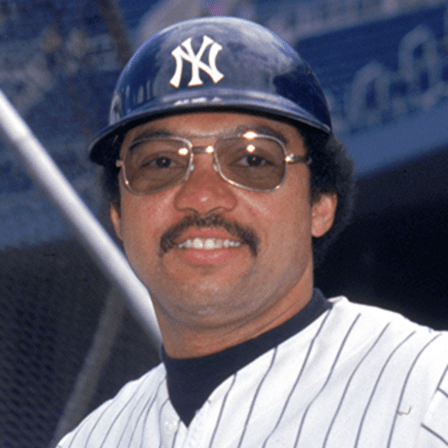
Reggie Jackson was an outfielder who played for the New York Yankees from 1977 to 1981. Career stats: .281 batting average, 144 home runs, 461 RBI.
Reggie Jackson is the most electrifying and controversial player in New York Yankees history -- a Hall of Fame slugger whose five seasons in the Bronx (1977--1981) produced two World Series championships, a mythology-level moment in Game 6 of the 1977 World Series, and a running soap opera with George Steinbrenner and Billy Martin that made the Bronx Zoo the biggest show in sports. He called himself "the straw that stirs the drink." New York gave him a stage worthy of the claim.
The Signing
Reggie Jackson arrived in New York as the most coveted free agent in the first significant class to hit the open market following the 1976 season. Jackson had already won three World Series championships with the Oakland Athletics (1972, 1973, 1974) and was universally regarded as the game's premier power hitter and biggest personality.
On November 29, 1976, Jackson signed a five-year, $2.96 million contract with the Yankees -- the richest deal in baseball history at the time. Steinbrenner outbid five other teams, including the Expos and Padres, sealing it at the Americana Hotel with a handshake and the line: "I'm going to build a cathedral for you." Jackson chose number 44 -- a new number for him, having worn #9 in Oakland.
| Years with Yankees | 1977--1981 |
| Games | 653 |
| Batting Average | .281 |
| Home Runs | 144 |
| RBI | 461 |
| OPS | .882 |
| WAR (Yankees) | 17.5 |
| World Series Titles | 2 |
| All-Star Selections | 5 |
Yankees Career
Jackson's tenure with the Yankees was the most turbulent, dramatic, and ultimately triumphant chapter in the franchise's post-dynasty era. From the moment he arrived in camp, he courted controversy -- most infamously in a Sport magazine profile where he declared himself "the straw that stirs the drink," adding that Thurman Munson "can only stir it bad." The quote detonated a clubhouse schism that never fully healed. (Reggie later claimed the quote was taken out of context. Nobody bought it.)
The friction with Martin was immediate and volcanic. Martin resented Steinbrenner's favoritism; Jackson bristled at Martin's attempts to humble him. Their conflict erupted on national television June 18, 1977, at Fenway Park, when Martin pulled Jackson mid-inning for not hustling on a Jim Rice blooper to right. Martin screamed at Jackson in the dugout on live TV. Coaches Yogi Berra and Elston Howard had to physically intervene. The footage became one of the defining images of late-'70s baseball -- and Steinbrenner watched from home, furious at Martin, not Jackson.
Despite all the chaos, Jackson delivered in every pressure moment. The signature performance came in Game 6 of the 1977 World Series.
You know, this team -- it all flows from me. I've got to keep it all going. I'm the straw that stirs the drink. It all comes back to me. Maybe I should say me and Munson -- but really he doesn't enter into it.
One's a born liar, and the other's convicted.
Reggie Jackson! Oh, what a blow! What a way to top it off! Forget about who the most valuable player is -- Reggie Jackson is just the most valuable player the world has ever seen!
Key Moments
Free Agent Signing
Jackson signs a five-year, $2.96 million deal with the Yankees -- the largest contract in baseball history at the time. Steinbrenner beats out five other clubs.
'The Straw That Stirs the Drink'
The Sport magazine profile hits newsstands. Munson is furious. The clubhouse fractures into factions. Martin sides with Munson. The quote poisons Jackson's first season from its first weeks.
The Fenway Dugout Confrontation
On a nationally broadcast NBC game at Fenway, Martin pulls Jackson mid-inning for loafing on a Jim Rice blooper. The dugout screaming match -- Berra and Howard physically separating them -- becomes one of the most replayed moments of the decade.
World Series Game 6: Three Home Runs on Three Pitches
In the clinching Game 6 against the Dodgers at the Stadium, Jackson hits three consecutive home runs on three consecutive first pitches from three different pitchers: Burt Hooton (4th inning, ~360 feet), Elias Sosa (5th inning, ~370 feet), and Charlie Hough's knuckleball (8th inning, ~450 feet into the center field black seats). He'd also homered in his final at-bat of Game 5 off a Don Sutton delivery, meaning four home runs on four consecutive swings across two games. He finished the Series batting .450 with 5 home runs and 8 RBI.
Martin's 'One's a Born Liar' Comment
After months of suspensions, lineup conflicts, and Steinbrenner interference, Martin tells reporters at Chicago's O'Hare Airport that "one's a born liar, and the other's convicted" -- referring to Jackson and Steinbrenner. The remark costs him his job. He's fired the next day, on July 24, replaced by Bob Lemon.
Back-to-Back Championships
The Yankees repeat as World Series champs, beating the Dodgers again in six games. Jackson bats .391 with two homers and eight RBI. The club had trailed Boston by 14 games in mid-July before staging the greatest comeback in AL history.
Departure from the Yankees
After the Yankees lose the '81 Series to the Dodgers, Steinbrenner declines to offer Jackson a new contract. Reportedly told he was "too old" at 35, Jackson signs with the California Angels. He'd hit 123 more home runs over five productive seasons -- which tells you something about Steinbrenner's judgment.
Munson
The Jackson-Munson relationship is one of baseball's great tragic dramas. Munson was the emotional core of the club -- the 1976 AL MVP, the first Yankees captain since Lou Gehrig, gruff and proud and deeply suspicious of Jackson's narcissism. The Sport magazine quote was the wound that never closed, though teammates said the two men eventually developed a grudging mutual respect -- Yogi Berra, who'd seen every kind of clubhouse drama, called it "two bulls in the same pen."
When Munson died on August 2, 1979 -- killed when his Cessna Citation crashed during a practice landing at Akron-Canton Airport -- Jackson was among the pallbearers at the funeral on August 6. The Yankees flew back to New York for a game that evening against the Orioles, and it was Bobby Murcer who delivered the unforgettable performance -- driving in all five runs in a 5-4 win at Yankee Stadium, hours after delivering the eulogy. Jackson homered in that game too, but Murcer's night belonged to Murcer. (There wasn't a dry eye in the Stadium. Or the visiting clubhouse, for that matter.)
The Triangle
The Steinbrenner-Martin-Jackson dynamic was the defining narrative of late-'70s baseball. Steinbrenner had personally recruited Jackson over Martin's objections. Martin resented the interference, the player, and the owner equally. Martin was fired and rehired by Steinbrenner five times between 1975 and 1989. His first firing -- July 24, 1978 -- was directly caused by the Jackson feud. Then Steinbrenner announced Martin's rehiring on Old Timers' Day, July 29, just five days later, to a crowd of 46,711 at the Stadium. It was one of the most surreal moments in franchise history. Only in the Bronx.
Legacy
Jackson was inducted into the Hall of Fame in 1993 on his first ballot, receiving 93.6% of the vote. The Yankees retired his number 44 on August 14, 1993 -- making him the only Yankee with a retired number despite fewer than six full seasons with the club. He cried during the ceremony. Reporters on his beat said it was the only time they could recall seeing him cry in public. He said of Munson: "I wish Thurman were here to see this."
Career totals: 563 home runs (6th all-time at retirement), 1,702 RBI, .262 average across 21 seasons. He also holds the all-time career strikeout record (2,597), which he wore like a badge of honor.
The 1977 World Series remains the watershed moment -- not just for Jackson but for the franchise. It announced that the Yankees, dormant since 1964, were back. It gave Steinbrenner his championship mandate. And it gave Reggie Jackson a permanent place in the sport's mythology. Three swings, three home runs, three first pitches. Nobody's ever done it since.
Frequently Asked Questions
How many home runs did Reggie Jackson hit in the 1977 World Series Game 6?
Three -- off Burt Hooton in the 4th inning, Elias Sosa in the 5th, and Charlie Hough in the 8th. Each came on the first pitch. Including his Game 5 homer off Don Sutton, Jackson hit four consecutive home runs on four consecutive swings across two games. He was unanimously named World Series MVP.
Why was Reggie Jackson called 'Mr. October'?
For his extraordinary postseason performances. He hit 18 postseason home runs in an era when October consisted of only the LCS and World Series. His 1977 World Series -- 5 home runs, .450 average in six games -- remains the greatest individual Fall Classic performance in baseball history.
What was Reggie Jackson's contract with the Yankees?
Five years, $2.96 million, signed November 29, 1976 -- the largest contract in baseball history at the time. The deal also included a Rolls-Royce. Steinbrenner wasn't subtle about it.
What did Reggie Jackson say about Thurman Munson?
In a June 1977 Sport magazine profile, Jackson declared himself "the straw that stirs the drink," adding that Munson "can only stir it bad." The quote detonated a lasting feud in the clubhouse and poisoned Jackson's relationship with Munson for the rest of his time in pinstripes. Jackson later said it was taken out of context -- which may be true, but the damage was done.
Why did Reggie Jackson leave the Yankees?
After the 1981 World Series loss to the Dodgers, Steinbrenner didn't offer Jackson a new contract. He reportedly told Jackson he was "too old" at 35. Jackson signed with the Angels and hit 123 more home runs over five seasons. One of Steinbrenner's bigger miscalculations.
Did Reggie Jackson and Billy Martin get along?
No. Their relationship was one of the most contentious player-manager conflicts in baseball history. Martin resented Jackson's celebrity and Steinbrenner's favoritism. The feud peaked during the Fenway dugout confrontation on June 18, 1977. Martin's "born liar" comment in July 1978 cost him his job the next day.
Is Reggie Jackson in the Hall of Fame?
Yes. Inducted in 1993 on his first ballot with 93.6% of the vote. The Yankees retired his number 44 on August 14, 1993.