
Career Stats
Regular Season
| Year | G | AB | R | H | 2B | 3B | HR | RBI | BB | SO | SB | AVG | OBP | SLG | OPS |
|---|---|---|---|---|---|---|---|---|---|---|---|---|---|---|---|
| 1980 | 116 | 321 | 39 | 92 | 18 | 0 | 2 | 27 | 29 | 20 | 0 | .287 | .343 | .361 | .704 |
| 1981 | 60 | 159 | 16 | 44 | 9 | 0 | 5 | 18 | 13 | 9 | 0 | .277 | .331 | .428 | .759 |
| 1982 | 102 | 261 | 33 | 80 | 17 | 1 | 6 | 37 | 18 | 18 | 0 | .307 | .352 | .448 | .800 |
| 1983 | 53 | 148 | 19 | 43 | 9 | 1 | 2 | 16 | 11 | 12 | 1 | .291 | .344 | .405 | .749 |
| 1984 | 29 | 86 | 8 | 26 | 4 | 1 | 1 | 6 | 7 | 5 | 0 | .302 | .355 | .407 | .762 |
| Career | 1037 | 3290 | 392 | 970 | 178 | 20 | 57 | 417 | 215 | 277 | 10 | .295 | .338 | .413 | .751 |
Career-best seasons highlighted in gold. Stats via Retrosheet.
Postseason
| Year | G | AB | R | H | 2B | 3B | HR | RBI | BB | SO | SB | AVG | OBP | SLG | OPS |
|---|---|---|---|---|---|---|---|---|---|---|---|---|---|---|---|
| 1976 | 8 | 20 | -- | 6 | -- | -- | 0 | 0 | -- | -- | -- | .300 | -- | -- | -- |
| 1977 | 11 | 43 | -- | 13 | -- | -- | 0 | 5 | -- | -- | -- | .302 | -- | -- | -- |
| 1978 | 10 | 42 | -- | 11 | -- | -- | 0 | 4 | -- | -- | -- | .262 | -- | -- | -- |
| 1980 | 2 | 5 | -- | 1 | -- | -- | 1 | 1 | -- | -- | -- | .200 | -- | -- | -- |
| 1981 | 13 | 31 | -- | 12 | -- | -- | 2 | 9 | -- | -- | -- | .387 | -- | -- | -- |
| Career | 44 | 141 | 0 | 43 | 0 | 0 | 3 | 19 | 0 | 0 | 0 | .305 | .305 | .369 | .674 |
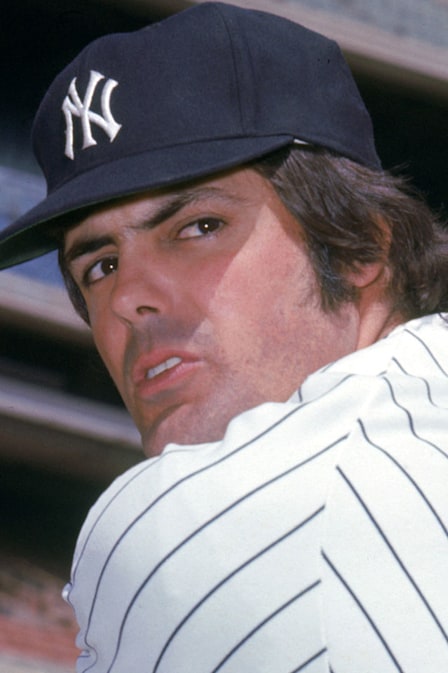
Lou Piniella was an outfielder who played for the New York Yankees from 1974 to 1984. Career stats: .295 batting average, 57 home runs, 417 RBI.
August 6, 1979. The Canton Civic Center, Canton, Ohio. Lou Piniella stood in front of Thurman Munson's family and roughly 300 mourners and tried to find words for a man who didn't usually need anyone to speak for him. "Thurman was the best of competitors," Piniella said, "unselfish, a winner, rough and tough but fair." Then he turned toward Munson's widow. "God give you the strength, Diana, to raise your family of three children just the way Thurman would have wanted."
Bobby Murcer delivered the other eulogy that day -- he was Munson's closest friend on the team, and hours later he'd drive in all five runs in a gutting 5-4 win back at the Stadium. But the Yankees picked Piniella to speak too, and that tells you something about where he stood in that clubhouse. He wasn't the captain. He wasn't the biggest star. He was the guy everybody trusted, in a room that didn't trust easily.
The Trade Kansas City Regretted
Piniella grew up in West Tampa, playing American Legion ball alongside a scrawny catcher-turned-manager named Tony La Russa, long before either of them made a living wearing a lineup card. He signed as an amateur and bounced through four organizations -- brief cups of coffee with the Orioles and Indians -- before the expansion Seattle Pilots grabbed him and immediately shipped him to the Kansas City Royals in April 1969, days before the season started. Pitcher Jim Bouton, chronicling that Pilots season in Ball Four, needled Piniella's temper enough that the nickname "Sweet Lou" stuck around for the rest of his career, entirely because it was the opposite of true.
He made the trade worth it fast. Piniella hit .282 for Kansas City in 1969 and won American League Rookie of the Year -- the first player from an expansion team to win it in the club's inaugural season. He stuck around Kansas City for five years, made the All-Star team in 1972, and looked like a Royal for good.
Then his average dipped to .250 in 1973, and on December 7 of that year, Kansas City traded him and pitcher Ken Wright to the Yankees for Lindy McDaniel, a 38-year-old reliever with not much left. McDaniel won six games total over his two years in Kansas City. Piniella hit .295 over eleven seasons in the Bronx and reached four World Series. Bill James later called it the only real mistake the Royals made in the 1970s. He wasn't wrong.
| Yankees Years | 1974-1984 (11 seasons) |
| Games | 1,037 |
| Batting Average / OBP / SLG | .295 / .338 / .413 |
| Home Runs | 57 |
| Doubles / Triples | 178 / 20 |
| RBI | 417 |
| World Series Rings | 2 (1977, 1978) |
| Postseason | .305 BA, 3 HR, 19 RBI in 44 games |
Sweet Lou in the Zoo
The late-'70s Yankees clubhouse split roughly three ways -- a Reggie Jackson faction, a Billy Martin faction, and a Thurman Munson faction, with most of the roster picking a side whether they meant to or not. Piniella didn't pick one. He got along with Reggie, got along with Billy, got along with Munson, and somehow kept his own locker out of the blast radius while everyone around him was setting fires.
That mattered most on June 18, 1977, at Fenway Park, when Martin yanked Jackson out of a game mid-inning for what he considered a lack of hustle on a Jim Rice bloop double. The two nearly came to blows in the dugout on live television before Yogi Berra and Elston Howard physically separated them. Jackson, shaken and furious, turned to Piniella afterward for advice. Piniella's advice was blunt: go back to the hotel, cool off, don't fight Billy. Jackson listened (for once).
A few weeks earlier, Piniella and Munson had gone to George Steinbrenner directly and told him, in essence, to knock it off -- stop ripping Martin to the press, stop undermining a manager who was actually winning games (a request that assumes Steinbrenner was capable of taking advice, which was its own kind of gamble). That's not a small thing. Munson was the captain. Piniella was a corner outfielder hitting .280-something. But Steinbrenner listened to both of them the same way.
We don't know why God took Thurman away from us -- but as long as we wear the Yankee uniform he'll never be too far from us.
October Lou
Piniella's regular-season numbers were solid, not spectacular. His October numbers were a different animal -- a .305 postseason average across four World Series, with a knack for the moment nobody was watching for.
Take Game 4 of the 1977 World Series. The Yankees led 2-1 in the series and needed a win to take control. Piniella ran down a Ron Cey line drive in left field and made a leaping catch that took a home run off the board, preserving Ron Guidry's four-hit complete game and pushing New York to a 3-1 series lead, within a win of the title. It's the kind of defensive play that never shows up in a highlight reel next to Reggie's three home runs the following game, but ask anyone who was in the ballpark and they'll tell you it mattered just as much.
A year later, in Game 4 of the 1978 World Series, Piniella hit a low liner to shortstop Bill Russell that Russell bobbled -- the ball caromed off Reggie Jackson's hip in foul territory, Munson scored, and the Yankees were suddenly back in a series they'd been on the brink of losing. Two innings later, Piniella lined a single to center to score the go-ahead run in the 10th. Tie series, 2-2. The whole comeback pivoted around him twice in one afternoon.
And then there's the one-game playoff at Fenway on October 2, 1978 -- Piniella's signature moment, and it wasn't even a hit. Ninth inning, Yankees clinging to a 5-4 lead, Jerry Remy lined a ball to right field that Piniella lost completely in the afternoon sun. Instead of panicking, he pounded his glove like he had the ball dead to rights, bluffing Rick Burleson into holding at first. The ball bounced past him untouched. Piniella scooped it on the hop and threw quickly enough that Burleson only reached second, not third -- which meant that when Jim Rice flew out, Burleson could only tag to third instead of scoring the tying run. Goose Gossage got Carl Yastrzemski to pop out one batter later. Season over, Boston. Nobody remembers that Piniella never actually caught the ball. They remember that he made it look like he did.
Sweet Lou Takes Over
Steinbrenner fired Billy Martin for the fourth time on October 28, 1985, despite a 91-54 record, and handed the job to Piniella for 1986. It was a deliberate contrast -- a calmer voice after a decade of Martin's chaos. The Yankees opened that season winning ten of their first fourteen games and finished 90-72, second place in the AL East. In 1987, Piniella's club won 89 games but slid to fourth. Steinbrenner moved him "up" to general manager that October and brought Martin back for a fifth stint -- a lateral move dressed up as a promotion.
Martin lasted 68 games into 1988 before Steinbrenner fired him one final time, on June 23, and Piniella came back down to the dugout to finish the season. He went 45-48 the rest of the way; combined with Martin's 40-28, the Yankees finished 85-76, fifth place, with baseball's highest payroll and nothing to show for it. Steinbrenner fired Piniella again on October 7, 1988. Across his two stints, Piniella's Yankees managerial record stood at 224-193.
Where Martin had clashed with Steinbrenner violently, Piniella mostly endured him quietly -- a difference in temperament, not in the amount of grief the owner handed out. It bought him a second stint. It didn't buy him a third.
Cooperstown's Doorstep
Piniella didn't stay unemployed long. The Cincinnati Reds hired him that November, and in his first year as their manager, the 1990 Reds swept the heavily favored Oakland Athletics in the World Series -- the only championship of Piniella's managerial career, and one that came against Tony La Russa, his old Tampa American Legion teammate, running the other dugout.
From there Piniella built a Hall of Fame-caliber managerial resume that dwarfed his time in the Bronx. He managed the Seattle Mariners from 1993 to 2002, winning AL Manager of the Year in 1995 and again in 2001, when the Mariners won a record-tying 116 games. He later managed Tampa Bay (2003-05) and the Chicago Cubs (2007-10), winning Manager of the Year a third time in 2008. Twenty-three seasons managing in the big leagues across five different franchises, and it all traces back to a corner outfielder Steinbrenner trusted enough to hand a struggling roster to twice.
He came within one vote of Cooperstown. The Hall of Fame's Contemporary Baseball Era Committee considered him for the Class of 2024, and Piniella received 11 of 16 votes -- one shy of the 75 percent threshold that elects a candidate (Jim Leyland cleared it with 15). Piniella is still on the outside, still eligible for future committee ballots, still waiting.
Traded to Kansas City
Drafted by the expansion Seattle Pilots, Piniella is traded to the Royals for Steve Whitaker and John Gelnar days before the season starts. He wins AL Rookie of the Year in his first Kansas City season -- the first player from an expansion franchise to take the award in its debut year.
Traded to the Yankees
Kansas City sends Piniella and pitcher Ken Wright to New York for reliever Lindy McDaniel. Piniella goes on to play eleven seasons and reach four World Series in pinstripes.
Delivers a Eulogy for Thurman Munson
Alongside Bobby Murcer, Piniella speaks at Munson's funeral in Canton, Ohio, hours before the Yankees fly home and beat Baltimore 5-4 that same night.
Named Yankees Manager
Steinbrenner fires Billy Martin for the fourth time and hands the job to Piniella, who leads the club to a 90-72 record in 1986.
Fired by the Yankees for the Second Time
After splitting the 1988 season with Martin (45-48 under Piniella), Steinbrenner lets him go. Piniella takes the Cincinnati Reds job the following month.
Wins the World Series with Cincinnati
In his first season managing the Reds, Piniella sweeps the Oakland Athletics to win the only championship of his managerial career.
Frequently Asked Questions
What were Lou Piniella's career stats with the Yankees?
Piniella played eleven seasons in the Bronx (1974-1984), batting .295/.338/.413 with 57 home runs, 417 RBI, and 178 doubles across 1,037 games. He hit .305 in 44 career postseason games and won two World Series rings, in 1977 and 1978. His best season came in 1977, when he hit a career-high .330 with 12 home runs.
Did Lou Piniella speak at Thurman Munson's funeral?
Yes. Piniella delivered a eulogy alongside Bobby Murcer at Munson's funeral on August 6, 1979, at the Canton Civic Center in Canton, Ohio. Piniella spoke about Munson's competitiveness and addressed Munson's widow, Diana, directly. Hours later, the Yankees flew back to New York and beat Baltimore 5-4, with Murcer driving in all five runs.
When did Lou Piniella manage the Yankees?
Piniella managed the Yankees in two stints: 1986 through 1987, and again for the second half of 1988 after Billy Martin was fired for the fifth time. He went 90-72 in 1986 and 89 wins in 1987, then 45-48 in his partial 1988 season. His combined Yankees managerial record was 224-193. Steinbrenner fired him for good on October 7, 1988.
Is Lou Piniella in the Baseball Hall of Fame?
Not yet. Piniella was a finalist on the Hall of Fame's 2024 Contemporary Baseball Era Committee ballot and received 11 of 16 votes -- one vote short of the 75 percent needed for election. His case rests almost entirely on his managerial career: a 1990 World Series title with the Reds, a record-tying 116-win season with the 2001 Mariners, and three Manager of the Year awards (1995, 2001, 2008).
He never made a Hall of Fame plaque, and he never got the captain's armband, and his own numbers -- solid as they were -- never put him in the conversation with the era's biggest names. But Piniella was the guy who could sit at Reggie's table and Billy's table and Munson's table in the same afternoon, and get invited back to all three. That's a harder trick than hitting .330. Sweet Lou pulled it off for eleven years, then came back twice more to try to run the whole show himself.