
Career Stats
Regular Season
| Year | G | GS | W | L | SV | IP | H | ER | K | BB | ERA | WHIP |
|---|---|---|---|---|---|---|---|---|---|---|---|---|
| 2005 | 34 | 34 | 17 | 8 | 0 | 225.2 | 207 | 95 | 211 | 47 | 3.79 | 1.13 |
| 2006 | 33 | 33 | 17 | 11 | 0 | 205.0 | 194 | 114 | 172 | 60 | 5.00 | 1.24 |
| Career | 67 | 67 | 34 | 19 | 0 | 430.2 | 401 | 209 | 383 | 107 | 4.37 | 1.18 |
Career-best seasons highlighted in gold. Stats via Retrosheet.
Postseason
| Year | G | GS | W | L | SV | IP | H | ER | K | BB | ERA | WHIP |
|---|---|---|---|---|---|---|---|---|---|---|---|---|
| 2005 | 2 | -- | 0 | 0 | 0 | 7.1 | -- | -- | -- | -- | 6.14 | -- |
| 2006 | 1 | -- | 0 | 1 | 0 | 5.2 | -- | -- | -- | -- | 7.94 | -- |
| Career | 3 | 0 | 0 | 1 | 0 | 13.0 | 0 | 0 | 0 | 0 | 0.00 | 0.00 |
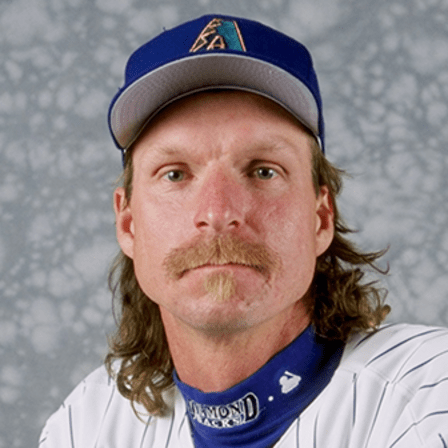
Randy Johnson was a pitcher who played for the New York Yankees from 2005 to 2006. Career stats: 34-19 record, 4.37 ERA, 383 strikeouts.
Randy Johnson's Hall of Fame plaque has a Diamondbacks cap on it. Not a Mariners cap, not pinstripes -- and that tells you almost everything about how his two years with the New York Yankees fit into the bigger picture. The Big Unit won five Cy Youngs, threw a perfect game, and beat the Yankees in a World Series before he ever put on their uniform. Then, at 41 years old with a bad back, he came to the Bronx to be an ace one more time. It didn't quite work out that way, but it wasn't nothing, either.
The Résumé He Brought With Him
By the time the Yankees got him, Johnson wasn't just good -- he was one of the most dominant pitchers who ever lived. Four straight NL Cy Youngs with Arizona (1999-2002), a fifth with Seattle back in 1995, a perfect game at age 40 against Atlanta in 2004 (the oldest man ever to throw one, at the time), and a share of the 2001 World Series MVP with Curt Schilling after the Diamondbacks knocked off... the Yankees. Six-foot-ten, left-handed, and mean about it. That's the guy Brian Cashman traded for.
The deal went down on December 30, 2004: Yankees sent Javier Vazquez, Brad Halsey, catching prospect Dioner Navarro, and $9 million to Arizona for Johnson, plus a 2-year, $32 million extension on top of the $16 million he was already owed for 2005. He had a no-trade clause and never made it an issue -- he wanted to pitch for a winner, and Cashman was desperate to fix a rotation that had just watched the 2004 ALCS fall apart. On paper, it looked like exactly the move a $200 million team should make.
Year One: Solid, Not Spectacular
Johnson made his Yankees debut on Opening Day, April 3, 2005, at the Stadium against Boston -- of all people, ex-Yankee David Wells was on the mound for the Red Sox. New York won 9-2, and Johnson got the win in his first start in pinstripes. He went on to torch the Sox all year, going 5-0 against them in six starts, which mattered a lot given the Yankees and Red Sox finished the season dead even at 95-67 and New York only took the AL East on a tiebreaker.
| Position | SP |
| Yankees Tenure | 2005-2006 |
| Yankees Record | 34-19 |
| Yankees ERA | 4.37 |
| Strikeouts (NYY) | 383 |
| Innings Pitched (NYY) | 430.2 |
| WHIP (NYY) | 1.18 |
| 2005 Season | 17-8, 3.79 ERA, 211 K |
| 2006 Season | 17-11, 5.00 ERA, 172 K |
| Postseason (NYY) | 3 G, 0-1, 6.92 ERA |
2005 was, in the end, the good year -- 17-8, a 3.79 ERA, second in the American League with 211 strikeouts, all at age 41. It wasn't the four-Cy-Young version of Johnson, but it was a genuinely useful ace for a Yankees team that needed one. He had his bad nights too (the White Sox touched him up for four home runs in a single fourth inning that August, the kind of outing that reminds you a 41-year-old arm doesn't have unlimited good days left in it), but the season overall held up.
Then came October, and it fell apart fast. In Game 3 of the 2005 ALDS at the Stadium, with the series tied at a game apiece, Garret Anderson took him deep for three in the first inning and Bengie Molina added two more in the third. With runners on first and third and nobody out in the fourth, the Yankees pulled him, and the Angels rolled to an 11-7 win. The Yankees lost the series in five. The ace they traded three players and $9 million for had a signature bad night at the worst possible time.
Year Two: The Back Catches Up
The Diamondbacks logo on my Hall of Fame plaque makes the most sense.
That quote is from a decade later, but it's worth sitting with here, because 2006 is the year that made it true. Johnson still won 17 games, but his ERA ballooned to 5.00 -- the worst full season of his career -- and a chronic back problem that had bothered him for years started dictating how he pitched. He gutted out a full workload anyway (33 starts, 172 strikeouts) on a back that was, by every account, just plain freakin' shot -- which says something about who he was, even if the results said something else.
The Yankees made the playoffs again, and Johnson got the ball for Game 3 of the ALDS against Detroit at Comerica Park, his last start in a Yankees uniform. Kenny Rogers threw 7.2 shutout innings for the Tigers. Johnson lasted 5.2, allowing 5 runs on 8 hits, and took the loss in a 6-0 defeat. The Yankees lost that series in four, their third straight postseason series loss -- a franchise first -- and by the time the season ended, everyone knew Johnson's back needed real work, not another five days' rest.
Traded to the Yankees
Arizona sends Johnson to New York for Javier Vazquez, Brad Halsey, Dioner Navarro, and $9 million, plus a 2-year, $32 million extension covering 2006-2007.
Yankees Debut on Opening Day
Johnson beats Boston 9-2 at the Stadium in his first Yankees start, opposite ex-Yankee David Wells.
Rocked in ALDS Game 3
Garret Anderson and Bengie Molina go deep as the Angels beat the Yankees 11-7; the Yankees pull Johnson in the 4th. Los Angeles wins the series in five games.
Back Surgery
Following a 5.00 ERA season with mounting back pain, Johnson undergoes surgery for a herniated disc, performed by the same surgeon who operated on his back a decade earlier.
Traded Back to Arizona
The Yankees send Johnson back to the Diamondbacks for Luis Vizcaino, Ross Ohlendorf, Steven Jackson, and Alberto Gonzalez, kicking in $2 million of his 2007 salary.
The Trade Back
By January 2007, it was over. The Yankees shipped Johnson back to Arizona for a modest return -- Luis Vizcaino, Ross Ohlendorf, Steven Jackson, and Alberto Gonzalez -- and kicked in $2 million toward his salary to make it happen. He wanted out of New York and closer to family in Phoenix after losing his brother, and nobody in the Bronx was fighting to keep a 43-year-old with a surgically repaired back and a 5.00 ERA. It was a clean, mutual, unsentimental split. Just over two years after arriving as a marquee ace, Johnson was gone, and the Yankees moved on to the next fix (Andy Pettitte's return, the arrival of a kid named Joba Chamberlain, and eventually a full teardown of the rotation-buying model altogether).
Johnson pitched three more seasons after leaving New York -- back with Arizona, then a final year with the Giants, where he picked up career win number 300 in June 2009. None of that happened in pinstripes. What happened in pinstripes was two years, a couple of bad Octobers, one very good regular season, and a uniform number (#41, since Bernie Williams already owned his usual #51) that most Yankees fans would be forgiven for forgetting.
Frequently Asked Questions
How did Randy Johnson end up on the Yankees?
The Yankees traded Javier Vazquez, Brad Halsey, Dioner Navarro, and $9 million to Arizona on December 30, 2004, and signed Johnson to a 2-year, $32 million extension on top of his existing 2005 salary. He waived a no-trade clause to approve the deal.
What was Randy Johnson's record with the Yankees?
He went 34-19 with a 4.37 ERA and 383 strikeouts across 2005 and 2006 -- 17-8 with a 3.79 ERA in his first season, then 17-11 with a 5.00 ERA in his second as back problems set in.
Why did the Yankees trade Randy Johnson back to Arizona?
After a rough, injury-affected 2006 that ended in an ALDS Game 3 loss to Detroit, the Yankees sent Johnson back to Arizona in January 2007 for Luis Vizcaino, Ross Ohlendorf, Steven Jackson, and Alberto Gonzalez, paying down $2 million of his 2007 salary. Johnson also wanted to be closer to family in Phoenix.
Did Randy Johnson win a World Series with the Yankees?
No. His only World Series ring came with Arizona in 2001, when he beat the Yankees and shared Series MVP honors with Curt Schilling. His two Yankees postseasons both ended in ALDS losses -- to the Angels in 2005 and the Tigers in 2006.
What number did Randy Johnson wear with the Yankees?
He wore #41. His usual #51 belonged to Bernie Williams in New York.
Johnson's Cooperstown case was built somewhere else -- Seattle, Arizona, a perfect game in Atlanta -- and his plaque says as much. But for two years, the most feared left-hander of his generation walked out to the mound at the Stadium in pinstripes, and for one of those years, he was genuinely great. That's more than most rental aces can say.