
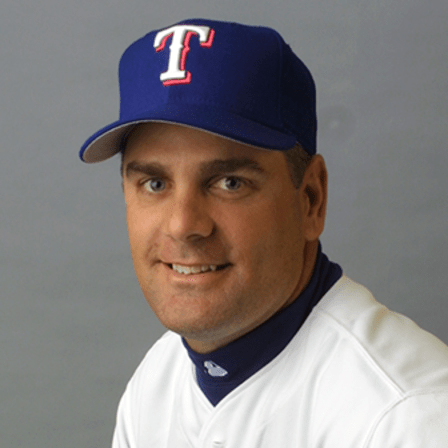
Career Stats
Regular Season
| Year | G | GS | W | L | SV | IP | H | ER | K | BB | ERA | WHIP |
|---|---|---|---|---|---|---|---|---|---|---|---|---|
| 1996 | 30 | 30 | 12 | 8 | 0 | 179.0 | 179 | 93 | 92 | 83 | 4.68 | 1.46 |
| 1997 | 31 | 22 | 6 | 7 | 0 | 145.0 | 161 | 91 | 78 | 62 | 5.65 | 1.54 |
| Career | 61 | 52 | 18 | 15 | 0 | 324.0 | 340 | 184 | 170 | 145 | 5.11 | 1.50 |
Career-best seasons highlighted in gold. Stats via Retrosheet.
Postseason
| Year | G | GS | W | L | SV | IP | H | ER | K | BB | ERA | WHIP |
|---|---|---|---|---|---|---|---|---|---|---|---|---|
| 1996 | 4 | -- | 0 | 0 | 0 | 7.0 | -- | -- | -- | -- | 14.14 | -- |
| Career | 4 | 0 | 0 | 0 | 0 | 7.0 | 0 | 0 | 0 | 0 | 0.00 | 0.00 |
Kenny Rogers was a pitcher who played for the New York Yankees from 1996 to 1997. Career stats: 18-15 record, 5.11 ERA, 170 strikeouts.
Quick housekeeping before we start: this is Kenny Rogers the left-handed pitcher, not Kenny Rogers the guy who sang "The Gambler" and "Islands in the Stream." No relation. Not even close. The pitcher's own nickname was actually "The Gambler" too -- a direct riff on the singer's biggest hit -- which means baseball's Kenny Rogers spent his whole career being nicknamed after a song written for a completely different guy who happened to share his name. Baseball is weird like that sometimes.
Now, the guy who actually matters here: Rogers signed a four-year, $19.5 million deal with the New York Yankees as a free agent on December 30, 1995, and for two seasons he was the walking definition of a contract that looked fine in the regular season and fell apart the second the lights got brighter. He won a ring in 1996. He was also, somehow, one of the worst big-game pitchers the dynasty ever rostered.
Path to the Bronx
Rogers didn't arrive as a nobody. He'd thrown the 14th perfect game in major league history for Texas on July 28, 1994 -- a 4-0 gem over the Angels -- and followed it with an All-Star season in 1995 that made him one of the more attractive arms on the free agent market that winter. Scott Boras was his agent, and Boras did what Boras does: he got Steinbrenner to guarantee Rogers four years, even though David Cone -- a genuinely better pitcher at the time -- only got three. (Boras has been doing this to front offices for three decades. This was an early one.)
Then spring training happened. On February 25, 1996, Rogers threw batting practice without a screen up and took a Tony Fernandez line drive off his left shoulder. Wanting to look "New York tough" in year one, he told the team he was fine and tried pitching through it for two more outings before the truth came out -- a bruised shoulder that kept him out of the rotation until late April. Torre was reportedly furious about being misled. Not exactly the debut a $19.5 million free agent draws up for himself.
Yankees Career
The regular season stuff was fine, genuinely. Rogers went 12-8 with a 4.68 ERA in 1996, and by the numbers he was the team's second-best starter and third-best pitcher on the whole staff that year (Mariano Rivera's absurd setup season ate up the top spot, obviously). He never fully won over the fan base or the front office -- his relationship with both Torre and Steinbrenner stayed uneasy the whole time (nobody's idea of a fun clubhouse dynamic) -- but on a night-to-night basis, he did his job.
| Yankees Seasons | 1996-1997 |
| Yankees Record | 18-15 |
| Yankees ERA | 5.11 |
| Yankees Innings Pitched | 324.0 |
| Yankees Strikeouts | 170 |
| Yankees WHIP | 1.50 |
| 1996 Postseason ERA | 14.14 (7.0 IP) |
| World Series Rings | 1 (1996) |
Then October showed up, and it was a different story entirely.
The Worst 14.14 ERA You'll Ever See With a Ring Attached
Rogers made four appearances in the 1996 postseason. He was rocked in basically all of them, and the Yankees won every single game he pitched in anyway -- which tells you everything about how good that bullpen and lineup were, and nothing good about how Rogers pitched.
It started in ALDS Game 2 against his own former team, Texas -- one batter faced in relief, and he walked him. Two games later, in the series-clinching Game 4, he got the start and lasted two innings before Torre had seen enough. In ALCS Game 4 against Baltimore, he gave up a homer to Chris Hoiles, walked Cal Ripken Jr., uncorked a wild pitch, and was gone after three. Then, in World Series Game 4 against Atlanta -- pitching through a partial shoulder tear and a bone spur that would later need surgery -- he faced 13 batters, got five of them out, and allowed five runs before Torre pulled him in the second inning.
Add it up: 7.0 innings, 11 earned runs, a freakin' 14.14 ERA, and a 0-0 record, because the Yankees kept bailing him out. Torre reportedly chalked it up to something mental more than physical -- that Rogers strayed from his plan and got impatient the second things got tight. Whatever the diagnosis, it became a pattern. By May of 1997, the New York Post ran the headline "Kenny Starting To Crack," and that about summed up where things stood.
1997 and the End
The second year was worse, and it wasn't close. Rogers carried an ERA north of 6.00 through his first 14 starts before getting bumped to the bullpen in mid-June, then bounced between roles the rest of the way. He finished 6-7 with a 5.65 ERA in 145 innings across 31 appearances. Combine both years and you get an 18-15 record with a 5.11 ERA over 324 innings -- a perfectly mediocre two-year stat line for $19.5 million guaranteed, minus the part where he also melted every time the games actually mattered.
The Yankees moved on that November. On November 7, 1997, they sent Rogers and roughly $5 million in cash to Oakland for a player to be named later. Eleven days later, on November 18, the A's sent back Scott Brosius -- a 31-year-old third baseman coming off a .203 season, viewed by basically everyone as an afterthought. You know how that turned out. Brosius hit .300 with 19 homers in 1998 and won World Series MVP. Rogers got salary relief and a change of scenery. One of those outcomes aged a lot better than the other.
Perfect Game with Texas
Rogers throws the 14th perfect game in MLB history, beating the Angels 4-0 at The Ballpark in Arlington.
Signs with the Yankees
Rogers signs a four-year, $19.5 million free agent deal with a fifth-year vesting option, negotiated by agent Scott Boras.
Shoulder Injury in Spring Training
Struck on the left shoulder by a Tony Fernandez line drive during an unscreened batting practice session, Rogers downplays the injury before the truth comes out. He doesn't join the rotation until late April.
Four Postseason Meltdowns, Zero Losses
Across the ALDS, ALCS, and World Series, Rogers allows 11 earned runs in 7.0 innings (14.14 ERA). The Yankees win every game he appears in and go on to win the championship.
Traded to Oakland
The Yankees send Rogers and cash to the Athletics for a player to be named later.
Brosius Comes to New York
Oakland names Scott Brosius as the player to be named later, completing the trade that would help define the 1998 championship team.
The Redemption Nobody in the Bronx Wanted to Watch
Here's the part that makes this whole story funnier in hindsight. Rogers kept pitching for another decade -- Oakland, the Mets, Texas again, Minnesota, and finally Detroit -- and in 2006, at age 41, he had maybe the best postseason run of his career. He threw 23 consecutive scoreless innings across three straight playoff starts for the Tigers. The first one came on October 6, 2006, at Comerica Park, when he threw 7⅔ scoreless innings against the Yankees in ALDS Game 3, outdueling Randy Johnson in a 6-0 Tigers win.
The same guy who couldn't get through two innings in three different 1996 Yankees postseason starts spent a decade later shutting the Yankees out entirely in October, on his way to one of the great late-career playoff stretches anyone's had. (Baseball has a sense of humor. It's usually a mean one.)
Rogers finished his career with 219 wins over 20 seasons and appeared on the Hall of Fame ballot exactly once, in 2014. He got a single vote and fell off. He's not walking into Cooperstown, and I don't think anyone -- Rogers included -- would argue he should. But for two years in the Bronx, he was proof that you can be a perfectly fine regular-season pitcher and still become a punchline the second October starts, and then, a decade and three teams later, prove it was never really about the arm at all.
Frequently Asked Questions
Is Kenny Rogers the Yankees pitcher related to the country singer Kenny Rogers?
No. They share a name and nothing else. The pitcher was born in 1964 in Savannah, Georgia; the singer was born in 1938 in Houston, Texas. The pitcher's nickname, "The Gambler," was actually a reference to the singer's signature song, not a family connection.
How did Kenny Rogers pitch for the Yankees in 1996 and 1997?
Rogers went 12-8 with a 4.68 ERA in 1996 and 6-7 with a 5.65 ERA in 1997, combining for an 18-15 record and 5.11 ERA over 324 innings. He won a ring in 1996 but posted a 14.14 ERA over four postseason appearances that October.
Why was Kenny Rogers traded by the Yankees?
After a rough two years in New York, the Yankees traded Rogers and roughly $5 million in cash to the Oakland Athletics on November 7, 1997, in a deal that brought back Scott Brosius as the player to be named later on November 18. Brosius went on to win the 1998 World Series MVP for the Yankees.
Did Kenny Rogers ever pitch well in the postseason?
Yes, just not for the Yankees. In 2006, at age 41 with the Detroit Tigers, Rogers threw 23 consecutive scoreless innings across three straight postseason starts, including a 7⅔-inning shutout performance against the Yankees in ALDS Game 3 on October 6, 2006.
Is Kenny Rogers in the Baseball Hall of Fame?
No. Rogers appeared on the BBWAA ballot once, in 2014, received a single vote, and fell off. He finished his 20-year career with 219 wins across six teams.
So no, it's not the singer. But if you're looking for a guy named Kenny Rogers who knew when to hold 'em and when to fold 'em, the pitcher picked the wrong two Octobers to find out.