
Career Stats
Regular Season
| Year | G | GS | W | L | SV | IP | H | ER | K | BB | ERA | WHIP |
|---|---|---|---|---|---|---|---|---|---|---|---|---|
| 1980 | 64 | 0 | 6 | 2 | 33 | 99.0 | 74 | 25 | 103 | 37 | 2.27 | 1.12 |
| 1981 | 32 | 0 | 3 | 2 | 20 | 46.2 | 22 | 4 | 48 | 14 | 0.77 | 0.77 |
| 1982 | 56 | 0 | 4 | 5 | 30 | 93.0 | 63 | 23 | 102 | 28 | 2.23 | 0.98 |
| 1983 | 57 | 0 | 13 | 5 | 22 | 87.1 | 82 | 22 | 90 | 25 | 2.27 | 1.23 |
| 1989 | 11 | 0 | 1 | 0 | 1 | 14.1 | 14 | 6 | 6 | 3 | 3.77 | 1.19 |
| Career | 318 | 0 | 42 | 28 | 150 | 530.1 | 385 | 125 | 510 | 184 | 2.12 | 1.07 |
Career-best seasons highlighted in gold. Stats via Retrosheet.
Postseason
| Year | G | GS | W | L | SV | IP | H | ER | K | BB | ERA | WHIP |
|---|---|---|---|---|---|---|---|---|---|---|---|---|
| 1978 | 5 | -- | 2 | 0 | 1 | 10.0 | -- | -- | -- | -- | 1.80 | -- |
| 1980 | 1 | -- | 0 | 1 | 0 | 0.1 | -- | -- | -- | -- | 54.00 | -- |
| 1981 | 8 | -- | 0 | 0 | 6 | 14.1 | -- | -- | -- | -- | 0.00 | -- |
| Career | 14 | 0 | 2 | 1 | 7 | 24.2 | 0 | 0 | 0 | 0 | 0.00 | 0.00 |
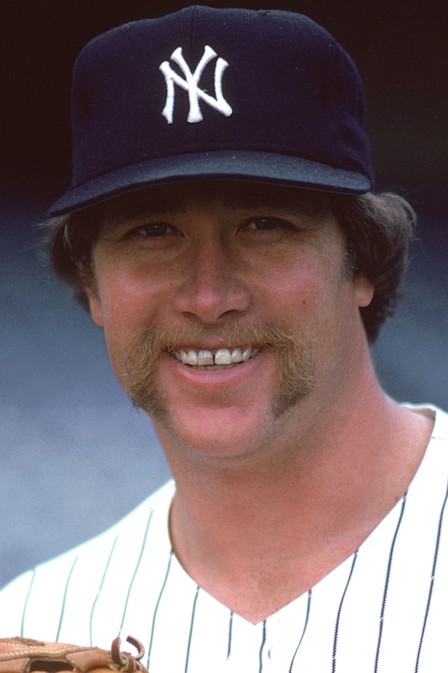
Rich Gossage was a pitcher who played for the New York Yankees in 1978-1983, 1989. Career stats: 42-28 record, 2.12 ERA, 510 strikeouts.
The mustache came first. Then the fastball. Rich "Goose" Gossage stormed into New York Yankees history in 1978 with a 98-mile-per-hour heater and the temperament of a man who'd just been cut off in traffic, and for six seasons he was the most terrifying closer in baseball. He didn't pitch the ninth inning -- he pitched the seventh, eighth, and ninth, sometimes throwing two or three innings of pure fury to slam the door on a game. Modern closers pitch one inning and call it a night. Gossage would have laughed at that.
Path to the Bronx
Gossage came up with the Chicago White Sox in 1972 and spent his early years bouncing between starting and relieving before the White Sox committed him to the bullpen full-time in 1975. He posted a 1.84 ERA with 26 saves that year, then was traded to the Pirates in 1977, where he saved 26 more games with a 1.62 ERA. The performance made him the most coveted reliever in free agency that winter.
George Steinbrenner signed Gossage to a six-year, $2.75 million deal before the 1978 season, pairing him with the defending champion Yankees. The signing created immediate tension -- Catfish Hunter was already the team's elder statesman, and Gossage's arrival meant that incumbent closer Sparky Lyle, the 1977 Cy Young winner, was being replaced. Lyle famously responded by writing a tell-all book called "The Bronx Zoo." Gossage responded by pitching like a force of nature.
Yankees Career
Gossage's first year in New York was a microcosm of everything he'd become. He saved 27 games with a 2.01 ERA in 134 innings -- not just closing games but dominating them, entering in the seventh or eighth inning with runners on base and simply overpowering everyone he faced. In the 1978 one-game playoff against the Red Sox at Fenway Park, Gossage came on in the seventh inning and got the final outs after Bucky Dent's famous home run gave the Yankees the lead.
| NYY Saves | 150 |
| NYY ERA | 2.14 |
| NYY Innings | 533 |
| NYY Strikeouts | 512 |
| All-Star Selections (NYY) | 4 |
| Hall of Fame | Inducted 2008 |
The 1980 season was his best in pinstripes: 33 saves with a 2.27 ERA in 99 innings, with 103 strikeouts against only 37 walks. He was utterly dominant, and the saves totals don't tell the full story because Gossage was routinely pitching two or three innings per appearance. A modern closer might throw 60 innings in a season -- Gossage regularly threw 90 to 140.
His tenure in New York wasn't without turbulence. In April 1979, a clubhouse altercation with teammate Cliff Johnson tore the ligaments in Gossage's right thumb, sidelining him until mid-July and costing the Yankees their closer during a crucial stretch. Despite that, he came back to save 18 games in the season's second half. In 1981, he saved 20 games during the strike-shortened season and pitched in the World Series against the Dodgers, though the Yankees lost in six games.
Gossage signed with the San Diego Padres after the 1983 season, but he returned for one final stint with the Yankees in 1989, saving 3 games in 11 appearances before being released.
Key Moments
Signs with the Yankees
Gossage joins the defending champions as a free agent, replacing Cy Young winner Sparky Lyle as the team's closer. The signing reshapes the bullpen.
The Playoff Game
Gossage enters the one-game playoff against Boston in the seventh inning and closes out the win after Bucky Dent's homer. He gets Carl Yastrzemski to pop up for the final out.
Career Year
Posts 33 saves with a 2.27 ERA and 103 strikeouts in 99 innings. He is the most dominant reliever in the American League.
World Series Heartbreak
The Yankees lose to the Dodgers in six games in the World Series. Gossage pitches in three games (Games 1, 2, and 5) and doesn't allow a run, picking up two saves, but the bullpen behind him can't hold off the Dodgers in the clincher.
Hall of Fame
Gossage is elected to Cooperstown by the BBWAA with 85.8% of the vote, recognized as one of the greatest relievers in baseball history.
The Last of His Kind
Gossage belonged to the final generation of closers who were expected to pitch multiple innings, enter games in the middle of rallies, and physically intimidate hitters with their presence on the mound. He didn't jog in from the bullpen -- he marched, jaw set, mustache bristling, looking like he wanted to fight every batter in the lineup. The fastball did the actual damage, but the aura was part of the package.
He's been vocal in retirement about what he sees as the softening of the closer role, and he's not wrong to point out the contrast. When Gossage saved a game, he earned it over multiple innings against the heart of the opposing order. The single-inning save, perfected by Mariano Rivera a generation later, was a different job entirely. Both approaches produced Hall of Famers, but Gossage's version demanded a durability that today's game no longer requires.
Frequently Asked Questions
How many saves did Goose Gossage record with the Yankees?
Gossage saved 150 games across two stints with the Yankees (1978-1983 and 1989), posting a 2.14 ERA in 533 innings. His best season was 1980, when he saved 33 games with a 2.27 ERA.
What happened in the 1978 playoff game?
In the one-game tiebreaker between the Yankees and Red Sox at Fenway Park, Gossage entered in the seventh inning with a 5-4 lead and closed out the game. He got Carl Yastrzemski to pop up to third baseman Graig Nettles for the final out, sending the Yankees to the postseason.
How did Goose Gossage pitch differently from modern closers?
Gossage routinely pitched two or three innings per save, entering games in the seventh or eighth inning rather than waiting for the ninth. He threw 90 to 140 innings per season as a reliever, compared to the 55-70 innings that most modern closers log.
When was Goose Gossage inducted into the Hall of Fame?
Gossage was elected to the Hall of Fame in 2008 by the BBWAA, receiving 85.8% of the vote in his ninth year on the ballot. He finished his career with 310 saves and a 3.01 ERA over 22 major league seasons.
Goose Gossage wasn't subtle. He wasn't crafty. He didn't nibble at the corners or try to trick hitters with off-speed stuff. He threw the ball as hard as he could, dared anyone to hit it, and more often than not they couldn't. Six seasons in the Bronx, 150 saves, a 2.14 ERA, and a presence on the mound that made grown men flinch. The game doesn't make relievers like that anymore. It probably can't.