
Career Stats
Regular Season
| Year | G | GS | W | L | SV | IP | H | ER | K | BB | ERA | WHIP |
|---|---|---|---|---|---|---|---|---|---|---|---|---|
| 1975 | 39 | 39 | 23 | 14 | 0 | 328.0 | 248 | 94 | 177 | 83 | 2.58 | 1.01 |
| 1976 | 36 | 36 | 17 | 15 | 0 | 298.2 | 268 | 117 | 173 | 68 | 3.53 | 1.13 |
| 1977 | 22 | 22 | 9 | 9 | 0 | 143.1 | 137 | 75 | 52 | 47 | 4.71 | 1.28 |
| 1978 | 21 | 20 | 12 | 6 | 0 | 118.0 | 98 | 47 | 56 | 35 | 3.58 | 1.13 |
| 1979 | 19 | 19 | 2 | 9 | 0 | 105.0 | 128 | 62 | 34 | 34 | 5.31 | 1.54 |
| Career | 137 | 136 | 63 | 53 | 0 | 993.0 | 879 | 395 | 492 | 267 | 3.58 | 1.15 |
Career-best seasons highlighted in gold. Stats via Retrosheet.
Postseason
| Year | G | GS | W | L | SV | IP | H | ER | K | BB | ERA | WHIP |
|---|---|---|---|---|---|---|---|---|---|---|---|---|
| 1976 | 3 | -- | 1 | 2 | 0 | 20.2 | -- | -- | -- | -- | 3.92 | -- |
| 1977 | 2 | -- | 0 | 1 | 0 | 4.1 | -- | -- | -- | -- | 10.38 | -- |
| 1978 | 3 | -- | 1 | 1 | 0 | 19.0 | -- | -- | -- | -- | 4.26 | -- |
| Career | 8 | 0 | 2 | 4 | 0 | 44.0 | 0 | 0 | 0 | 0 | 0.00 | 0.00 |
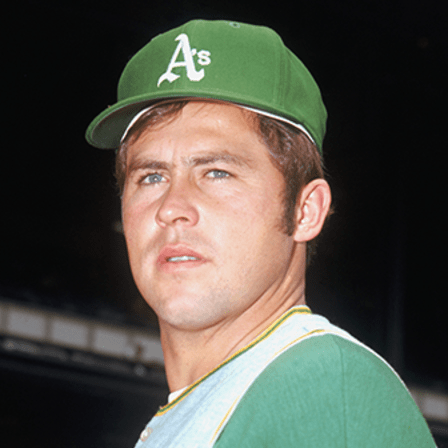
Catfish Hunter was a pitcher who played for the New York Yankees from 1975 to 1979. Career stats: 63-53 record, 3.58 ERA, 492 strikeouts.
Jim "Catfish" Hunter didn't just pitch for the New York Yankees -- he changed the way baseball worked. When an arbitrator declared him a free agent in December 1974 after Oakland A's owner Charlie Finley breached his contract, Hunter became the most sought-after arm in the sport's history. He signed with the Yankees for $3.25 million over five years, and over the next half-decade he helped bring championship baseball back to the Bronx after more than a decade of drought.
Path to the Bronx
Hunter had already won three consecutive World Series with Oakland from 1972 to 1974 and earned the 1974 AL Cy Young Award with a 25-12 record and 2.49 ERA. He was, by any measure, the best pitcher in the American League. Then Finley failed to make a $50,000 annuity payment -- a term written into Hunter's contract -- and arbitrator Peter Seitz voided the deal entirely. Every team in baseball came calling.
The bidding war that followed was unlike anything the sport had seen. Twenty-three of the 24 major league clubs made offers. George Steinbrenner and the Yankees won out with a five-year package that made Hunter the highest-paid pitcher in history. He signed on New Year's Eve 1974, and the free agency era had officially begun.
Yankees Career
Hunter's first season in pinstripes was his best in New York. In 1975, he went 23-14 with a 2.58 ERA, tying Jim Palmer for the AL lead in wins while topping the league in complete games (30) and innings pitched (328). He started the All-Star Game and finished second in Cy Young voting. The Yankees didn't reach the postseason that year, but Hunter's arrival signaled to the rest of the league that the franchise was serious about competing again.
In 1976, Hunter went 17-15 with a 3.53 ERA as the Yankees won their first pennant since 1964. His arm, however, was already showing signs of wear. He'd thrown over 300 innings in each of the previous three seasons, and the mileage was catching up. By 1977, shoulder trouble limited him to 143 innings and a 9-9 record with a 4.71 ERA -- the worst of his career to that point.
| NYY Record | 63-53 |
| NYY ERA | 3.58 |
| NYY Innings | 993 |
| World Series Titles (NYY) | 2 (1977, 1978) |
| Career Record (Overall) | 224-166 |
| Hall of Fame | Inducted 1987 |
Hunter fought his way back in 1978, spending time on the disabled list before posting a 6-0 record in August and contributing down the stretch as the Yankees rallied from 14 games back to catch the Red Sox. He pitched in the World Series that October, helping the club repeat as champions. Diabetes forced his retirement after the 1979 season at just 33 years old. He'd won 224 games, five World Series rings, and started a revolution that reshaped professional sports.
Key Moments
Baseball's First Modern Free Agent
Arbitrator Peter Seitz declares Hunter a free agent after A's owner Charlie Finley breaches his contract. Twenty-three teams bid for his services.
Signs with the Yankees
Hunter agrees to a five-year, $3.25 million deal with New York -- the richest contract in baseball history at the time.
23-Win Season
Goes 23-14 with a 2.58 ERA, 30 complete games, and 328 innings pitched in his first year as a Yankee.
First World Series Title in New York
The Yankees beat the Dodgers in six games for the franchise's first championship since 1962. Hunter starts Game 2 and earns the win.
Back-to-Back Championships
The Yankees defeat the Dodgers again, winning the World Series in six games. Hunter contributes out of the bullpen during the postseason run.
The Pioneer
Hunter's impact on baseball extended far beyond his pitching line. His free agency case didn't just change the Yankees -- it changed every team, every contract negotiation, and every player's understanding of their own market value. Reggie Jackson, who'd follow Hunter to the Bronx two years later, once said that Catfish opened the door for everyone who came after him.
The sun don't shine on the same dog's tail all the time. But I tell you, it sure shined on me when I was in New York.
On the mound, Hunter was a control artist who worked fast and attacked hitters with precision rather than power. He walked fewer than two batters per nine innings for his career, trusted his defense, and rarely wasted pitches. In an era of flamethrowers, he won with smarts.
Frequently Asked Questions
How did Catfish Hunter become a free agent?
A's owner Charlie Finley failed to make a $50,000 annuity payment that was written into Hunter's contract. Arbitrator Peter Seitz ruled that the breach voided the contract entirely, making Hunter a free agent in December 1974. It was the first major free agency case in modern baseball history and set the stage for the broader free agency era that followed.
What was Catfish Hunter's record with the Yankees?
Hunter went 63-53 with a 3.58 ERA in 993 innings over five seasons (1975-1979) with the Yankees. His best year was 1975, when he posted a 23-14 record with a 2.58 ERA and led the AL in complete games (30) and innings pitched (328).
How many World Series did Catfish Hunter win?
Hunter won five World Series championships -- three with Oakland (1972, 1973, 1974) and two with the Yankees (1977, 1978). He posted a 5-3 record with a 3.29 ERA in World Series play across his career.
When was Catfish Hunter inducted into the Hall of Fame?
Hunter was inducted into the National Baseball Hall of Fame in 1987, receiving 76.3% of the vote from the Baseball Writers' Association of America. He finished his career with a 224-166 record and a 3.26 ERA over 15 seasons.
Catfish Hunter pitched only five seasons in the Bronx, but the ripple effects of his arrival reshaped the franchise and the sport. He helped the Yankees win two championships, proved that free agency could work for players and teams alike, and did it all with a quiet confidence that belied the magnitude of what he'd started.