
Career Stats
Regular Season
| Year | G | AB | R | H | 2B | 3B | HR | RBI | BB | SO | SB | AVG | OBP | SLG | OPS |
|---|---|---|---|---|---|---|---|---|---|---|---|---|---|---|---|
| 1905 | 152 | 570 | 83 | 173 | 16 | 4 | 4 | 33 | 45 | 13 | 14 | .304 | .360 | .367 | .727 |
| 1906 | 152 | 596 | 98 | 180 | 7 | 4 | 2 | 33 | 40 | 4 | 23 | .302 | .351 | .337 | .688 |
| 1907 | 110 | 436 | 51 | 101 | 6 | 2 | 0 | 16 | 16 | 7 | 7 | .232 | .264 | .255 | .519 |
| 1908 | 91 | 323 | 38 | 85 | 3 | 1 | 1 | 15 | 28 | 8 | 14 | .263 | .331 | .288 | .619 |
| 1909 | 104 | 381 | 45 | 101 | 7 | 5 | 1 | 27 | 23 | 5 | 11 | .265 | .321 | .318 | .639 |
| Career | 888 | 3376 | 492 | 990 | 67 | 32 | 10 | 196 | 223 | 59 | 116 | .293 | .337 | .341 | .678 |
Career-best seasons highlighted in gold. Stats via Retrosheet.
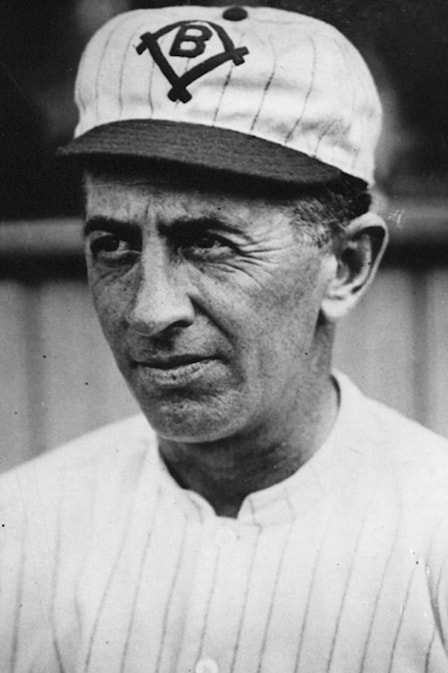
Willie Keeler was a right fielder who played for the New York Yankees from 1903 to 1909. Career stats: .293 batting average, 10 home runs, 196 RBI.
The New York Highlanders paid Willie Keeler $10,000 for the 1903 season, making him professional baseball's first $10,000-a-year player. He stood 5-foot-4, weighed 140 pounds (generously), and swung a 30-inch bat that a bat boy could've mistaken for a fungo. He was also, by then, already a Hall of Famer in everything but the plaque.
Keeler built his legend in Baltimore and Brooklyn before the American League's new New York club ever signed a check. He batted .424 in 1897, still the highest single-season average by a left-handed hitter in the sport's history. He set a hitting streak record that lasted 44 years, until a fellow Yankee finally beat it. And he left behind the single most quoted piece of hitting advice in the game: keep your eye clear, and hit 'em where they ain't.
From Brooklyn Sandlots to the Big Four
William Henry Keeler was born in Brooklyn on March 3, 1872, and broke into pro ball in 1892 with Binghamton of the Eastern League for $90 a month. The New York Giants bought his contract that fall -- he debuted at the Polo Grounds on September 30, 1892, an infield single and two stolen bases off future Hall of Famer Tim Keefe. He was twenty years old and already showing the two skills that would define him: he could put the bat on the ball, and he could run.
A broken leg got him sold to Brooklyn in 1893. Then, on January 1, 1894, Brooklyn traded him to the Baltimore Orioles, and everything changed. Manager Ned Hanlon built a dynasty around "scientific baseball" -- the bunt, the hit-and-run, the squeeze -- and Keeler became its purest practitioner, working alongside John McGraw, Hughie Jennings, and Joe Kelley in a foursome the papers called the Big Four. Keeler and McGraw, with an assist from groundskeeper Tom Murphy's rock-hard infield dirt (baked deliberately hard, not by accident), perfected the "Baltimore Chop": pound the ball straight down, watch it leap over the pitcher's head, and beat the throw before the second bounce.
The Orioles won three straight National League pennants from 1894 to 1896. Keeler hit .371, .377, and .386 across those years, and then, in 1897, he had the best season anyone with his build has ever had.
The .424 Season and the Streak
Keeler's 1897 line still doesn't look real: .424, a batting title by 34 points, 239 hits in 129 games. No left-handed hitter has topped that average since. He opened the year on a tear that became a 44-game hitting streak, a modern-era record that stood until July 2, 1941, when Joe DiMaggio hit a two-run homer at Yankee Stadium to push his own streak past it on the way to 56. Forty-four years is a long time for a record to sit unbothered, and it took a Yankee -- in a Yankee ballpark -- to finally take it down.
Keeler wasn't done setting marks nobody would touch for a century. From 1894 through 1901, he collected 200 or more hits in eight consecutive seasons, a record that stood alone until Ichiro Suzuki tied it in 2008 and broke it the year after. Along the way, a Brooklyn Eagle writer named Abe Yager asked him to explain his approach at the plate, and Keeler gave the answer that outlived every one of his records: "Keep your eye clear and hit 'em where they ain't; that's all."
He followed Hanlon to the Brooklyn Superbas in 1899 when the National League folded Baltimore's franchise, and won two more pennants there. By the time the American League came calling in 1903, Keeler had already played on five pennant winners across two boroughs. He wasn't a prospect. He was a finished, famous product (a 31-year-old one, no less) -- which is exactly why the fledgling Highlanders were willing to pay what nobody else in baseball had ever been paid.
| Highlanders/Yankees Years | 1903-1909 |
| Highlanders Games | 888 |
| Highlanders Hits | 990 |
| Highlanders Batting Average | .293 |
| Career Batting Average | .341 |
| Career Hits | 2,932 (3rd all-time at retirement) |
| Career OPS | .802 (.388 OBP / .415 SLG) |
| 44-Game Hitting Streak | 1897 -- MLB record for 44 years, broken by DiMaggio in 1941 |
| Hall of Fame | Inducted 1939 (75.55% of vote) |
Seven Years in New York
Keeler signed with the Highlanders for the club's inaugural 1903 season, part of Ban Johnson's raid on National League talent as the American League muscled into Manhattan. He batted second in the franchise's very first game and hit .313 that year, the best average on the roster. He was 31 years old, already past his prime by Baltimore standards, and still better than almost everyone he played next to.
His finest Highlanders season came in 1904, when he hit .343 and finished runner-up to Cleveland's Nap Lajoie for the American League batting title -- as close as Keeler ever came to leading the league in pinstripes. That was also the year Jack Chesbro won 41 games and New York nearly won the pennant, only to lose it on Chesbro's final-day wild pitch. Keeler kept hitting through the near-miss and the years after it, carrying a thin Highlanders lineup almost single-handedly in 1905, back when $10,000 a year meant you were expected to.
By 1906 the legs were going. He played a career-high 152 games that year, but 1907 brought the first sub-.300 season of his entire career -- the body had finally caught up with the man who'd always outsmarted it. Clark Griffith resigned as manager in June 1908, and Keeler, now the graybeard of a collapsing roster, was named team captain. He held the job through the 1909 season, playing hurt on a charley horse and a severed foot tendon, still bunting his way on base because that was one skill age couldn't touch.
New York released him in February 1910. He signed with the crosstown Giants that May, reuniting with his old Baltimore double-play partner John McGraw for one last 19-game season before he retired for good.
Keep your eye clear and hit 'em where they ain't; that's all.
Cooperstown Comes Late
Keeler died in Brooklyn on January 1, 1923, of chronic endocarditis, a heart condition he'd fought for years. He never saw Yankee Stadium, which opened the same year he died, and he never saw the dynasty his old franchise became. The Hall of Fame elected him in 1939, sixteen years too late for him to know about it, with 75.55 percent of the writers' vote -- part of the induction class on hand for Cooperstown's formal dedication that June.
Born in Brooklyn
William Henry Keeler is born in Brooklyn, NY.
.424 Average and a 44-Game Streak
Keeler bats .424 for Baltimore, still the highest average by a left-handed hitter in MLB history, and sets a 44-game hitting streak that stands as the record for 44 years.
Signs with the Highlanders
Keeler joins New York's new American League franchise for a reported $11,000, becoming baseball's first $10,000-a-year player, and bats .313 in the club's first season.
Runner-Up for the Batting Title
Keeler hits .343, his best season in New York, finishing second to Nap Lajoie for the AL batting crown.
Named Team Captain
Keeler becomes the Highlanders' captain, playing through injury as the club's last link to its 1903 founding.
Hall of Fame Induction
Keeler is elected to Cooperstown with 75.55% of the vote, sixteen years after his death.
Frequently Asked Questions
Why was Willie Keeler called 'Wee Willie'?
The nickname came from his size -- Keeler stood 5-foot-4 and weighed 140 pounds, making him one of the smallest players in major-league history. He offset it with a 30-inch, 29-ounce bat and some of the best bat control the game has ever seen.
What does 'hit 'em where they ain't' mean and who said it first?
It was Keeler's own explanation of his hitting philosophy, given to Brooklyn Eagle writer Abe Yager: "Keep your eye clear and hit 'em where they ain't; that's all." It meant placing the ball where fielders weren't standing, rather than trying to overpower them.
Did Willie Keeler play for the Yankees?
Yes, though the franchise was still called the Highlanders during his tenure. Keeler played for New York's American League club from 1903 to 1909, serving as team captain in his final two seasons before the club adopted the Yankees name in 1913.
What was Willie Keeler's hitting streak before Joe DiMaggio broke it?
Keeler hit safely in 44 consecutive games for Baltimore in 1897, a record that stood for 44 years until DiMaggio tied it on July 1, 1941, then passed it with a home run the next day at Yankee Stadium on his way to 56 straight.
Is Willie Keeler in the Baseball Hall of Fame?
Yes. Keeler was elected in 1939 with 75.55% of the vote, part of the class on hand for the Hall's formal dedication in Cooperstown that June. He'd died in 1923, sixteen years before his induction.
He never lived to see the interlocking NY become the most recognized logo in sports. He didn't need to. Keeler had already proven you didn't need size, power, or a hard swing to make the record book -- just a clear eye, a short bat, and a knack for finding the one spot on the field nobody else was standing in.