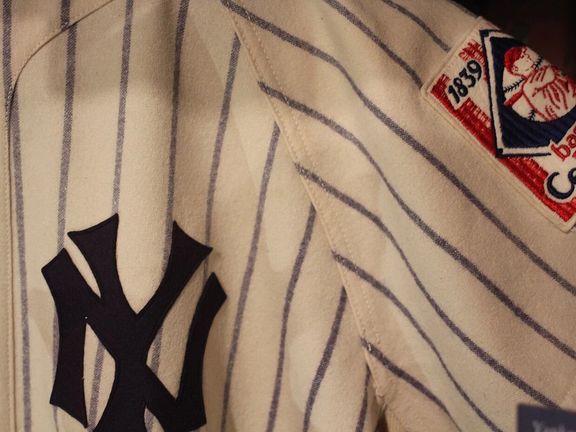
July 4, 1939. A Friday afternoon at Yankee Stadium. 61,808 people packed the old triple-deck, and most of them were already crying before Lou Gehrig reached the microphone. The Iron Horse stood at home plate, flanked by the 1927 squad on one side and the current roster on the other, and told a stadium full of people he was the luckiest man on the face of the earth. He was dying. Everybody in the building knew it. And somehow the 1939 New York Yankees still won 106 games, swept the World Series, and captured their fourth straight championship -- a feat they'd surpass a decade later with five straight.
The Iron Horse Steps Down
The end came quietly, in a visiting clubhouse in Detroit. On May 2, Gehrig walked into manager Joe McCarthy's office at Briggs Stadium and told him to write someone else's name on the lineup card. The streak -- 2,130 consecutive games, a monument of stubbornness and physical will that had run since June 2, 1925 -- was over. Gehrig had batted .143 through eight games. He couldn't turn on a fastball. He couldn't field routine grounders without stumbling.
McCarthy didn't argue. He wrote Babe Dahlgren's name at first base and penciled Gehrig in as the captain. When the lineup was announced, the crowd at Briggs Stadium gave Gehrig a standing ovation -- a visiting player, in an opposing park, getting two minutes of applause for sitting down. That should tell you everything about what the man meant to baseball.
On June 19 -- his 36th birthday -- the Mayo Clinic confirmed what the trembling hands and failing legs had already suggested. Amyotrophic lateral sclerosis. The doctors gave him two years. He had less.
July 4, 1939
The Yankees declared it Lou Gehrig Appreciation Day, and members of the '27 team came back -- including Babe Ruth, who hadn't spoken to Gehrig in years. The rift had been personal, petty, the kind of grudge that embarrasses everyone involved. But Ruth walked straight to Gehrig at home plate, threw his arm around him, and whispered something nobody else could hear. The crowd roared. The photographers got the shot. And for one afternoon, the two greatest Yankees of the first generation stood together again.
Then Gehrig spoke. No notes. Two minutes that became the most famous speech in the history of American sports. He thanked the groundskeepers. He thanked the writers. He thanked his mother-in-law (and got a laugh). He called himself lucky -- a word so preposterous under the circumstances that it still stops you cold.
The Yankees retired his number 4 that afternoon -- widely recognized as the first retired number in Major League Baseball history. Every number hanging from every rafter in every ballpark in America traces back to that ceremony at the Stadium.
The Season Without Lou
What the 1939 club did after losing Gehrig shouldn't have been possible. It was, because Joe DiMaggio played the best baseball of his life, and because McCarthy had assembled a roster so deep it could absorb the unthinkable.
DiMaggio hit .381 -- his career high -- with 30 home runs and 126 RBI in just 120 games. He struck out only 20 times in 462 at-bats, a ratio that still looks like a typo. The Baseball Writers gave him his first MVP award, and for once nobody argued. Bill Dickey hit .302 with 24 home runs and 105 RBI behind the plate. Joe Gordon -- only his second full season -- clubbed 28 home runs and drove in 111 from second base. Red Rolfe led the American League in hits (213) and runs scored (139) while hitting .329. And rookie Charlie Keller, a 22-year-old outfielder from Middletown, Maryland, batted .334 and showed the kind of raw power that earned him the nickname "King Kong."
The pitching staff didn't flinch. Red Ruffing went 21-7 with a 2.93 ERA and 22 complete games. Rookie Atley Donald went 13-3, pitching with the nerve of a ten-year veteran. The team ERA sat at 3.31, and the rotation collectively treated the fifth inning like a personal insult.
The Yankees won the pennant by 17 games over the Red Sox. They batted .287 as a team and scored 967 runs. McCarthy managed the grief and the lineup with the same stoic efficiency, never letting the emotional weight of Gehrig's absence become an excuse for anything short of excellence.
| Record | 106-45 (.702) |
| Runs Scored | 967 |
| Team BA | .287 |
| Team ERA | 3.31 |
| DiMaggio | .381 / 30 HR / 126 RBI (MVP) |
| Dickey | .302 / 24 HR / 105 RBI |
| Ruffing | 21-7, 2.93 ERA, 22 CG |
October
The World Series against the Cincinnati Reds lasted four games, but it was tighter than the sweep suggests. In the opener, Ruffing and Paul Derringer locked into a pitching duel that stayed 1-1 into the bottom of the ninth, when Dickey singled home the winning run for a 2-1 Yankee victory. Game 2 belonged to Monte Pearson, who carried a no-hitter deep into the game before Ernie Lombardi broke it up with a single. Pearson settled for a two-hit, 4-0 shutout, which isn't a bad consolation.
Game 3 was Keller's show. He hit two home runs, drove in four, and looked like a 10-year veteran rather than a kid in his first October. The Yankees won 7-3. Game 4 became one of the stranger endings in World Series history: tied 4-4 in the tenth, Keller stood on third when DiMaggio singled to right. Right fielder Ival Goodman misplayed the ball, and Keller barreled home. The throw arrived at the same time he did -- the collision knocked Lombardi down at the plate, and the ball rolled away. DiMaggio, never one to miss an opportunity, circled the bases and slid in behind Keller while Lombardi lay dazed in the dirt. The press dubbed it "Schnozz's Snooze" -- a cruel nickname for a catcher who'd just been steamrolled by a freight train in a baseball uniform.
Keller finished the Series hitting .438 with 3 home runs and 6 RBI. There was no official MVP award yet (that didn't start until 1955), but if there had been, it was his.
Key Moments
Gehrig Benches Himself
In Detroit, Gehrig tells McCarthy to take him out of the lineup. The 2,130-game consecutive streak -- the standard for durability in American professional sports -- ends quietly in a visiting clubhouse.
ALS Diagnosis
On his 36th birthday, the Mayo Clinic confirms Gehrig has amyotrophic lateral sclerosis. The disease will bear his name.
Lou Gehrig Appreciation Day
61,808 fans at Yankee Stadium. Gehrig delivers the "luckiest man" speech. Ruth and Gehrig embrace. Number 4 is retired -- widely recognized as the first retired number in MLB history.
World Series Sweep
The Yankees sweep Cincinnati in four games for their fourth consecutive championship. Keller hits .438 with 3 home runs.
Today I consider myself the luckiest man on the face of the earth.
I told him it took some guts to do what he just did. It took more guts than anything he'd ever done on a ballfield.
Frequently Asked Questions
What was the Yankees' record in 1939?
The 1939 Yankees went 106-45 in the regular season (.702 winning percentage) and swept the Cincinnati Reds in four games in the World Series. They won the American League pennant by 17 games over the Boston Red Sox and captured their fourth consecutive World Series title -- a streak that ran from 1936 to 1939 and one they'd top with five straight from 1949 to 1953.
When did Lou Gehrig play his last game?
Gehrig's final game was April 30, 1939, against the Washington Senators. He went 0-for-4. Two days later, on May 2 in Detroit, he told manager Joe McCarthy to take him out of the lineup, ending his streak of 2,130 consecutive games. He never played again.
What was Lou Gehrig's 'Luckiest Man' speech?
On July 4, 1939 -- Lou Gehrig Appreciation Day at Yankee Stadium -- Gehrig addressed a crowd of 61,808 fans with a brief, unscripted speech in which he called himself "the luckiest man on the face of the earth" despite having been diagnosed with ALS just two weeks earlier. The speech lasted roughly two minutes and is widely considered the most famous address in American sports history.
Who won the 1939 World Series MVP?
There was no official World Series MVP award in 1939 -- the honor wasn't introduced until 1955. However, rookie outfielder Charlie Keller was the standout performer, batting .438 with 3 home runs and 6 RBI across the four-game sweep of Cincinnati. His Game 3 performance -- two home runs and four RBI -- was the most dominant individual game of the Series.
Season Roster
Position Players (27)
| Player | Pos | G▼ | AVG | HR | RBI | H | R | SB | OBP | SLG | OPS |
|---|---|---|---|---|---|---|---|---|---|---|---|
| Frankie Crosetti | SS | 152 | .233 | 10 | 56 | 153 | 109 | 11 | .315 | .332 | .647 |
| Red Rolfe | 3B | 152 | .329 | 14 | 80 | 213 | 139 | 7 | .404 | .495 | .899 |
| Joe Gordon | 2B | 151 | .284 | 28 | 111 | 161 | 92 | 11 | .370 | .506 | .876 |
| Babe Dahlgren | 1B | 144 | .235 | 15 | 89 | 125 | 71 | 2 | .312 | .377 | .689 |
| Bill Dickey | C | 128 | .302 | 24 | 105 | 145 | 98 | 5 | .403 | .513 | .916 |
| George Selkirk | OF | 128 | .306 | 21 | 101 | 128 | 103 | 12 | .452 | .517 | .969 |
| Joe DiMaggio | OF | 120 | .381 | 30 | 126 | 176 | 108 | 3 | .448 | .671 | 1.119 |
| Charlie Keller | OF | 111 | .334 | 11 | 83 | 133 | 87 | 6 | .447 | .500 | .947 |
| Tommy Henrich | OF | 99 | .277 | 9 | 57 | 96 | 64 | 7 | .371 | .429 | .800 |
| Joe Gallagher | OF | 85 | .277 | 11 | 49 | 85 | 49 | 1 | .325 | .459 | .784 |
| Red Ruffing | P | 44 | .307 | 1 | 20 | 35 | 12 | 1 | .347 | .342 | .689 |
| Buddy Rosar | C | 43 | .276 | 0 | 12 | 29 | 18 | 4 | .356 | .343 | .699 |
| Johnny Murphy | P | 38 | .182 | 0 | 1 | 2 | 1 | 0 | .357 | .182 | .539 |
| Jake Powell | OF | 31 | .244 | 1 | 9 | 21 | 12 | 1 | .270 | .349 | .619 |
| Lefty Gomez | P | 26 | .151 | 0 | 4 | 11 | 3 | 0 | .205 | .178 | .383 |
| Bump Hadley | P | 26 | .177 | 0 | 3 | 11 | 3 | 1 | .227 | .210 | .437 |
| Atley Donald | P | 24 | .250 | 0 | 7 | 15 | 7 | 0 | .297 | .300 | .597 |
| Steve Sundra | P | 24 | .265 | 0 | 6 | 13 | 7 | 0 | .308 | .367 | .675 |
| Monte Pearson | P | 22 | .321 | 0 | 7 | 17 | 9 | 0 | .379 | .415 | .794 |
| Oral Hildebrand | P | 21 | .182 | 0 | 5 | 8 | 5 | 0 | .200 | .205 | .405 |
| Marius Russo | P | 21 | .244 | 0 | 9 | 10 | 4 | 0 | .279 | .293 | .572 |
| Spud Chandler | P | 11 | .400 | 0 | 1 | 2 | 2 | 0 | .500 | .600 | 1.100 |
| Lou Gehrig | 1B | 8 | .143 | 0 | 1 | 4 | 2 | 0 | .273 | .143 | .416 |
| Bill Knickerbocker | 2B | 6 | .154 | 0 | 1 | 2 | 2 | 0 | .154 | .231 | .385 |
| Wes Ferrell | P | 3 | .125 | 0 | 1 | 1 | 0 | 0 | .125 | .250 | .375 |
| Arndt Jorgens | C | 3 | .000 | 0 | 0 | 0 | 1 | 0 | .000 | .000 | .000 |
| Marv Breuer | P | 1 | .000 | 0 | 0 | 0 | 0 | 0 | .000 | .000 | .000 |
Pitching Staff (12)
| Pitcher | G▼ | GS | W | L | ERA | IP | SO | BB | SV | WHIP |
|---|---|---|---|---|---|---|---|---|---|---|
| Johnny Murphy | 38 | 0 | 3 | 6 | 4.40 | 61.1 | 30 | 28 | 19 | 1.39 |
| Red Ruffing | 28 | 28 | 21 | 7 | 2.93 | 233.1 | 95 | 75 | 0 | 1.23 |
| Lefty Gomez | 26 | 26 | 12 | 8 | 3.41 | 198.0 | 102 | 84 | 0 | 1.30 |
| Bump Hadley | 26 | 18 | 12 | 6 | 2.98 | 154.0 | 65 | 85 | 2 | 1.41 |
| Atley Donald | 24 | 20 | 13 | 3 | 3.71 | 153.0 | 55 | 60 | 1 | 1.33 |
| Steve Sundra | 24 | 11 | 11 | 1 | 2.76 | 120.2 | 27 | 56 | 0 | 1.38 |
| Monte Pearson | 22 | 20 | 12 | 5 | 4.49 | 146.1 | 76 | 70 | 0 | 1.51 |
| Oral Hildebrand | 21 | 15 | 10 | 4 | 3.06 | 126.2 | 50 | 41 | 2 | 1.13 |
| Marius Russo | 21 | 11 | 8 | 3 | 2.41 | 116.0 | 55 | 41 | 2 | 1.09 |
| Spud Chandler | 11 | 0 | 3 | 0 | 2.84 | 19.0 | 4 | 9 | 0 | 1.84 |
| Wes Ferrell | 3 | 3 | 1 | 2 | 4.66 | 19.1 | 6 | 17 | 0 | 1.60 |
| Marv Breuer | 1 | 0 | 0 | 0 | 9.00 | 1.0 | 0 | 1 | 0 | 3.00 |