
Career Stats
Regular Season
| Year | G | GS | W | L | SV | IP | H | ER | K | BB | ERA | WHIP |
|---|---|---|---|---|---|---|---|---|---|---|---|---|
| 1940 | 34 | 30 | 15 | 12 | 0 | 233.2 | 230 | 91 | 98 | 78 | 3.50 | 1.32 |
| 1941 | 38 | 23 | 15 | 6 | 0 | 185.2 | 177 | 73 | 60 | 54 | 3.54 | 1.24 |
| 1942 | 30 | 24 | 14 | 7 | 0 | 217.0 | 208 | 83 | 94 | 48 | 3.44 | 1.18 |
| 1945 | 21 | 11 | 7 | 3 | 0 | 87.1 | 85 | 28 | 24 | 20 | 2.89 | 1.20 |
| 1946 | 8 | 8 | 5 | 1 | 0 | 61.0 | 37 | 12 | 19 | 23 | 1.77 | 0.98 |
| Career | 637 | 391 | 231 | 124 | 9 | 3418.1 | 3285 | 1369 | 1645 | 1170 | 3.60 | 1.30 |
Career-best seasons highlighted in gold. Stats via Retrosheet.
Postseason
| Year | G | GS | W | L | SV | IP | H | ER | K | BB | ERA | WHIP |
|---|---|---|---|---|---|---|---|---|---|---|---|---|
| 1932 | 2 | -- | 1 | 0 | 0 | 9.0 | -- | -- | -- | -- | 3.00 | -- |
| 1936 | 3 | -- | 0 | 1 | 0 | 14.0 | -- | -- | -- | -- | 4.50 | -- |
| 1937 | 1 | -- | 1 | 0 | 0 | 9.0 | -- | -- | -- | -- | 1.00 | -- |
| 1938 | 2 | -- | 2 | 0 | 0 | 18.0 | -- | -- | -- | -- | 1.50 | -- |
| 1939 | 1 | -- | 1 | 0 | 0 | 9.0 | -- | -- | -- | -- | 1.00 | -- |
| 1941 | 1 | -- | 1 | 0 | 0 | 9.0 | -- | -- | -- | -- | 1.00 | -- |
| 1942 | 4 | -- | 1 | 1 | 0 | 17.2 | -- | -- | -- | -- | 4.08 | -- |
| Career | 14 | 0 | 7 | 2 | 0 | 85.2 | 0 | 0 | 0 | 0 | 0.00 | 0.00 |
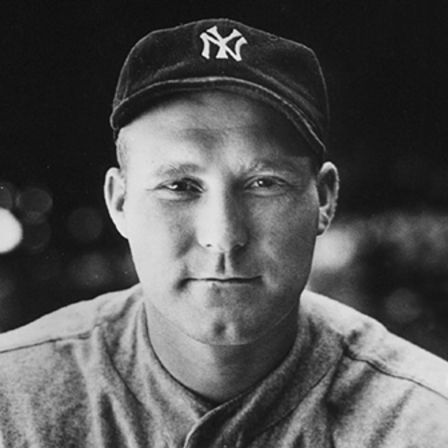
Red Ruffing was a pitcher who played for the New York Yankees in 1930-1942, 1945-1946. Career stats: 231-124 record, 3.60 ERA, 1645 strikeouts.
Red Ruffing lost four toes on his left foot in a mining accident when he was fifteen years old. Then he went out and won 273 major league games for the New York Yankees and others. The determination it took to build a Hall of Fame pitching career while compensating for a mangled foot -- adjusting his balance on the mound, finding ways to field his position, running the bases when called upon -- tells you everything about the kind of man Charles Herbert Ruffing was. He didn't complain. He just figured it out.
Path to the Bronx
Ruffing's early career was a disaster by any statistical measure. The Red Sox signed him out of the coal mining towns of central Illinois, and he pitched six miserable seasons in Boston from 1924 to 1930, compiling a 39-96 record on teams that were among the worst in baseball. He lost 25 games in 1928 and 22 in 1929. His ERA wasn't terrible -- the run support was. Boston gave him nothing to work with, and the losses piled up like winter snow.
Then, on May 6, 1930, the Red Sox traded Ruffing to the Yankees for outfielder Cedric Durst and $50,000. It was the kind of deal that changed a career overnight. Ruffing went from pitching for a laughingstock to pitching for the best franchise in baseball, and the transformation was immediate. In his first full season with the Yankees, he went 16-14. By 1932, he was 18-7. By 1936, he was the ace of a dynasty.
Yankees Career
The 1936 through 1939 Yankees won four consecutive World Series titles, and Ruffing was the workhorse who anchored the rotation through all of it. He won 20 or more games four straight years: 20 in 1936, 20 in 1937, 21 in 1938, and 21 in 1939. The consistency was staggering -- he was giving manager Joe McCarthy 250-plus innings every season, starting every fourth day, and winning at a rate that made the rest of the league jealous.
| NYY Record | 231-124 |
| NYY ERA | 3.47 |
| 20-Win Seasons | 4 consecutive (1936-1939) |
| World Series Record | 7-2 |
| World Series Titles | 6 |
| Hall of Fame | Inducted 1967 |
Ruffing was also one of the best-hitting pitchers in baseball history. He batted .269 for his career with 36 home runs -- numbers that would be respectable for a position player. He was occasionally used as a pinch hitter, which tells you how much managers trusted his bat. In an era before the designated hitter, having a pitcher who could actually hit was a genuine competitive advantage, and Ruffing exploited it fully.
He kept pitching effectively into his late thirties, going 15-6 in 1941 and 14-7 in 1942 before entering military service at age 38. He missed the 1943 and 1944 seasons serving in World War II, returned in 1945 at age 40, and pitched one more season with the Yankees in 1946 before recurring knee injuries led the club to release him. He finished his career with a full season on the White Sox in 1947. His final record with the Yankees: 231-124.
Key Moments
Traded to the Yankees
The Red Sox send Ruffing to New York for Cedric Durst and $50,000. He leaves behind a 39-96 record in Boston and begins the greatest stretch of his career.
Four Straight 20-Win Seasons
Ruffing wins 20 or more games in four consecutive years as the Yankees capture four straight World Series titles. He goes 82-33 during the stretch.
World Series Game 1
Ruffing scatters nine hits but goes the distance to beat the Cubs 3-1 in the opening game of the 1938 World Series, setting the tone for a four-game sweep.
Final Full Season
Goes 14-7 at age 37 before enlisting for military service in World War II. He won't pitch again until 1945.
Hall of Fame
The BBWAA elects Ruffing to the Hall of Fame, recognizing a career that produced 273 wins despite starting 39-96 in Boston.
The Complete Ballplayer
The foot injury shaped everything about Ruffing's career, though he rarely discussed it publicly. He lost the toes in the coal mine as a teenager, before he'd even considered professional baseball. The injury affected his ability to push off the rubber, field bunts, and cover first base -- basic requirements for a major league pitcher. He adapted by developing impeccable mechanics, building upper-body strength to compensate for the compromised base, and simply outworking the limitation.
His hitting deserves its own paragraph. Ruffing's .269 career average included 36 home runs and 273 RBI -- totals that made him one of the most dangerous-hitting pitchers in baseball history. He loved to hit, and opposing managers couldn't afford to pitch around him the way they might dismiss other pitchers in the nine-hole. It gave his lineups a genuine advantage every time he started.
Frequently Asked Questions
How many games did Red Ruffing win with the Yankees?
Ruffing won 231 games as a Yankee over fifteen seasons (1930-1942, 1945-1946), posting a 3.47 ERA. He combined that with his 39 wins in Boston and 3 with the White Sox for a career total of 273 victories.
What happened to Red Ruffing's foot?
Ruffing lost four toes on his left foot in a coal mining accident when he was fifteen years old. He overcame the injury to build a Hall of Fame pitching career, adapting his mechanics to compensate for the compromised foot.
Was Red Ruffing a good hitter?
Yes. Ruffing batted .269 for his career with 36 home runs and 273 RBI, making him one of the best-hitting pitchers in baseball history. He was occasionally used as a pinch hitter due to his ability at the plate.
How many World Series did Red Ruffing win?
Ruffing won six World Series championships with the Yankees: 1932, 1936, 1937, 1938, 1939, and 1941. He posted a 7-2 record with a 2.63 ERA in World Series play.
Red Ruffing walked into the Yankees clubhouse in 1930 as a pitcher with a losing record, a mangled foot, and a reputation as a hard-luck case. He walked out fifteen years later as one of the most successful pitchers in franchise history, with 231 wins, six championship rings, and a legacy built on the kind of toughness that doesn't show up in a box score. The coal mines took his toes. They couldn't take anything else.