Career Stats
Regular Season
| Year | G | AB | R | H | 2B | 3B | HR | RBI | BB | SO | SB | AVG | OBP | SLG | OPS |
|---|---|---|---|---|---|---|---|---|---|---|---|---|---|---|---|
| 1940 | 158 | 628 | 114 | 175 | 32 | 10 | 30 | 103 | 52 | 57 | 18 | .279 | .338 | .505 | .843 |
| 1941 | 160 | 600 | 106 | 164 | 26 | 7 | 24 | 87 | 77 | 83 | 11 | .273 | .360 | .460 | .820 |
| 1942 | 148 | 542 | 90 | 175 | 29 | 4 | 20 | 105 | 79 | 95 | 12 | .323 | .410 | .502 | .912 |
| 1943 | 156 | 557 | 85 | 140 | 31 | 5 | 17 | 70 | 101 | 77 | 4 | .251 | .368 | .417 | .785 |
| 1946 | 115 | 388 | 35 | 81 | 15 | 0 | 11 | 48 | 50 | 73 | 2 | .209 | .305 | .332 | .637 |
| Career | 1024 | 3775 | 613 | 1026 | 192 | 38 | 160 | 634 | 492 | 518 | 72 | .272 | .356 | .470 | .826 |
Career-best seasons highlighted in gold. Stats via Retrosheet.
Postseason
| Year | G | AB | R | H | 2B | 3B | HR | RBI | BB | SO | SB | AVG | OBP | SLG | OPS |
|---|---|---|---|---|---|---|---|---|---|---|---|---|---|---|---|
| 1938 | 4 | 15 | -- | 6 | -- | -- | 1 | 6 | -- | -- | -- | .400 | -- | -- | -- |
| 1939 | 4 | 14 | -- | 2 | -- | -- | 0 | 1 | -- | -- | -- | .143 | -- | -- | -- |
| 1941 | 5 | 14 | -- | 7 | -- | -- | 1 | 5 | -- | -- | -- | .500 | -- | -- | -- |
| 1942 | 5 | 21 | -- | 2 | -- | -- | 0 | 0 | -- | -- | -- | .095 | -- | -- | -- |
| 1943 | 5 | 17 | -- | 4 | -- | -- | 1 | 2 | -- | -- | -- | .235 | -- | -- | -- |
| Career | 23 | 81 | 0 | 21 | 0 | 0 | 3 | 14 | 0 | 0 | 0 | .259 | .259 | .370 | .630 |
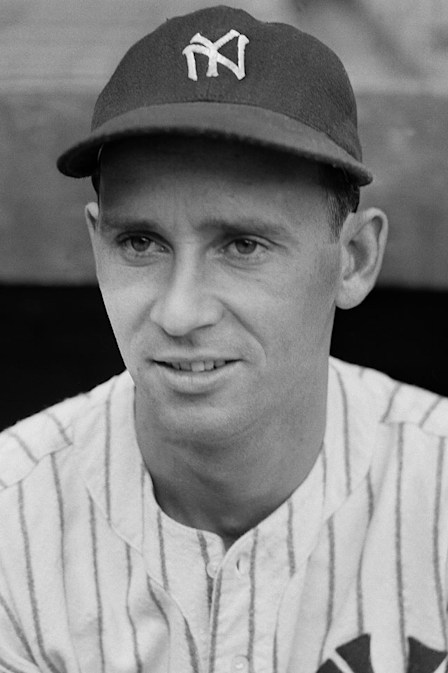
Joe Gordon was a second baseman who played for the New York Yankees in 1938-1943, 1946. Career stats: .272 batting average, 160 home runs, 634 RBI.
New York Yankees second baseman Joe Gordon could do something at that position that nobody had done before him: he could hit 30 home runs. In 1940, the compact, acrobatic infielder from Portland, Oregon, slammed 30 homers while playing a position that was supposed to belong to slick-fielding contact men. He reinvented what a second baseman could be, and he did it while turning double plays with a flair that made the routine look like vaudeville. The Yankees had him for seven seasons -- five of which ended with a World Series appearance. They won four of them.
Path to the Bronx
Gordon played at the University of Oregon before signing with the Yankees organization in 1936. He spent two seasons tearing through the minor leagues -- hitting .280 with power at Newark in the International League -- while Tony Lazzeri held down second base in the Bronx. When Lazzeri's production declined after the 1937 season, the Yankees handed the job to Gordon without hesitation.
The transition was seamless. Gordon stepped into Lazzeri's spot in 1938 and immediately became one of the best players in the American League, hitting .255 with 25 home runs and 97 RBI while playing spectacular defense. The average looked modest, but the power was extraordinary for a middle infielder in the 1930s. Manager Joe McCarthy had found his next star.
Yankees Career
Gordon's peak was short -- the war saw to that -- but it was brilliant. In 1939, he hit .284 with 28 homers as the Yankees won their fourth consecutive World Series. In 1940, the 30-homer season announced him as something the sport hadn't seen before: a middle infielder with genuine power. And in 1942, he won the American League MVP award, hitting .322 with 18 home runs while the Yankees won another pennant.
| NYY Batting Average | .271 |
| NYY Home Runs | 153 |
| NYY RBI | 617 |
| MVP Award | 1942 AL MVP |
| World Series Titles | 4 |
| Hall of Fame | Inducted 2009 |
What the numbers don't capture is how Gordon played the position. He had extraordinary range, soft hands, and a throwing arm that could make plays from deep in the hole that left teammates shaking their heads. He was acrobatic in the field -- he'd go airborne to turn double plays, throwing from his knees or off-balance with an accuracy that defied physics. Bill Dickey once said that Gordon was the greatest all-around infielder he'd ever seen.
Gordon enlisted in the Army Air Corps after the 1943 season, missing the 1944 and 1945 campaigns entirely. When he returned in 1946, the Yankees traded him to the Cleveland Indians for Allie Reynolds -- a deal that worked out spectacularly for both sides. Gordon helped Cleveland win the 1948 World Series, while Reynolds became one of the great pitchers in Yankees history.
Key Moments
Rookie Season
Gordon replaces Tony Lazzeri at second base and hits 25 home runs -- extraordinary power for a middle infielder. The Yankees win their third straight World Series.
30 Home Runs from Second Base
Becomes one of the first second basemen in history to hit 30 home runs in a season, finishing with a .281 average and 103 RBI.
AL MVP
Wins the American League Most Valuable Player award, hitting .322 with 18 homers as the Yankees take the pennant. He beat out Ted Williams, who won the Triple Crown that year.
Final Yankees Season
Hits .249 with 17 home runs before enlisting in the Army Air Corps. He wouldn't play another game in pinstripes.
Hall of Fame at Last
The Veterans Committee elects Gordon to Cooperstown, sixty-three years after his final Yankees game. The long wait finally ends.
The Long Wait
Gordon's Hall of Fame case was a lesson in how the institution's process could fail a deserving player. He retired with numbers that compared favorably to any second baseman of his era -- 253 career home runs, an MVP award, five World Series rings, and defensive brilliance that changed the position. But the BBWAA voters of the 1960s and 1970s didn't give him enough support, and he fell off the ballot.
For decades, Gordon existed in a strange limbo: too good to forget, not famous enough to generate the sustained campaign that might push his case through the Veterans Committee. It took until 2009 -- sixty-three years after his last game as a Yankee -- for the committee to finally elect him. Gordon had died in 1978 and never knew the honor was coming. His daughter accepted the plaque on his behalf.
Frequently Asked Questions
How many World Series did Joe Gordon win with the Yankees?
Gordon won four World Series championships with the Yankees: 1938, 1939, 1941, and 1943. He also appeared in the 1942 Series, which the Yankees lost to the Cardinals. He added a fifth ring with Cleveland in 1948.
Why was Joe Gordon traded from the Yankees?
After missing the 1944 and 1945 seasons due to military service, Gordon returned in 1946 and was traded to the Cleveland Indians for pitcher Allie Reynolds. Both players went on to have significant success with their new teams.
Why did it take so long for Joe Gordon to enter the Hall of Fame?
Gordon fell off the BBWAA ballot before receiving enough votes and had to wait for the Veterans Committee process, which moves slowly and considers many candidates. He wasn't elected until 2009, thirty-one years after his death and sixty-three years after his last Yankees season.
Did Joe Gordon really beat Ted Williams for MVP?
Yes. In 1942, Gordon won the AL MVP over Williams despite Williams winning the Triple Crown. The writers gave Gordon the nod because the Yankees won the pennant while the Red Sox finished nine games back.
Joe Gordon changed what it meant to play second base. Before him, the position belonged to contact hitters and smooth glovemen. After him, teams started looking for infielders who could do everything -- hit for power, field with brilliance, and carry a lineup. He didn't get his due in time to know about it, but the plaque in Cooperstown says what his teammates always knew: Joe Gordon was one of the best to ever play the game.