Career Stats
Regular Season
| Year | G | GS | W | L | SV | IP | H | ER | K | BB | ERA | WHIP |
|---|---|---|---|---|---|---|---|---|---|---|---|---|
| 1965 | 36 | 32 | 12 | 14 | 0 | 212.0 | 185 | 80 | 179 | 105 | 3.40 | 1.37 |
| 1966 | 32 | 30 | 10 | 11 | 0 | 212.2 | 192 | 83 | 161 | 88 | 3.51 | 1.32 |
| 1967 | 32 | 28 | 14 | 10 | 0 | 201.2 | 158 | 59 | 171 | 61 | 2.63 | 1.09 |
| 1968 | 15 | 12 | 3 | 3 | 0 | 61.1 | 54 | 24 | 40 | 20 | 3.52 | 1.21 |
| 1969 | 30 | 15 | 7 | 5 | 0 | 130.2 | 117 | 49 | 85 | 49 | 3.38 | 1.27 |
| Career | 216 | 175 | 72 | 57 | 2 | 1264.0 | 1036 | 452 | 1053 | 539 | 3.22 | 1.25 |
Career-best seasons highlighted in gold. Stats via Retrosheet.
Postseason
| Year | G | GS | W | L | SV | IP | H | ER | K | BB | ERA | WHIP |
|---|---|---|---|---|---|---|---|---|---|---|---|---|
| 1963 | 1 | -- | 0 | 1 | 0 | 5.0 | -- | -- | -- | -- | 5.40 | -- |
| 1964 | 3 | -- | 0 | 1 | 0 | 7.2 | -- | -- | -- | -- | 8.22 | -- |
| Career | 4 | 0 | 0 | 2 | 0 | 12.2 | 0 | 0 | 0 | 0 | 0.00 | 0.00 |
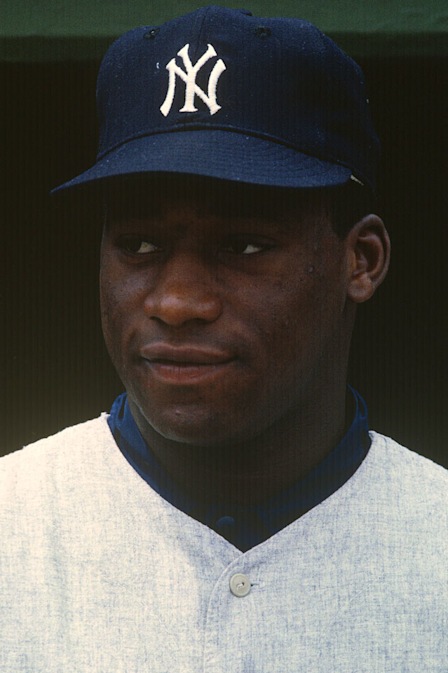
Al Downing was a pitcher who played for the New York Yankees from 1961 to 1969. Career stats: 72-57 record, 3.22 ERA, 1053 strikeouts.
July 19, 1961. Al Downing takes the mound at Yankee Stadium against the Washington Senators, a 20-year-old left-hander out of Trenton with all of six professional starts behind him. He's the first Black pitcher in the history of the New York Yankees -- six years after Elston Howard became the first Black player to wear the pinstripes at all, and a full fourteen years after Jackie Robinson broke the game's color line everywhere else.
Nobody in that ballpark could've told you what Downing would end up best remembered for. It wouldn't happen in New York. It wouldn't happen for another thirteen years. And when it finally did happen, on an April night in Atlanta in 1974, it would overshadow a Yankees career that deserved better than a footnote.
The Kid the Phillies Passed On
Downing grew up in Trenton, one of eight children, and lost his mother in a car accident when he was seven. He found his way into organized ball through a Police Athletic League program in fifth grade and kept getting better from there, pitching for Trenton Central High School into a legend nobody outside New Jersey had heard of yet.
Bill Yancey had heard of him. Yancey was a former Negro Leagues shortstop turned scout, and he caught Downing throwing at a Trenton-area high school all-star game in the spring of 1959. The Phillies had already looked and passed -- their scouts decided Downing was too short (a scouting report that aged about as well as most scouting reports do). Yancey didn't agree, and he had a card to play: when the Yankees offered to make him the organization's first Black scout, he said yes on one condition. They had to sign Downing.
They did, for a reported $15,000 bonus. It's a hell of a story on its own -- a Negro Leagues veteran using his own hiring as trade bait for a kid the Phillies didn't want -- and it's the story that put a Black pitcher on the Yankees mound for the first time in franchise history two years later.
Arriving, Then Actually Arriving
The first two years were nothing -- 5 games and one start in 1961, a single mop-up inning in 1962, most of the development happening far from the Bronx. Then 1963 came, and Downing suddenly looked like the pitcher Yancey had promised: 13-5, a 2.56 ERA, a real rotation spot on a Yankees team that ran away with the pennant at 104-57.
October brought the Dodgers, and October brought a gut punch. Downing started Game 2 of the 1963 World Series on October 3 at Yankee Stadium, opposite Johnny Podres. He struck out six. He also lost, 4-1 -- Willie Davis doubled in two runs in the first, Bill Skowron (a Yankee for nine years before LA) took him deep in the fourth, and the Dodgers were on their way to a sweep that ended the Yankees' season in four straight games. Not the welcome a 21-year-old ace-in-waiting was hoping for.
1964 is the year that made him. Downing went 13-8 with a 3.47 ERA and led the American League with 217 strikeouts, breaking Whitey Ford's own Yankees record in the process. It stood as the franchise mark for fourteen years, until Ron Guidry blew past it with 248 in 1978. The Yankees won 99 games and their fifth straight pennant, and this time Downing got three cracks at the World Series instead of one.
None of them ended well, but he earned every appearance. In the 1964 World Series, he relieved Ford in the sixth inning of Game 1 -- Ford took the loss in a 9-5 blowout, not Downing, who threw 1.2 scoreless innings after the damage was already done. Four days later he got the ball himself for Game 4 and was nearly perfect, taking a 3-0 lead into the sixth. Ken Boyer, who'd already struck out on a Downing changeup back in Game 1, got the bases loaded and a pitch up in his eyes -- exactly where a hitter wants it -- and drove it out for a grand slam. 4-3 Cardinals, series tied. Downing came back one more time in Game 7 and couldn't get an out, and St. Louis closed it out behind Bob Gibson. The dynasty that had run the American League since Mickey Mantle and Ford first teamed up in the '50s had just played its last game as a dynasty, and nobody in that Busch Stadium crowd knew it yet.
| Yankees Record | 72-57, 3.23 ERA |
| Innings Pitched | 1,235.1 |
| Strikeouts | 1,028 |
| Peak Season | 1964: led AL with 217 K |
| Best ERA Season | 1963: 13-5, 2.56 ERA |
| All-Star Selections | 1 (1967) |
| World Series Appearances | 4 games (1963, 1964 x3) |
The Lean Years, and One Great Season Inside Them
The Yankees collapsed fast after 1964 -- last place by 1966 -- and Downing's own numbers sagged with the team's (12-14 in 1965, 10-11 in 1966, both years with an ERA that stayed respectable even as the wins didn't come). Then, in the middle of that stretch of nothing, he had the best year of his Yankees career.
1967: 14-10, a 2.63 ERA, and his only All-Star selection, two innings of work in a 15-inning marathon at Anaheim Stadium that the National League finally won on a Tony Perez homer. The signature moment came that August, on the road in Cleveland. Downing struck out the side on nine pitches in the second inning -- Tony Horton, Don Demeter, Duke Sims, gone in order -- the first immaculate inning thrown in the majors since Sandy Koufax did it in 1964, and the first one in Yankees franchise history. He finished the game, a 5-3 win, like it was nothing unusual.
It was the high point of a career that was about to run into real trouble.
Yankees and MLB Debut
Downing takes the mound against the Washington Senators, becoming the first Black pitcher in Yankees history -- six years after Elston Howard broke the franchise's color line as a position player.
World Series Game 2 Start
Downing starts and loses Game 2 of the 1963 World Series, 4-1, to Johnny Podres and the Dodgers, who complete a four-game sweep of the Yankees.
Breaks the Yankees Strikeout Record
Downing goes 13-8 and leads the American League with 217 strikeouts, breaking Whitey Ford's franchise mark -- a record that stands until Ron Guidry's 248 in 1978.
Throws an Immaculate Inning
Downing strikes out the side on nine pitches against the Indians in Cleveland -- the first immaculate inning in the majors since 1964 and the first in Yankees history -- during his lone All-Star season.
Traded to the Oakland Athletics
The Yankees send Downing and catcher Frank Fernandez to Oakland for Danny Cater and Ossie Chavarria, ending a nine-year Yankees tenure.
The Arm Gives Out, and New York Lets Go
An undiagnosed torn ligament in his elbow wrecked 1968 -- just 15 games, 61.1 innings, a 3-3 record buried under a season that was really about survival, not stats. He spent stretches of it back in the minors trying to rebuild what the injury had taken.
1969 was stranger still. Downing held out in a contract dispute that spring and opened the year all the way down at Triple-A Syracuse before New York called him back up in late April. Ralph Houk used him as a swingman the rest of the way -- fifteen starts, fifteen relief outings, 130.2 innings of a pitcher trying to find his old fastball in whatever role he was handed. He scuffled through the middle of the summer before pitching himself back into form down the stretch. It wasn't enough to convince the front office he still had it in New York.
On December 5, 1969, the Yankees traded Downing and catcher Frank Fernandez to the Oakland Athletics for first baseman Danny Cater and Ossie Chavarria. Nine years, 72 wins, 1,028 strikeouts, one franchise record, one All-Star nod -- gone as part of a deal general manager Lee MacPhail made to add right-handed power. It happens to a lot of pitchers on the wrong side of an arm injury. It still stung for a guy who'd broken Whitey Ford's own record five years earlier.
What Came After (Briefly)
Downing bounced from Oakland to Milwaukee to Los Angeles, and it was with the Dodgers that his career found its second wind -- the 1971 National League Comeback Player of the Year, a decade removed from that debut in the Bronx. He pitched until 1977 and finished 123-107 with a 3.22 ERA across seventeen big-league seasons.
Then came April 8, 1974, at Atlanta-Fulton County Stadium, in front of 53,775 people. Hank Aaron drove a Downing pitch over the left-field wall in the fourth inning for career home run number 715, passing Babe Ruth on the all-time list. It's the moment Downing is remembered for by people who never saw him pitch a single game in pinstripes -- which is its own kind of unfair, given what he'd already done in New York before any of that happened. He went on to broadcast Dodgers games through the 1980s and later worked Atlanta Braves and CBS Radio broadcasts (a second career spent describing the sport he'd once been good enough to star in).
Frequently Asked Questions
Was Al Downing the first Black pitcher for the Yankees?
Yes. Downing debuted on July 19, 1961, against the Washington Senators, becoming the first Black pitcher in Yankees franchise history -- six years after Elston Howard became the first Black player to appear for the club, in 1955.
What was Al Downing's record with the Yankees?
Downing went 72-57 with a 3.23 ERA over 208 games (175 starts) for the Yankees from 1961-1969, striking out 1,028 batters in 1,235.1 innings. His best season came in 1964, when he led the American League with 217 strikeouts, and his best ERA came in 1963 at 2.56.
Did Al Downing make an All-Star team with the Yankees?
Yes, in 1967 -- his only All-Star selection, and his best overall season in pinstripes at 14-10 with a 2.63 ERA. That August he also threw the first immaculate inning in Yankees history, striking out the side on nine pitches against Cleveland.
Why is Al Downing famous outside of his Yankees career?
Downing is best known for surrendering Hank Aaron's 715th career home run on April 8, 1974, while pitching for the Los Angeles Dodgers -- the home run that broke Babe Ruth's all-time record. That came five years after the Yankees traded him to Oakland in December 1969.
That's the part of the story most people know. The part worth remembering in the Bronx is the kid a rival team's scouts called too short, who broke a Hall of Famer's strikeout record at 23 and struck out the side on nine pitches three years later -- pinstripes on, first of his kind on that mound, doing it before anybody outside Trenton thought to notice.