
Career Stats
Regular Season
| Year | G | AB | R | H | 2B | 3B | HR | RBI | BB | SO | SB | AVG | OBP | SLG | OPS |
|---|---|---|---|---|---|---|---|---|---|---|---|---|---|---|---|
| 1959 | 133 | 479 | 67 | 137 | 25 | 1 | 21 | 71 | 46 | 39 | 1 | .286 | .352 | .474 | .826 |
| 1960 | 122 | 368 | 48 | 102 | 14 | 1 | 16 | 63 | 38 | 24 | 2 | .277 | .346 | .451 | .797 |
| 1961 | 121 | 399 | 63 | 108 | 11 | 0 | 22 | 61 | 37 | 28 | 2 | .271 | .332 | .464 | .796 |
| 1962 | 86 | 232 | 25 | 52 | 8 | 0 | 10 | 35 | 24 | 18 | 0 | .224 | .297 | .388 | .685 |
| 1963 | 64 | 147 | 20 | 43 | 6 | 0 | 8 | 28 | 15 | 17 | 1 | .293 | .360 | .497 | .857 |
| Career | 2140 | 7640 | 1196 | 2177 | 323 | 49 | 367 | 1449 | 715 | 416 | 30 | .285 | .346 | .484 | .830 |
Career-best seasons highlighted in gold. Stats via Retrosheet.
Postseason
| Year | G | AB | R | H | 2B | 3B | HR | RBI | BB | SO | SB | AVG | OBP | SLG | OPS |
|---|---|---|---|---|---|---|---|---|---|---|---|---|---|---|---|
| 1947 | 6 | 19 | -- | 3 | -- | -- | 1 | 2 | -- | -- | -- | .158 | -- | -- | -- |
| 1949 | 4 | 16 | -- | 1 | -- | -- | 0 | 1 | -- | -- | -- | .063 | -- | -- | -- |
| 1950 | 4 | 15 | -- | 3 | -- | -- | 1 | 2 | -- | -- | -- | .200 | -- | -- | -- |
| 1951 | 6 | 23 | -- | 6 | -- | -- | 0 | 0 | -- | -- | -- | .261 | -- | -- | -- |
| 1952 | 7 | 28 | -- | 6 | -- | -- | 2 | 3 | -- | -- | -- | .214 | -- | -- | -- |
| 1953 | 6 | 21 | -- | 9 | -- | -- | 1 | 4 | -- | -- | -- | .429 | -- | -- | -- |
| 1955 | 7 | 24 | -- | 10 | -- | -- | 1 | 2 | -- | -- | -- | .417 | -- | -- | -- |
| 1956 | 7 | 25 | -- | 9 | -- | -- | 3 | 10 | -- | -- | -- | .360 | -- | -- | -- |
| 1957 | 7 | 25 | -- | 8 | -- | -- | 1 | 2 | -- | -- | -- | .320 | -- | -- | -- |
| 1958 | 7 | 27 | -- | 6 | -- | -- | 0 | 2 | -- | -- | -- | .222 | -- | -- | -- |
| 1960 | 7 | 22 | -- | 7 | -- | -- | 1 | 8 | -- | -- | -- | .318 | -- | -- | -- |
| 1961 | 4 | 11 | -- | 3 | -- | -- | 1 | 3 | -- | -- | -- | .273 | -- | -- | -- |
| 1962 | 2 | 2 | -- | 0 | -- | -- | 0 | 0 | -- | -- | -- | .000 | -- | -- | -- |
| 1963 | 1 | 1 | -- | 0 | -- | -- | 0 | 0 | -- | -- | -- | .000 | -- | -- | -- |
| Career | 75 | 259 | 0 | 71 | 0 | 0 | 12 | 39 | 0 | 0 | 0 | .274 | .274 | .413 | .687 |
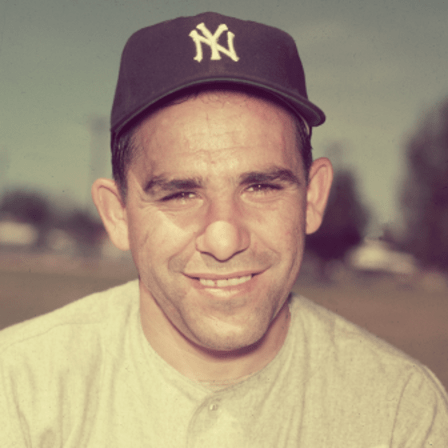
Yogi Berra was a catcher who played for the New York Yankees from 1946 to 1963. Career stats: .285 batting average, 367 home runs, 1449 RBI.
Yogi Berra was the New York Yankees' catcher from 1946 to 1963, a three-time AL MVP, 18-time All-Star, and 10-time World Series champion -- the most decorated winner in the history of American professional sports. The Cardinals could've had him first. They offered his childhood friend Joe Garagiola a $500 signing bonus, looked at Berra -- 5'7", built like a fire hydrant, a kid from The Hill in St. Louis who swung at everything and caught the ball like he was wrestling it -- and offered him less. First no bonus at all, then $250. Berra turned them down both times. The Yankees gave him the $500 bonus he'd wanted plus $90 a month. It might be the worst personnel decision in Cardinals history, and that franchise has made some beauties.
Lawrence Peter Berra became a Yankees legend, won ten World Series rings (more than any player who's ever lived), collected three MVP awards, and turned himself into the most beloved figure in the history of the organization. All because St. Louis wouldn't match the number.
A Gunner at Utah Beach
Before any of that, Berra went to war. He was nineteen years old when the Navy put him on a rocket boat -- a 36-foot LCSS designed to suppress enemy fire during amphibious landings. On June 6, 1944, he was off Utah Beach at Normandy, firing rockets at German positions while men died in the water around him. He rarely talked about it afterward. When reporters asked, he'd change the subject or crack a joke. That was Yogi -- he'd survived D-Day and decided the world didn't need to hear about it from him.
He came home, got called up in September 1946, and went 2-for-4 with a home run off Jesse Flores of the Philadelphia A's in his first game. The career was underway.
Behind the Plate
The early scouting reports weren't kind. Berra was raw behind the plate -- athletic enough, but rough on mechanics, and nobody confused his footwork with ballet. Then Bill Dickey got hold of him. Dickey, the greatest catching instructor the Yankees ever had, rebuilt Berra's receiving from the ground up. "He was the most coachable catcher I ever worked with," Dickey said. The results showed fast.
| Career Batting Average | .285 |
| Home Runs | 358 |
| RBI | 1,430 |
| OPS | .830 |
| World Series Rings | 10 |
| AL MVP Awards | 3 (1951, 1954, 1955) |
| All-Star Selections | 18 (1948-1962) |
| Career WAR | 59.5 |
| Hall of Fame | Inducted 1972 |
What the stat line doesn't tell you is how impossible Berra was to strike out. In 1950, he whiffed only 12 times across 597 at-bats -- a number so absurd it sounds made up. Casey Stengel summed him up best: "He'd fall in a sewer and come up with a gold watch."
He'd fall in a sewer and come up with a gold watch.
October's Catcher
Berra didn't just play in the World Series -- he practically lived there. From 1947 through 1963, he appeared in fourteen Fall Classics. The Yankees won ten of them. He hit the first pinch-hit home run in World Series history in 1947, taking Ralph Branca deep in Game 3 against the Dodgers (Branca would later give up another famous October home run, but that's a different story).
The signature moment came on October 8, 1956. Don Larsen threw the only perfect game in World Series history, and Berra was behind the plate for every pitch. When Dale Mitchell took strike three to end it, Berra sprinted to the mound and leaped into Larsen's arms -- producing a photograph that's become shorthand for pure, unrehearsed joy in sports. Larsen caught him like it was the most natural thing in the world.
Five consecutive titles from 1949 to 1953 -- Berra was the constant, catching every one, while Mantle arrived in '51 and Ford missed two years for the Army. Three MVPs in five years. Eighteen All-Star selections. The man's October resume reads like fiction.
I really didn't say everything I said.
The Firings
Berra's post-playing career with the Yankees reads like a Greek comedy performed by George Steinbrenner. In 1964, the club handed him the manager's job. He guided them to a 99-63 record and a pennant -- then lost the World Series to the Cardinals in seven games. The Yankees fired him the next day. One day after a pennant.
He came back in 1984 to manage again. Steinbrenner fired him sixteen games into the 1985 season, with a 6-10 record. Worse, George didn't even deliver the news himself -- he sent Clyde King. Berra took that personally, and who wouldn't?
What followed was one of the great standoffs in Yankees history. Berra refused to set foot in Yankee Stadium as long as Steinbrenner owned the team. Fourteen years. He didn't attend Old-Timers' Day. He didn't show up for ceremonies. He simply stayed away.
The Apology
On January 5, 1999, Steinbrenner drove to the Yogi Berra Museum in Little Falls, New Jersey, and personally apologized. Not a phone call. Not a letter. George got in the car and went to Yogi. Berra accepted, returned to the Stadium, and the whole thing was over -- just like that. Fourteen years of stubborn silence, resolved by one man swallowing his pride and the other deciding that was enough.
MLB Debut
Goes 2-for-4 with a home run off Jesse Flores of the Philadelphia A's.
First Pinch-Hit HR in World Series History
Takes Ralph Branca deep against the Dodgers -- the first pinch-hit home run in Fall Classic history.
Five Straight Titles
Berra catches every game of five consecutive World Series championships -- a run the sport hasn't seen since.
Larsen's Perfect Game
Catches every pitch of Don Larsen's perfect game in World Series Game 5 against the Dodgers. The leap into Larsen's arms becomes one of baseball's most famous photographs.
Three AL MVP Awards
Wins three MVP awards in five seasons, anchoring the most dominant stretch of Yankees baseball since the Ruth-Gehrig era.
The Reconciliation
Steinbrenner drives to the Yogi Berra Museum in Little Falls, NJ, and personally apologizes. Berra ends his 14-year boycott of Yankee Stadium.
Berra Dies at 90
Berra passes away in West Caldwell, NJ -- 69 years to the day after his major league debut. The Yankees honor him with a No. 8 patch, a Yankee Stadium tribute ceremony, and a funeral eulogy from Joe Torre.
Frequently Asked Questions
How many World Series rings did Yogi Berra win?
Berra won ten World Series championships with the Yankees -- the most by any player in Major League Baseball history. He appeared in fourteen Fall Classics between 1947 and 1963, winning rings in 1947, 1949, 1950, 1951, 1952, 1953, 1956, 1958, 1961, and 1962.
Was Yogi Berra at D-Day?
Yes. Berra served in the Navy as a gunner on a rocket boat (LCSS) during the D-Day invasion at Normandy on June 6, 1944. He fired rockets off Utah Beach to provide cover for troops landing on shore. He rarely spoke publicly about his wartime service.
Why did Yogi Berra boycott Yankee Stadium?
Berra refused to return to Yankee Stadium for fourteen years (1985-1999) after George Steinbrenner fired him as manager sixteen games into 1985 -- his second season at the helm -- and didn't deliver the news personally, sending Clyde King instead. The boycott ended on January 5, 1999, when Steinbrenner drove to Berra's museum in New Jersey and apologized in person.
Did Yogi Berra really say all those famous quotes?
Berra himself addressed this one: "I really didn't say everything I said." People attributed many of the so-called "Yogi-isms" to him over the years without clear sourcing. Some -- like "It ain't over 'til it's over" (said while managing the 1973 Mets, who were 11.5 games back in early July and won the NL pennant) -- are well documented. Others entered the culture and attached themselves to him whether he said them or not.
When was Yogi Berra inducted into the Hall of Fame?
Berra was elected to the Baseball Hall of Fame and inducted on August 7, 1972, part of a class that also included Sandy Koufax and Early Wynn.
When did Yogi Berra die?
Berra died on September 22, 2015, at an assisted-living facility in West Caldwell, New Jersey. He was 90 years old -- exactly 69 years after his major league debut. Read the full story of his death and the tributes that followed.
The Cardinals offered Joe Garagiola $500. They wouldn't do the same for the squat kid who swung at bad pitches. Berra walked, took the Yankees' $500 bonus and $90 a month, took ten rings, took three MVPs, took a rocket boat to Normandy and back, and never once asked anyone to make a fuss about any of it.