
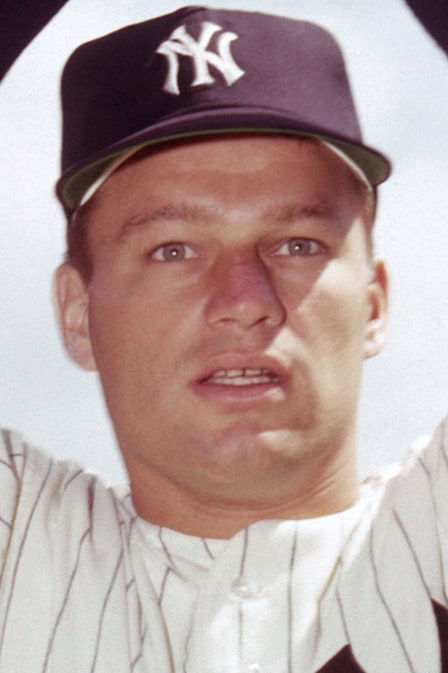
Career Stats
Regular Season
| Year | G | GS | W | L | SV | IP | H | ER | K | BB | ERA | WHIP |
|---|---|---|---|---|---|---|---|---|---|---|---|---|
| 1964 | 38 | 37 | 18 | 13 | 0 | 271.1 | 227 | 91 | 125 | 60 | 3.02 | 1.06 |
| 1965 | 31 | 25 | 4 | 15 | 0 | 151.1 | 158 | 81 | 97 | 60 | 4.82 | 1.44 |
| 1966 | 25 | 19 | 3 | 8 | 1 | 128.1 | 122 | 38 | 71 | 40 | 2.66 | 1.26 |
| 1967 | 17 | 1 | 1 | 0 | 0 | 44.1 | 47 | 23 | 31 | 18 | 4.67 | 1.47 |
| 1968 | 12 | 3 | 1 | 1 | 0 | 44.0 | 49 | 18 | 24 | 9 | 3.68 | 1.32 |
| Career | 203 | 131 | 55 | 51 | 4 | 1023.2 | 920 | 381 | 569 | 335 | 3.35 | 1.23 |
Career-best seasons highlighted in gold. Stats via Retrosheet.
Postseason
| Year | G | GS | W | L | SV | IP | H | ER | K | BB | ERA | WHIP |
|---|---|---|---|---|---|---|---|---|---|---|---|---|
| 1963 | 1 | -- | 0 | 1 | 0 | 7.0 | -- | -- | -- | -- | 1.29 | -- |
| 1964 | 2 | -- | 2 | 0 | 0 | 17.1 | -- | -- | -- | -- | 1.56 | -- |
| Career | 3 | 0 | 2 | 1 | 0 | 24.1 | 0 | 0 | 0 | 0 | 0.00 | 0.00 |
Jim Bouton was a pitcher who played for the New York Yankees from 1962 to 1968. Career stats: 55-51 record, 3.35 ERA, 569 strikeouts.
July 25, 1998. Old-Timers' Day at Yankee Stadium, and a 59-year-old man in an ill-fitting replica jersey walks out onto the grass for the first time since 1970. The crowd doesn't know quite what to do at first. Then it stands up. Jim Bouton, the pitcher the Yankees spent nearly three decades pretending never existed, gets an ovation that lasts longer than some of his old starts.
Nobody in that ballpark needed reminding why he'd been gone. Bouton had written a book. The book had told the truth. And for a franchise that ran on myth-making -- pinstripes, ghosts, the House That Ruth Built -- the truth was the one thing it couldn't forgive.
The Bulldog Arrives
James Alan Bouton grew up partly in New Jersey and partly in the Chicago suburbs, where his father wrote letters to all 16 major-league clubs in the fall of 1958 announcing that his son intended to sign a contract by Thanksgiving -- so clubs had better get their offers in. Yankees scout Art Stewart won the bidding at $30,000. It turned out to be a bargain.
Bouton debuted on April 22, 1962, and went 7-7 with a 4.00 ERA as a rookie on a team that won the World Series without needing much from him (he was reportedly in line for a possible Game 7 start that October before rain reshuffled the schedule and Ralph Terry got the ball instead). He didn't pitch an inning of that Series. He got a locker in a championship clubhouse anyway, and a nickname to go with it -- sportswriter Maury Allen tagged him "Bulldog" for the way he lunged toward the plate on every pitch, hard enough that his cap kept flying off his head. It became his signature almost as fast as his fastball did.
1963-64: The Ace of a Dying Dynasty
Then came the breakout nobody saw coming. In 1963, Bouton went 21-7 with a 2.53 ERA, made the All-Star team, and looked like the next great arm in a rotation that already had Whitey Ford. The Yankees won the pennant easily. Then the Dodgers swept them in the World Series, and Bouton got the Game 3 assignment against Don Drysdale at Dodger Stadium -- the first World Series game ever played there. He pitched well enough to win most days. This wasn't most days. A first-inning single, a wild pitch, another single, and Drysdale made the 1-0 lead stand up on a three-hitter. Bouton took the loss anyway.
1964 was even better in the ways that mattered least and best in the ways that mattered most. He went 18-13 with a 3.02 ERA and led the American League with 37 starts, holding a rotation together while Ford pitched hurt and Ralph Terry broke down completely. The Yankees won a tighter pennant race this time, then met the Cardinals in October, and Bouton delivered the two best starts of his career when the team needed them most.
Game 3 at Yankee Stadium was a scoreless standoff with Curt Simmons that turned into a 1-1 nail-biter, and Bouton was still out there in the bottom of the ninth when Mickey Mantle led off with a home run to win it, 2-1, complete game. Three days later in St. Louis, Game 6: Bouton went 8 1/3 innings, Joe Pepitone hit a grand slam, and the Yankees forced a Game 7 with an 8-3 win. St. Louis took the finale behind Bob Gibson. Nobody in that Yankee Stadium crowd knew it yet, but the dynasty that had run the American League for four decades had just played its last game as a dynasty.
| Yankees Record | 55-51, 3.35 ERA |
| Innings Pitched | 1,023.2 |
| Strikeouts | 569 |
| Peak Season | 1963: 21-7, 2.53 ERA |
| World Series Starts | 3 (1963, 1964 x2) |
| Postseason Record | 2-1, 1.48 ERA |
| All-Star Selections | 1 (1963) |
The Dead Arm
The good years didn't last, and they didn't fade gently. Bouton showed up in 1965 with a sore bicep, pitched through it because that's what you did in 1965, and watched his fastball disappear for good. He finished 4-15 with a 4.82 ERA.
What I had, and I only came to realize it years later, was a dead arm. I didn't have a particular arm injury. I did have pain in my bicep, but it wasn't a sharp pain.
It just stopped working, the way a light bulb doesn't dim so much as it simply goes out.
He spent the next three seasons scrapping for a role, eventually leaning almost entirely on a knuckleball to survive at all. On June 15, 1968, the Yankees sold his contract to the expansion Seattle Pilots for $20,000 -- and kicked in $8,000 of his own 1968 salary to help the deal along, which tells you how eager the front office was to move on. Bouton, the 21-game winner five years earlier, was a $20,000 afterthought heading to a team that didn't exist yet.
Major League Debut
Bouton debuts for the Yankees and goes 7-7 with a 4.00 ERA as a rookie on the World Series champions -- without pitching an inning of that October.
Loses Game 3 of the World Series, 1-0
Bouton pitches well enough to win against Don Drysdale in the first-ever World Series game at Dodger Stadium, but a single run is all L.A. needs in a sweep.
Wins Game 6 to Force Game 7
Bouton goes 8 1/3 innings and Joe Pepitone's grand slam carries an 8-3 win, extending the World Series -- his second win of the Series after Mantle's walk-off carried Game 3.
Sold to the Seattle Pilots
The Yankees sell Bouton's contract for $20,000 and absorb part of his salary to close the deal, ending his pinstriped career at 55-51.
Ball Four Is Published
Bouton's diary of the 1969 season detonates inside baseball's clubhouse culture and gets him frozen out of Yankees alumni events for nearly three decades.
Ball Four
Bouton spent 1969 with the Pilots and, briefly, the Houston Astros, keeping a diary the whole way with the help of editor Leonard Shecter. What came out of it in 1970 was Ball Four -- a book that described ballplayers drinking too much, popping amphetamines like breath mints, chasing women on the road, and generally behaving like the flawed grown men they were instead of the cardboard heroes the sports pages had been selling for decades. It also, almost as an aside, portrayed Mickey Mantle -- baseball's golden boy -- as someone who sometimes played hungover. Bouton always insisted that wasn't the point. "It wasn't really even so much as a put-down of Mickey Mantle," he said years later, "as it was a story of what a great athlete he was."
Baseball's establishment didn't want the fine print. Commissioner Bowie Kuhn called Bouton in, labeled the book "detrimental to baseball," and tried to get him to sign a statement admitting it was fiction. Bouton refused. Teammates who'd once shared a clubhouse with him stopped speaking to him. The Yankees quietly stopped inviting him to Old-Timers' Day. It's the closing line of the book that ended up outlasting all of it: "A ballplayer spends a good piece of his life gripping a baseball, and in the end it turns out that it was the other way around all the time." Twenty-five years later, the New York Public Library would name Ball Four one of the notable books of the century. The Bulldog who'd been erased from his old team's history had, without really trying to, rewritten how every sports book after his got written.
Exile, and Getting the Locker Back
The freeze-out held for the better part of three decades -- Bouton wasn't shy about mocking the hypocrisy of it, but it clearly cost him something to be treated as a stranger by the only organization that had ever given him a pennant. Then, in August 1997, his daughter Laurie was killed in a car accident in New Jersey at 31. Grief broke something loose. The following summer, Bouton's son Michael published an open letter in the New York Times, asking the Yankees to finally let his father come home.
They said yes. That's how a pitcher who'd been gone since 1970 ended up back on the Yankee Stadium grass on July 25, 1998, getting an ovation instead of a cold shoulder. He kept showing up after that, year after year, until he died on July 10, 2019, in Great Barrington, Massachusetts, at 80. The exile ended. The book never stopped being read.
Frequently Asked Questions
What was Jim Bouton's record with the Yankees?
Bouton went 55-51 with a 3.35 ERA across 203 games for the Yankees from 1962-1968, peaking with a 21-7, 2.53 ERA season in 1963. His full major-league career, including stints with the Seattle Pilots, Houston Astros, and Atlanta Braves, ended at 62-63 with a 3.57 ERA.
How did Jim Bouton pitch in the World Series?
Bouton went 2-1 with a 1.48 ERA in three World Series starts. He lost Game 3 of the 1963 World Series, 1-0, to Don Drysdale, then won both his starts in the 1964 World Series against St. Louis -- Game 3 on a Mickey Mantle walk-off homer and Game 6 behind a Joe Pepitone grand slam.
Why was Jim Bouton banned from Yankees events?
Bouton's 1970 memoir Ball Four exposed drinking, amphetamine use, and womanizing among major leaguers, including candid stories about Mickey Mantle. The book angered Commissioner Bowie Kuhn and many of Bouton's former teammates, and the Yankees stopped inviting him to Old-Timers' Day for nearly 28 years.
When did the Yankees invite Jim Bouton back?
The Yankees invited Bouton to Old-Timers' Day on July 25, 1998, after his son Michael wrote a New York Times open letter following the 1997 death of Bouton's daughter, Laurie, in a car accident. It was Bouton's first appearance at Yankee Stadium since 1970.
Is Ball Four considered an important baseball book?
Yes. Ball Four is widely credited with changing sports journalism by portraying athletes honestly instead of as sanitized heroes. The New York Public Library named it one of the notable books of the 20th century in 1995, and it remains one of the best-selling baseball books ever published.
His locker at Yankee Stadium had sat empty, in every sense that mattered, since 1970. Nobody touched it for 28 years. Then a grieving old pitcher walked back out onto the grass, and the ovation lasted longer than some of his old starts.