
Career Stats
Regular Season
| Year | G | AB | R | H | 2B | 3B | HR | RBI | BB | SO | SB | AVG | OBP | SLG | OPS |
|---|---|---|---|---|---|---|---|---|---|---|---|---|---|---|---|
| 1976 | 138 | 594 | 95 | 185 | 32 | 8 | 8 | 67 | 13 | 52 | 43 | .311 | .328 | .433 | .761 |
| 1977 | 138 | 565 | 79 | 184 | 18 | 5 | 12 | 69 | 18 | 45 | 22 | .326 | .350 | .439 | .789 |
| 1978 | 140 | 557 | 77 | 147 | 24 | 8 | 11 | 48 | 27 | 51 | 23 | .264 | .298 | .395 | .693 |
| 1979 | 74 | 286 | 37 | 82 | 18 | 5 | 3 | 25 | 13 | 21 | 3 | .287 | .315 | .416 | .731 |
| Career | 490 | 2002 | 288 | 598 | 92 | 26 | 34 | 209 | 71 | 169 | 91 | .299 | .323 | .422 | .744 |
Career-best seasons highlighted in gold. Stats via Retrosheet.
Postseason
| Year | G | AB | R | H | 2B | 3B | HR | RBI | BB | SO | SB | AVG | OBP | SLG | OPS |
|---|---|---|---|---|---|---|---|---|---|---|---|---|---|---|---|
| 1976 | 9 | 41 | -- | 11 | -- | -- | 0 | 0 | -- | -- | -- | .268 | -- | -- | -- |
| 1977 | 11 | 50 | -- | 15 | -- | -- | 0 | 3 | -- | -- | -- | .300 | -- | -- | -- |
| 1978 | 9 | 29 | -- | 11 | -- | -- | 0 | 1 | -- | -- | -- | .379 | -- | -- | -- |
| Career | 29 | 120 | 0 | 37 | 0 | 0 | 0 | 4 | 0 | 0 | 0 | .308 | .308 | .308 | .617 |
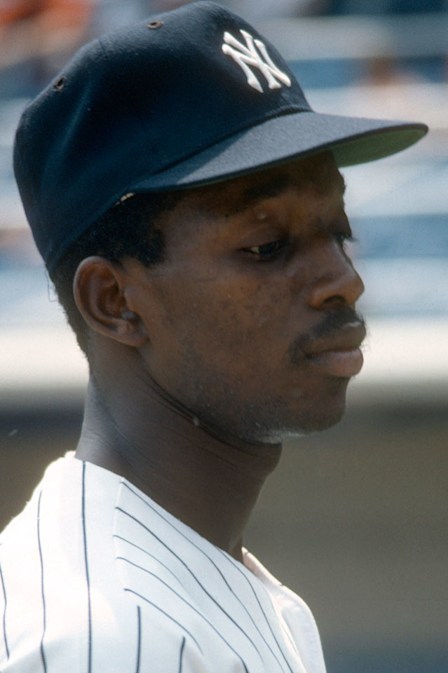
Mickey Rivers was an outfielder who played for the New York Yankees from 1976 to 1979. Career stats: .299 batting average, 34 home runs, 209 RBI.
Spring 1976. A new leadoff hitter shows up in Yankees camp, fresh off a trade from the California Angels, and within a week half the clubhouse is being called "Gozzlehead." Nobody asked for the nickname. Mickey Rivers just handed it out like batting gloves.
That was Rivers in one anecdote -- fast, funny, and utterly unbothered by anybody's ego, including his own. Over four seasons in the Bronx (1976-1979), he set the table for three pennants and two World Series championships, batting .299 for the New York Yankees while playing center field like he'd stolen the position from somebody slower (he pretty much had).
The Long Way to the Bronx
Rivers -- born John Milton Rivers on October 30, 1948, in Miami -- was such an obvious talent that four different teams drafted him before he ever signed a contract. The Chicago White Sox took him in the first round in January 1968. The Mets grabbed him that June. The Washington Senators picked him in the first round of another January draft in 1969. He didn't sign with any of them.
He finally signed with the Atlanta Braves in June 1969.
That lasted about three months. On September 8, 1969, the Braves flipped him -- along with pitcher Clint Compton -- to the California Angels for knuckleballer Hoyt Wilhelm and Bob Priddy, a trade the Braves made to load up for a division race. (They got their stretch run. The Angels got the guy who'd make three different franchises' outfields faster.)
Rivers debuted with the Angels on August 4, 1970, as a 21-year-old pinch hitter. By December 11, 1975, the Yankees needed a real center fielder and a mid-rotation arm, so GM Gabe Paul sent Bobby Bonds to California for Rivers and right-hander Ed Figueroa in one swing of a trade. Bonds never found a permanent home after that. Rivers and Figueroa became foundational pieces of the next three pennant winners.
Mick the Quick Sets the Table
| Yankees Career (1976-1979) | .299/.324/.422, 34 HR, 209 RBI |
| Games Played | 490 |
| Stolen Bases | 91 |
| 1976 (All-Star season) | .312 AVG, 8 HR, 67 RBI, 43 SB |
| 1977 (career peak) | .326 AVG, 12 HR, 69 RBI, .789 OPS |
| Postseason as a Yankee | 29 G, .308 AVG, 4 RBI |
| World Series Rings | 2 (1977, 1978) |
1976 was the breakout. Rivers hit .312, stole 43 bases in 50 tries, made his only All-Star team, and finished third in AL MVP voting -- behind teammate Thurman Munson (who won it) and George Brett. The Yankees won their first pennant in twelve years. They also got swept in the World Series by the Cincinnati Reds' Big Red Machine, which stung, but nobody in the Bronx was in a mood to complain about progress.
1977 was better in every way that mattered. Rivers set career highs across the board -- .326, 12 homers, 69 RBI, a .789 OPS -- while missing about a month to injury. He hit .391 in the ALCS. Then the Yankees beat the Los Angeles Dodgers in six games in the World Series, and Rivers had his first ring.
His average dipped to .265 in 1978 (25 steals, 78 runs scored across 138 games), but the calendar didn't care. He hit .455 in that year's ALCS and .333 in the World Series as the Yankees beat the Dodgers again. Two rings in two years. Not bad for a guy who batted leadoff mostly so other people could drive him in.
The Voice of the Bronx Zoo
The 1976-1978 Yankees clubhouse -- Billy Martin managing, Reggie Jackson arriving as a superstar free agent in 1977, George Steinbrenner hovering over everything -- earned the nickname "the Bronx Zoo" for good freakin' reason. Rivers didn't cause the chaos so much as narrate it, usually at Jackson's expense.
He was good at it, too.
The way the story's been told and retold for decades: when Jackson bragged about having a 160 IQ, Rivers reportedly shot back, "Out of what -- a thousand?" When Jackson suggested Rivers should read and write more, Rivers didn't miss a beat: "You need to stop reading and writing and start hitting." And when Jackson's full name came up, Rivers supposedly needled him with the line about having "a white man's first name, a Spanish man's middle name, and a black man's last name."
Nobody wrote those down in real time with a tape recorder running, so treat them as clubhouse folklore rather than sworn testimony. But they've survived forty-plus years of retelling for a reason -- they sound exactly like a guy who once summarized his own career goals as: "hit .300, score 100 runs, and stay injury-prone." (He meant injury-free. Everybody knew what he meant. That was the whole charm.)
On his relationship with his manager and owner, Rivers put it about as plainly as anyone in that clubhouse ever did: "Me and George and Billy are two of a kind." Considering how often Martin and Steinbrenner were feuding, lumping himself in with both of them wasn't exactly a compliment -- but it wasn't wrong, either.
Born in Miami, Florida
John Milton Rivers is born. Four different teams will draft him as an amateur before he signs with the Atlanta Braves in 1969.
Traded to the Angels
The Braves send Rivers and pitcher Clint Compton to the California Angels for Hoyt Wilhelm and Bob Priddy.
Traded to the Yankees
New York sends Bobby Bonds to California for Rivers and pitcher Ed Figueroa -- the deal that fills out the Yankees' next three pennant-winning rosters.
All-Star Season, AL Pennant
Rivers hits .312 with 43 stolen bases, makes his only All-Star team, and finishes third in AL MVP voting as the Yankees win their first pennant since 1964.
First World Series Ring
After a career-best .326 season and a .391 ALCS, Rivers and the Yankees beat the Los Angeles Dodgers in six games.
Second World Series Ring
Rivers hits .455 in the ALCS and .333 in the World Series as the Yankees beat the Dodgers again, back-to-back champions.
Traded to the Texas Rangers
The Yankees deal Rivers to Texas for outfielder Oscar Gamble, ending his Bronx tenure at four seasons.
After the Bronx
Rivers played on for Texas through 1984, then retired and went back to Florida to train racehorses -- a fitting second act for a man whose entire game was built on legs nobody could keep up with. He was never a Hall of Fame candidate and never pretended to be one. What he was: the leadoff hitter for the team that ended the Yankees' championship drought, twice, and the funniest guy in a clubhouse that had no shortage of competition for that title.
Frequently Asked Questions
What trade brought Mickey Rivers to the Yankees?
On December 11, 1975, the Yankees traded outfielder Bobby Bonds to the California Angels for Mickey Rivers and pitcher Ed Figueroa. Both new arrivals became core pieces of the Yankees' 1976-1978 pennant-winning and championship teams.
How many stolen bases did Mickey Rivers have with the Yankees?
Rivers stole 91 bases across his four seasons in pinstripes (1976-1979). His best year was 1976, when he swiped 43 bases in 50 attempts on his way to his only All-Star selection.
Did Mickey Rivers win a World Series with the Yankees?
Yes -- two. The Yankees beat the Los Angeles Dodgers in the World Series in both 1977 and 1978, and Rivers was the everyday leadoff hitter and center fielder for both championship teams. He hit .308 in 29 career postseason games as a Yankee.
Why was Mickey Rivers traded away from the Yankees in 1979?
The Yankees traded Rivers to the Texas Rangers on July 30, 1979, in exchange for outfielder Oscar Gamble, as New York reshaped its roster during a turbulent season.
Where does the nickname 'Gozzlehead' come from?
Rivers coined the word himself during his time at Miami-Dade Community College, using it (along with variants like "Warplehead") as a catch-all nickname for teammates. It stuck so well that people eventually turned it around and used it on Rivers.