
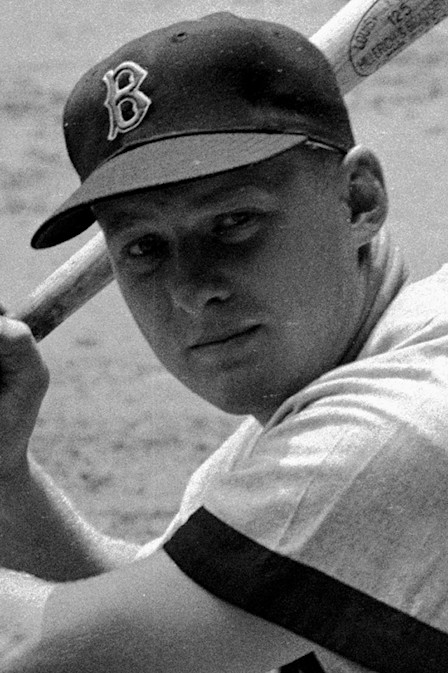
Career Stats
Regular Season
| Year | G | AB | R | H | 2B | 3B | HR | RBI | BB | SO | SB | AVG | OBP | SLG | OPS |
|---|---|---|---|---|---|---|---|---|---|---|---|---|---|---|---|
| 1950 | 45 | 70 | 13 | 12 | 2 | 2 | 1 | 5 | 7 | 8 | 4 | .171 | .247 | .300 | .547 |
| 1951 | 57 | 172 | 30 | 52 | 9 | 1 | 8 | 26 | 18 | 18 | 8 | .302 | .372 | .506 | .878 |
| 1952 | 7 | 19 | 3 | 2 | 1 | 1 | 0 | 2 | 4 | 4 | 1 | .105 | .261 | .263 | .524 |
| Career | 109 | 261 | 46 | 66 | 12 | 4 | 9 | 33 | 29 | 30 | 13 | .253 | .328 | .433 | .761 |
Career-best seasons highlighted in gold. Stats via Retrosheet.
Postseason
| Year | G | AB | R | H | 2B | 3B | HR | RBI | BB | SO | SB | AVG | OBP | SLG | OPS |
|---|---|---|---|---|---|---|---|---|---|---|---|---|---|---|---|
| 1950 | 1 | 0 | -- | 0 | -- | -- | 0 | 0 | -- | -- | -- | -- | -- | -- | -- |
| Career | 1 | 0 | 0 | 0 | 0 | 0 | 0 | 0 | 0 | 0 | 0 | .000 | .000 | .000 | .000 |
Jackie Jensen was an outfielder who played for the New York Yankees from 1950 to 1952. Career stats: .253 batting average, 9 home runs, 33 RBI.
May 3, 1952. Casey Stengel, sitting on a Yankees dynasty that had just won three straight championships, looked at a 25-year-old outfielder hitting .105 and decided the crowded, retooled Yankees outfield didn't need him. So the Yankees packaged Jackie Jensen with three other players and sent him to the Washington Senators for Irv Noren and Tom Upton.
Stengel later called it the worst trade he made in his entire Yankees tenure.
He wasn't exaggerating for effect, either. Six years and one more trade later, Jensen was the American League's Most Valuable Player, playing right field in Fenway Park instead of the Bronx, and the Yankees were left explaining how they'd let a bonus-baby sensation walk out the door for a part-time outfielder and a middle infielder nobody remembers.
Cal's Golden Boy
Jack Eugene Jensen was born March 9, 1927, in San Francisco, and by the time he got to the University of California, Berkeley, he was already the best two-sport athlete on the West Coast. He became Cal's first 1,000-yard rusher in 1948, ran a 67-yard touchdown in the Rose Bowl against Northwestern before leg cramps ended his day (Cal lost 20-14 anyway), and finished fourth in the Heisman Trophy voting -- as a running back, while also pitching Cal's baseball team to the first College World Series title in 1947. They started calling him "the Golden Boy," and it stuck for the rest of his life.
Every big-league club wanted him. The Yankees reportedly offered $75,000 to sign him outright. Jensen turned them down and signed instead with the Oakland Oaks of the Pacific Coast League for $25,000 a year over three years, figuring the level of competition mattered more than the biggest number on the page (a decision most 22-year-olds with a $75,000 offer on the table wouldn't have made).
It didn't matter. Oakland hit .261 with 9 homers and 77 RBI out of him in 1949, and that October the Oaks sold his contract -- along with a scrappy infielder named Billy Martin -- to the Yankees. Martin and Jensen came up through the same organization together and arrived in the Bronx the same winter. One of them became a Yankee for life. The other one barely got three years.
A Bonus Baby Behind DiMaggio
The problem was obvious from the start: the Yankees already had a center fielder, and his name was Joe DiMaggio.
Jensen debuted April 18, 1950, and spent his rookie year as a pinch-hitter and fifth outfielder, coming to the plate just 78 times and hitting a miserable .171 with a single home run. He got a World Series ring that fall anyway -- the Yankees swept the Phillies -- though his only appearance was a pinch-running stint for Bobby Brown in the eighth inning of Game 3 (Johnny Mize popped out to end the inning before Jensen ever got a chance to do anything with it).
1951 looked more promising. Jensen hit .298 with 8 home runs over 56 games before the Yankees optioned him to Triple-A Kansas City on July 31 -- a demotion for a player who was outhitting most of the regulars, which tells you everything about how buried he was on the depth chart. He got recalled in September and then watched the World Series from the outside again, left off the roster entirely.
By 1952, DiMaggio had retired, Mantle had taken over center field, and Jensen was fighting for a corner outfield job in a suddenly wide-open Yankees outfield. He won a starting spot in spring training. Then he went 2-for-19 to start the season, and Stengel's patience -- never a bottomless well to begin with -- ran out.
The Trade Stengel Regretted
On May 3, 1952, the Yankees sent Jensen, pitcher Spec Shea, infielder Jerry Snyder, and outfielder Archie Wilson to the Washington Senators. Back the other way came outfielder Irv Noren and infielder Tom Upton.
| Yankees Years | 1950-1952 |
| Yankees Totals | 109 G, 66 H, 9 HR, 33 RBI, .253/.330/.433 |
| Best Yankees Season | 1951 -- .298 AVG, 8 HR, 56 G (before demotion to Triple-A) |
| World Series Championships | 1 (1950, as a non-active pinch-runner) |
| Traded | May 3, 1952, to Washington Senators (with Spec Shea, Jerry Snyder, Archie Wilson, for Irv Noren and Tom Upton) |
| 1958 AL MVP (Boston) | .286 AVG, 35 HR, 122 RBI (led AL) |
Noren became a useful Yankees outfielder for a few years. That's it. That's the return.
Jensen, meanwhile, walked into Washington and immediately became a different hitter. Manager Bucky Harris put him in right field and hit him third for the rest of 1952, and Jensen responded with a .286 average and 80 RBI, led the American League in outfield assists with 17, and finished third in the league in steals. He made his first All-Star team that summer. Whatever had been suppressing him in New York -- the crowded outfield, DiMaggio's shadow, the pressure of being the $75,000 kid who couldn't crack .200 as a rookie -- evaporated the moment he left.
Stengel noticed. Years later, he was blunt about it: trading Jensen away was the worst deal he ever made running the Yankees. Coming from a man who won seven championships in twelve seasons, that's not a small admission.
Finding a Home in Boston
Washington traded Jensen again on December 9, 1953, sending him to the Boston Red Sox for pitcher Mickey McDermott and outfielder Tom Umphlett. This is the trade that actually made his career.
Jensen spent seven seasons in Fenway Park, from 1954 through 1959, and averaged roughly 25 home runs a year hitting behind Ted Williams -- as good a spot in a batting order as existed anywhere in baseball. He led the AL in stolen bases in 1954. He won three American League RBI titles in Boston -- 1955 (116), 1958 (122), and 1959 (112) -- a level of consistent run production that outlasted almost every other right fielder of his generation. He picked up a Gold Glove in 1959, his best all-around season, when he hit .277 with 27 homers, 112 RBI, and 100 runs scored.
None of it topped 1958.
The MVP Season
Jensen hit .286 with 157 hits, 31 doubles, 35 home runs, and a league-leading 122 RBI in 1958, drawing 99 walks (second in the AL) while playing every day in a lineup that also had Williams hitting for the actual batting title (.328 -- Jensen never claimed to outhit Ted Williams, and nobody else did that year either). The RBI crown, the power, and steady defense in right were enough. The Baseball Writers gave Jensen the American League Most Valuable Player Award for 1958.
Six years after the Yankees shipped him out for a part-time outfielder and an infielder who barely stuck, the Golden Boy was the best player in the American League.
Born in San Francisco
Jack Eugene Jensen is born; he'll grow up to become "Cal's Golden Boy" as a two-sport star at Berkeley.
Sold to the Yankees
The Oakland Oaks sell Jensen's contract, along with Billy Martin's, to the Yankees.
MLB Debut
Jensen debuts for the Yankees as a reserve outfielder behind Joe DiMaggio.
Traded to Washington
After a 2-for-19 start, the Yankees trade Jensen, Spec Shea, Jerry Snyder, and Archie Wilson to the Senators for Irv Noren and Tom Upton -- a deal Casey Stengel later calls the worst of his Yankees tenure.
Traded to Boston
Washington trades Jensen to the Red Sox for Mickey McDermott and Tom Umphlett, setting up seven productive seasons in Fenway Park.
American League MVP
Jensen hits .286 with 35 HR and a league-leading 122 RBI, winning the AL MVP award with the Red Sox.
Final MLB Game
Jensen plays his last major-league game, fittingly against the Yankees, closing out an 11-year career shortened by a well-documented fear of flying.
Grounded, Literally
Jensen's career ended earlier than it should have, and the reason had nothing to do with his bat. He developed a serious fear of flying in the 1950s -- well-documented at the time, including in a 1976 Sports Illustrated feature devoted to exactly that -- and by several accounts it traced back to a frightening overseas flight during an exhibition tour. Tranquilizers and a hypnotist got him through some road trips. Red Sox owner Tom Yawkey reportedly arranged therapy to help him cope. None of it fully worked.
Jensen retired after the 1959 season rather than keep boarding planes, and sat out all of 1960. He tried a comeback in 1961, but the American League had just expanded to the West Coast, which meant even more time in the air. Jensen hit .263 with 13 homers and 66 RBI over 137 games -- a solid year for most players, a disappointment for a former MVP -- and walked away from baseball for good afterward, fittingly closing his career on October 1, 1961, against the Yankees.
He finished with 199 home runs, 929 RBI, and a .279 average across 1,438 games, all for teams that weren't the New York Yankees. He's not in Cooperstown, and the Hall of Fame case was never really close. But for one summer in 1958, the kid the Yankees couldn't find room for was the best player in the American League -- and Casey Stengel never stopped saying so.
Frequently Asked Questions
Why did the Yankees trade Jackie Jensen?
Mickey Mantle's move into center field after Joe DiMaggio's 1951 retirement left Jensen fighting for a corner outfield job in a crowded, retooled Yankees outfield. After he started the 1952 season 2-for-19, the Yankees traded him, Spec Shea, Jerry Snyder, and Archie Wilson to the Washington Senators on May 3, 1952, for Irv Noren and Tom Upton. Casey Stengel later called it the worst trade he made during his Yankees tenure.
Did Jackie Jensen win the AL MVP award?
Yes. Jensen won the 1958 American League MVP award with the Boston Red Sox, hitting .286 with 35 home runs and a league-leading 122 RBI.
Why did Jackie Jensen retire early?
Jensen developed an intense, well-documented fear of flying during the 1950s. He retired after the 1959 season rather than keep flying to road games, missed all of 1960, and made one final comeback season in 1961 -- made harder by the American League's expansion to the West Coast -- before retiring for good.
Is Jackie Jensen in the Hall of Fame?
No. Despite the 1958 MVP award and three AL RBI titles with Boston, the Hall of Fame never called Jensen's number.