
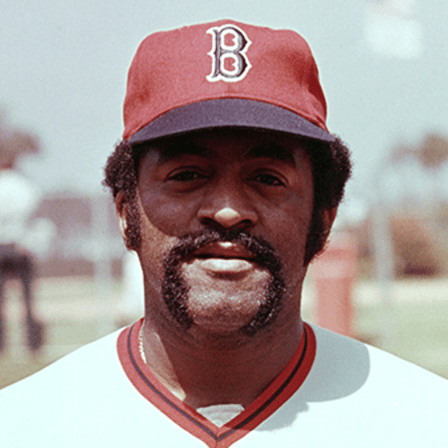
Career Stats
Regular Season
| Year | G | GS | W | L | SV | IP | H | ER | K | BB | ERA | WHIP |
|---|---|---|---|---|---|---|---|---|---|---|---|---|
| 1979 | 30 | 30 | 13 | 8 | 0 | 195.2 | 190 | 85 | 104 | 53 | 3.91 | 1.24 |
| 1980 | 25 | 25 | 8 | 9 | 0 | 136.1 | 139 | 74 | 84 | 50 | 4.89 | 1.39 |
| Career | 55 | 55 | 21 | 17 | 0 | 332.0 | 329 | 159 | 188 | 103 | 4.31 | 1.30 |
Career-best seasons highlighted in gold. Stats via Retrosheet.
Luis Tiant was a pitcher who played for the New York Yankees from 1979 to 1980. Career stats: 21-17 record, 4.31 ERA, 188 strikeouts.
Luis Tiant threw the five pitches that Ron Blomberg took for a walk on April 6, 1973, the at-bat that made Blomberg the answer to a trivia question forever. Tiant deserves better than to be somebody else's footnote. By the time he retired, he'd won 229 games, led his league in ERA twice, started three games in one World Series for a team he nearly dragged to a championship, and become one of the most beloved players Boston baseball ever had -- beloved enough that when the Red Sox let him leave, Carl Yastrzemski said it tore out the team's heart and soul. Then, six years after that Blomberg walk, Tiant put on the uniform of the team he'd been beating for a decade. The corkscrew came to the Bronx.
The Corkscrew Comes to America
Luis Clemente Tiant y Vega was born November 23, 1940, in Marianao, Cuba, into a family that already had a pitcher in it. His father, Luis Tiant Sr., spent two decades in the Negro Leagues and the Cuban League -- mostly with the New York Cubans -- throwing a screwball out of his own exaggerated pirouette windup. Luis Sr. never got a shot at the majors (the color line made sure of that, not his talent). He was still good enough to go 10-0 for the Cubans at age 41.
The son left Cuba in 1961 to chase a career the father never got, and the timing turned out to be brutal. Within months, the United States and Cuba severed diplomatic relations, and Tiant couldn't go home. He wouldn't see his parents again for fourteen years.
He signed with Cleveland's organization, debuted in the majors in 1964, and by 1968 had turned into one of the best pitchers alive -- 21-9, a league-leading 1.60 ERA, 264 strikeouts, and an afternoon in Cleveland that July where he struck out 19 Minnesota Twins over ten innings and won 1-0. Opposing hitters batted .168 against him that season. Then baseball lowered the mound to bring offense back, and Tiant fell apart along with it: 9-20 in 1969, a broken shoulder blade in Minnesota that limited him to 7-3 in 1970, and a 1-7 disaster with Boston in 1971 that had teams wondering if the shoulder was simply done. He was 30 years old and out of chances.
The Ace Boston Almost Lost
He wasn't done. In 1972, Tiant went 15-6 with a league-leading 1.91 ERA and won AL Comeback Player of the Year, and from there he became exactly what the Red Sox needed him to be -- a workhorse ace who threw 20 wins four separate times (1968, 1973, 1974, 1976), made three All-Star teams, started the 1968 All-Star Game, and finished top-six in Cy Young voting three times without ever winning it. The corkscrew windup got more elaborate as he got older, not less -- full leg kick, torso spun toward second base, back fully turned to the hitter before he'd whip back around and fire (hitters had time to read a newspaper before the ball actually showed up). Somewhere in the middle of all that, he'd usually have a cigar going in the runway between innings, because apparently pitching a shutout wasn't stressful enough on its own.
1975 gave him the best and hardest year of his life, in that order. In August, after fourteen years apart, Tiant's parents were finally allowed out of Cuba -- a Massachusetts senator leaned on George McGovern, McGovern leaned on Fidel Castro, and it worked. Father and son reunited at Logan Airport on August 22. Four days later, 69-year-old Luis Tiant Sr. walked out to the Fenway Park mound in a brown suit and threw a ceremonial first pitch before his son's start that night. Then came October: Tiant started Game 1 of the World Series against the Big Red Machine and threw a five-hit shutout, won Game 4 on roughly 163 pitches, and started Game 6 too -- the Carlton Fisk game, the one where Fisk waved his own home run fair off the left-field foul pole in the 12th inning to force a Game 7. Tiant was long gone from the mound by then, relieved after building the lead the Reds eventually erased. Boston lost the Series in seven games. Nobody who watched Tiant that October remembers him as a loser.
| Career Record (19 seasons) | 229-172, 3.30 ERA |
| Career WHIP / Strikeouts | 1.199 WHIP, 2,416 K |
| Complete Games / Shutouts | 187 CG, 49 SHO |
| ERA Titles | 1968 (1.60), 1972 (1.91) |
| 20-Win Seasons | 4 -- 1968, 1973, 1974, 1976 |
| Yankees Seasons | 1979-1980 |
| Yankees Record | 21-17, 4.31 ERA |
| Yankees Games / Innings | 55 G, 332.0 IP |
| Yankees Strikeouts / WHIP | 188 K, 1.30 WHIP |
Signing With His Own Rival
Here's where the story gets genuinely strange. On October 1, 1978, the final day of the regular season, Tiant threw a two-hit shutout against Toronto at Fenway to force a tie atop the AL East -- and by pitching that game, made himself unavailable to start the winner-take-all playoff the next day. Mike Torrez started that game instead, and Torrez gave up the home run everyone remembers Bucky Dent for. Tiant's own shutout built the stage for the biggest home run in Yankees history, and he never got to be on the mound for it.
That winter, the Red Sox offered their beloved 38-year-old ace exactly one year. The Yankees offered more (Boston fans have never quite forgiven the math on that one). Tiant took it. "When they let Luis Tiant go to New York," Yastrzemski said, looking back, "they tore out our heart and soul." He signed as a free agent on November 13, 1978 -- barely five weeks after his own shutout had indirectly handed the Yankees a championship.
The Yankees Years
The 1979 Yankees needed a Tiant a lot more than the record showed. Goose Gossage tore up his thumb in an April clubhouse fight and missed two months. George Steinbrenner fired Bob Lemon in July and brought Billy Martin back. Then, on August 2, captain Thurman Munson died in a plane crash, and a team defending back-to-back titles turned into a funeral procession that finished 89-71, fourth place, thirteen and a half games out. In the middle of all that chaos, the 38-year-old Cuban went out every fifth day and gave the Yankees exactly what they needed most: stability. He finished 13-8 with a 3.91 ERA, New York's most reliable starter behind Ron Guidry -- not flashy, just there, inning after inning, on a roster that badly needed somebody to be.
1980 wasn't as kind. At 39, Tiant slipped to 8-9 with a 4.89 ERA while the rest of the roster caught fire around him -- 103 wins, an AL East title under Dick Howser, Tommy John winning 22 games at the top of the rotation. Tiant's arm simply had less left than it used to; the corkscrew still looked the same, but the ball didn't do what it used to do when it got there. New York released him after the season. Two years, 21-17, 4.31 ERA -- not the number that defines his career, but not a paycheck-cashing farewell tour either. He'd been genuinely useful on a team that, for one tragic and then triumphant stretch, needed everybody it could get.
Born in Marianao, Cuba
Son of Negro Leagues pitcher Luis Tiant Sr., who threw two decades in the Cuban League and the New York Cubans but never got a shot at the majors.
The Best Season Nobody Rewarded
Goes 21-9 with a league-leading 1.60 ERA and 264 strikeouts for Cleveland -- and gets zero Cy Young votes because Denny McLain won 31 games that year.
Rock Bottom
Falls to 9-20, breaks his shoulder blade in Minnesota, and goes 1-7 in a brief Boston tryout -- three years that nearly ended his career at 30.
AL Comeback Player of the Year
Leads the league with a 1.91 ERA for Boston, launching a second act better than the first.
Reunited With His Parents
After 14 years apart, Tiant's parents are allowed to leave Cuba; his father throws a ceremonial first pitch at Fenway days later.
Three World Series Starts
Wins Games 1 and 4 against Cincinnati and starts Game 6 -- the Fisk homer game -- before Boston loses in seven.
The Shutout That Set Up Bucky Dent
Blanks Toronto on the final day to force a tie atop the AL East -- and pitches himself out of availability for the playoff game the next day.
Signs With the Yankees
Leaves Boston as a free agent after the Red Sox offer only one year; New York offers more.
Steadying a Team in Crisis
Goes 13-8, 3.91 ERA for a Yankees team rocked by Thurman Munson's death and a midseason managerial change.
Final Season in Pinstripes
Slips to 8-9, 4.89 ERA at 39 as the Yankees win 103 games around him; released after the season.
Dies at Age 83
Passes away having never been elected to the Baseball Hall of Fame despite 15 years on the BBWAA ballot and multiple era-committee ballots.
After the Bronx, and the Hall of Fame That Never Called
Tiant pitched one more year after leaving New York -- 1981 with Pittsburgh, who released him -- then found no big-league offers at all heading into 1982 and kept himself sharp in the Mexican League. The California Angels called him up that August anyway, for one last look. His final major-league win, fittingly, came against the Red Sox on August 17, 1982. He retired that winter at 41, a 19-year career closed out.
The Hall of Fame never came. Tiant spent 15 years on the BBWAA ballot, from 1988 to 2002, peaking at 30.9 percent his very first year and never getting closer. Era committees passed him over in 2007, 2011, 2014, and 2017, and he landed on the Classic Baseball Era Committee ballot again in December 2025 -- more than a year after he'd already died. Two ERA titles, four 20-win seasons, three World Series starts that live forever in Boston, and a Cooperstown plaque that still doesn't exist. He died October 8, 2024, at 83, still one of the more debated absences in the Hall's history.
Frequently Asked Questions
Did Luis Tiant play for the Yankees?
Yes. He signed as a free agent on November 13, 1978, and pitched for New York in 1979 and 1980, going 21-17 with a 4.31 ERA across 55 games -- the final full seasons of a 19-year career spent mostly with Cleveland and Boston.
Why did Luis Tiant leave the Red Sox for the Yankees?
Boston, despite Tiant's stature as the emotional ace of the 1975 pennant-winning team, offered him only a one-year contract after the 1978 season. The Yankees offered more, and Tiant took it -- barely five weeks after his own season-ending shutout had made him unavailable for Boston's playoff loss to New York on Bucky Dent's home run.
Who was pitching when Ron Blomberg became MLB's first designated hitter?
Luis Tiant, pitching for the Red Sox, threw the five pitches -- four balls and a called strike -- that Ron Blomberg took for a bases-loaded walk on April 6, 1973, at Fenway Park, the first plate appearance by a designated hitter in major-league history. Read more in the full story of that at-bat.
Is Luis Tiant in the Baseball Hall of Fame?
No. He spent 15 years on the BBWAA ballot (1988-2002), peaking at 30.9 percent, and has been passed over by every era committee that's considered him since, most recently the Classic Baseball Era Committee ballot voted on in December 2025, after his death. His career case -- two ERA titles, four 20-win seasons, three World Series starts in 1975 -- remains one of the more debated Cooperstown snubs.
How is Luis Tiant connected to the Negro Leagues?
His father, Luis Tiant Sr., pitched for two decades in the Negro Leagues and the Cuban League, mostly with the New York Cubans, throwing a screwball out of his own exaggerated windup -- but the color line kept him out of the majors for most of his career.
Blomberg got the trivia answer. Tiant threw the pitches that created it, on his way to a career that outclasses the question by a wide margin -- 229 wins, two ERA titles, a father's windup he carried into two different decades, and, right at the end, two seasons wearing the uniform of the team his own shutout had unintentionally helped win a championship. He never got Cooperstown. He got something that lasted anyway: nobody who saw him pitch has ever needed a plaque to remember him.