
Career Stats
Regular Season
| Year | G | GS | W | L | SV | IP | H | ER | K | BB | ERA | WHIP |
|---|---|---|---|---|---|---|---|---|---|---|---|---|
| 1958 | 44 | 1 | 6 | 4 | 20 | 75.2 | 42 | 17 | 87 | 44 | 2.02 | 1.11 |
| 1959 | 41 | 0 | 3 | 6 | 14 | 76.2 | 50 | 16 | 96 | 44 | 1.88 | 1.21 |
| 1960 | 42 | 1 | 3 | 4 | 9 | 49.0 | 27 | 27 | 67 | 49 | 4.96 | 1.55 |
| 1961 | 4 | 0 | 0 | 1 | 0 | 5.0 | 2 | 3 | 7 | 4 | 5.40 | 1.20 |
| Career | 131 | 2 | 12 | 15 | 43 | 206.1 | 121 | 63 | 257 | 141 | 2.75 | 1.27 |
Career-best seasons highlighted in gold. Stats via Retrosheet.
Postseason
| Year | G | GS | W | L | SV | IP | H | ER | K | BB | ERA | WHIP |
|---|---|---|---|---|---|---|---|---|---|---|---|---|
| 1958 | 3 | -- | 1 | 1 | 1 | 9.1 | -- | -- | -- | -- | 1.93 | -- |
| 1960 | 2 | -- | 0 | 0 | 0 | 4.0 | -- | -- | -- | -- | 2.25 | -- |
| Career | 5 | 0 | 1 | 1 | 1 | 13.1 | 0 | 0 | 0 | 0 | 0.00 | 0.00 |
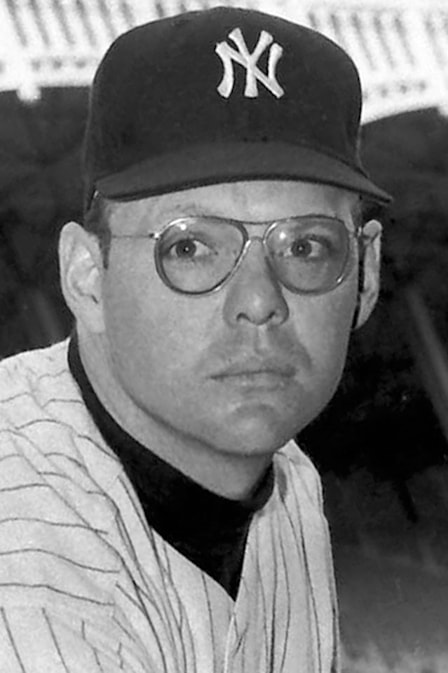
Ryne Duren was a pitcher who played for the New York Yankees from 1958 to 1961. Career stats: 12-15 record, 2.75 ERA, 257 strikeouts.
Before he threw a single pitch that counted, Ryne Duren would sometimes uncork a warm-up throw that sailed clean over his catcher's head and rattled off the backstop screen. He didn't do it every outing. He didn't need to. Word got around fast enough on its own -- a 6-foot-2 right-hander with a fastball that touched the upper 90s, eyesight bad enough that he needed glasses thick as ashtrays just to find home plate, and now this: an opening act designed to make hitters wonder if the next one might be aimed at them.
Nobody dug in against Ryne Duren. Casey Stengel put it best: "I would not admire hitting against Ryne Duren, because if he ever hit you in the head you might be in the past tense."
A Long Way From Cazenovia
Rinold George Duren was born February 22, 1929, in the tiny town of Cazenovia, Wisconsin, and signed with the St. Louis Browns organization as an amateur free agent in 1949. He spent five years buried in the low minors before the Browns -- by then relocated and renamed the Baltimore Orioles -- gave him one big-league look (a single appearance, September 25, 1954). It didn't take. Back down he went, first to the Pacific Coast League's Seattle Rainiers, then to Vancouver, where he pitched under Lefty O'Doul and kept working on a fastball that scouts already knew was special and a strike zone he still couldn't find with any consistency. The Orioles gave up on him in September 1956, trading him to the Kansas City Athletics. Kansas City didn't have much more patience -- Duren went 0-3 with a 5.27 ERA in 14 games there in 1957, mostly getting hit around when he wasn't walking people.
Then, on June 15, 1957, his career took the turn that mattered. Thirty days after the Copacabana brawl gave the Yankees an excuse to trade Billy Martin out of the Bronx, general manager George Weiss sent Martin, Ralph Terry, Woodie Held, and Bob Martyn to Kansas City. Back the other way came outfielder Harry Simpson, outfielder Jim Pisoni, and a wild-armed reliever the Yankees figured was worth a flier. The trade cost New York a future World Series hero in Terry. It also, almost as an afterthought, brought them Duren.
Finally, a Role That Fit
The Yankees spent the rest of 1957 letting him work things out in the minors. By Opening Day 1958, under Casey Stengel, Duren had a job: come in from the bullpen, throw as hard as humanly possible, and make the ninth inning somebody else's problem to solve. It worked immediately. He went 6-4 with a 2.02 ERA in 44 games, struck out 87 batters in just 75 2/3 innings, and led the American League with 20 saves -- a number nobody was officially tracking yet, since the save wouldn't become an official statistic until 1969, but one that held up fine under the retroactive count everyone uses now.
| Yankees Years | 1958-1961 |
| Yankees Record | 12-15, 43 saves |
| Yankees Innings | 206.1 IP, 257 K |
| 1958 Season | 6-4, 2.02 ERA, 20 SV (led AL) |
| 1959 Season | 3-6, 1.88 ERA (career-best), 96 K |
| All-Star Selections | 1958, 1959 (both games), 1961 |
| Career Totals (1954-1965) | 27-44, 3.83 ERA, 630 K, 57 SV |
The writers noticed, too. Duren finished second in the 1958 American League Rookie of the Year vote, well behind Washington's Albie Pearson but comfortably ahead of the field otherwise. Not that "rookie" fit quite right for a 29-year-old who'd already bounced through five organizations (the Browns, the Orioles, two Pacific Coast League stops, and the Athletics). Baseball didn't much care. He'd earned the ballot.
Champion
The 1958 Yankees won 92 games, the pennant by 10, and then did something baseball had seen only once before -- they came back from down 3-1 in the World Series to beat the Milwaukee Braves in seven, avenging the loss Milwaukee had handed them the year before. Duren was part of it. He worked three games in that Series comeback, throwing 9 1/3 innings, going 1-1 with a save and a 1.93 ERA, teaming with Don Larsen for a Game 3 win and closing out the pennant-clinching stretch alongside a rotation anchored by Whitey Ford and Bob Turley's Cy Young season. The Braves played in Duren's home state (Wisconsin doesn't produce many major leaguers, and it had adopted this one's opponents as its own). He beat them anyway.
The Best Season Nobody Remembers
If 1958 made Duren famous, 1959 made him better. He posted a career-best 1.88 ERA, struck out 96 hitters in 76 2/3 innings, and reeled off a stretch of 17 straight scoreless appearances between May and July -- 31 1/3 innings without allowing a run, out of a bullpen, in an era when relievers weren't supposed to be the best pitcher on the staff. He made both All-Star Games that year (baseball played two in 1959) and struck out four batters in three innings of work in the second one, including Willie Mays and Eddie Mathews, which is as good a two-batter flex as a middle reliever from Wisconsin ever got. The season ended early and abruptly -- he fell at Yankee Stadium on September 19 and broke a bone in his wrist -- but by then he'd already made his point.
The Fade, and a Trade to the Coast
The stuff didn't leave all at once. Duren went 3-4 with a 4.96 ERA in 1960, still striking out 67 batters, but the walks piled up and the results slipped. In 1961 he made just four appearances for New York before the Yankees moved him on May 8, sending him along with Johnny James and Lee Thomas to the expansion Los Angeles Angels for Bob Cerv and Tex Clevenger. A month later, wearing an Angels uniform, Duren struck out seven straight Boston Red Sox hitters -- an American League record at the time. The arm never really lost anything. What it lost, more and more, was him.
He pitched five more seasons after that, bouncing through the Phillies, Reds, and Senators before his final major-league appearance on August 18, 1965. Across 10 seasons and seven organizations, he finished 27-44 with a 3.83 ERA, 630 strikeouts, and 57 saves. Not a Hall of Fame résumé. A genuinely feared one, for a few years, in the only place that mattered to him.
What the Glasses Couldn't Fix
The wildness on the mound had an off-the-field twin. Duren drank hard through most of his playing career and kept drinking after it ended, and the years following his 1965 retirement were rough ones. He finally got sober in 1968 and spent the rest of his life working as an addiction counselor -- hospitals, agencies, adolescents, whoever needed to hear from someone who'd actually lived it (nobody talks their way out of that particular fight without having been in it themselves). The Yankees gave him their Yankee Family Award in 1983 for that work. In 2003, he co-wrote a memoir about the whole arc, "I Can See Clearly Now," a title that does double duty for a man once famous for barely being able to see the plate.
There's an earlier story, too, less famous but worth telling. Pitching for the Texas League's San Antonio Missions in 1955, in a league only recently and unevenly integrated, Duren reportedly answered a rival manager's orders to throw at Black hitters by throwing hard right back -- an account that comes down through teammate Willie Tasby and appears in historian Bruce Adelson's research on integration in Southern minor league ball. It's not a box score. It's the kind of thing that gets remembered anyway.
Ryne Duren died January 6, 2011, at his winter home in Lake Wales, Florida. He was 81. He spent four seasons in pinstripes and made every one of them count, walking to the mound each time with a fastball hitters couldn't catch up to and a stare, through those impossibly thick lenses, that made them wonder if he could even see them coming.
Born in Cazenovia, Wisconsin
Rinold George Duren is born in Cazenovia, Wisconsin. He signs with the St. Louis Browns organization as an amateur free agent in 1949.
Traded to the Yankees
As part of the trade that sends Billy Martin to Kansas City following the Copacabana incident, the Yankees acquire Duren, Jim Pisoni, and Harry Simpson from the Athletics.
AL Saves Leader, World Series Champion
Duren goes 6-4 with a 2.02 ERA and leads the American League with 20 saves. He finishes second in AL Rookie of the Year voting and helps the Yankees beat Milwaukee in a seven-game World Series comeback from down 3-1.
Career-Best Year
Duren posts a career-best 1.88 ERA, reels off 17 consecutive scoreless appearances, and makes both All-Star Games. A broken wrist from a fall at Yankee Stadium ends his season on September 19.
Traded to the Los Angeles Angels
After four appearances that season, the Yankees trade Duren, Johnny James, and Lee Thomas to the expansion Angels for Bob Cerv and Tex Clevenger.
Death
Ryne Duren dies at his winter home in Lake Wales, Florida, at age 81.
Frequently Asked Questions
Why did Ryne Duren wear such thick glasses?
A bout of rheumatic fever in 1945 left Duren with severely poor eyesight, and he needed thick "coke-bottle" glasses to see the plate for the rest of his career. Combined with his reputation for wildness and a fastball that touched the upper 90s, the glasses made him one of the most intimidating relievers of his era -- few hitters wanted to dig in against a pitcher who looked like he genuinely couldn't see where the ball was going.
Did Ryne Duren lead the American League in saves?
Yes. In 1958, his first full season with the Yankees, Duren went 6-4 with a 2.02 ERA and led the AL with 20 saves (a total calculated retroactively, since saves didn't become an official MLB statistic until 1969). He finished second to Albie Pearson in that year's AL Rookie of the Year vote and helped the Yankees win the World Series.
How did Ryne Duren end up with the Yankees?
The Yankees acquired Duren from the Kansas City Athletics on June 15, 1957, as part of the trade that sent Billy Martin away following the Copacabana nightclub incident. New York gave up Martin, Ralph Terry, Woodie Held, and Bob Martyn; Duren came back along with outfielders Jim Pisoni and Harry Simpson.
What happened to Ryne Duren after he retired from baseball?
Duren struggled with alcoholism through much of his playing career and after his 1965 retirement, finally getting sober in 1968. He spent the rest of his life as an addiction counselor, working with hospitals and agencies to help others with the same struggle, and the Yankees honored that work with their Yankee Family Award in 1983. He co-wrote a memoir, "I Can See Clearly Now," in 2003.