
Career Stats
Regular Season
| Year | G | AB | R | H | 2B | 3B | HR | RBI | BB | SO | SB | AVG | OBP | SLG | OPS |
|---|---|---|---|---|---|---|---|---|---|---|---|---|---|---|---|
| 1946 | 154 | 583 | 96 | 147 | 26 | 4 | 19 | 85 | 89 | 64 | 5 | .252 | .358 | .408 | .766 |
| 1947 | 143 | 556 | 110 | 159 | 36 | 13 | 16 | 101 | 71 | 56 | 3 | .286 | .370 | .484 | .854 |
| 1948 | 148 | 596 | 140 | 184 | 42 | 14 | 25 | 100 | 78 | 43 | 3 | .309 | .392 | .552 | .944 |
| 1949 | 117 | 418 | 91 | 122 | 21 | 4 | 24 | 85 | 88 | 34 | 2 | .292 | .421 | .533 | .954 |
| 1950 | 73 | 151 | 20 | 41 | 6 | 8 | 6 | 34 | 27 | 6 | 0 | .272 | .382 | .536 | .918 |
| Career | 1303 | 4680 | 919 | 1321 | 275 | 74 | 183 | 807 | 723 | 390 | 40 | .282 | .378 | .490 | .868 |
Career-best seasons highlighted in gold. Stats via Retrosheet.
Postseason
| Year | G | AB | R | H | 2B | 3B | HR | RBI | BB | SO | SB | AVG | OBP | SLG | OPS |
|---|---|---|---|---|---|---|---|---|---|---|---|---|---|---|---|
| 1938 | 4 | 16 | -- | 4 | -- | -- | 1 | 1 | -- | -- | -- | .250 | -- | -- | -- |
| 1941 | 5 | 18 | -- | 3 | -- | -- | 1 | 1 | -- | -- | -- | .167 | -- | -- | -- |
| 1947 | 7 | 31 | -- | 10 | -- | -- | 1 | 5 | -- | -- | -- | .323 | -- | -- | -- |
| 1949 | 5 | 19 | -- | 5 | -- | -- | 1 | 1 | -- | -- | -- | .263 | -- | -- | -- |
| Career | 21 | 84 | 0 | 22 | 0 | 0 | 4 | 8 | 0 | 0 | 0 | .262 | .262 | .405 | .667 |
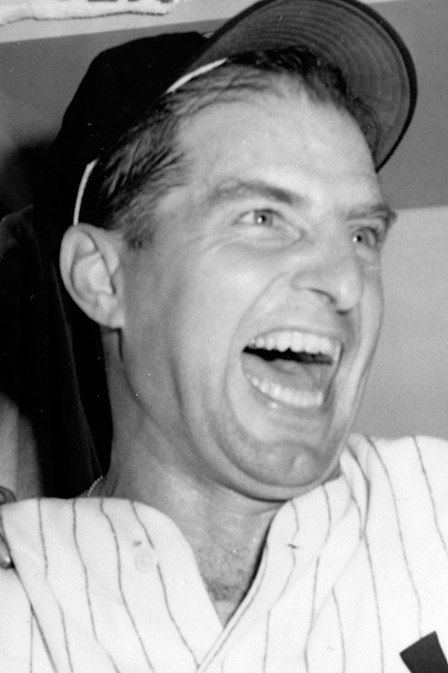
Tommy Henrich was an outfielder who played for the New York Yankees in 1937-1942, 1946-1950. Career stats: .282 batting average, 183 home runs, 807 RBI.
October 5, 1949. Yankee Stadium, bottom of the ninth, the score still 0-0. Don Newcombe had been magnificent -- four hits, eleven strikeouts, 111 pitches over eight innings, not a single run allowed. The Brooklyn Dodgers were one out away from stealing Game 1 of the World Series in the Bronx.
Tommy Henrich stepped in to lead off the inning.
He'd gone 0-for-3 against Newcombe -- a groundout, a pop fly, a fly to center. Nothing had worked. Newcombe threw two curveballs, both off the plate, and the count went to 2-0. The crowd stirred. On the 114th pitch of Newcombe's night, the Dodger ace tried another hard curve, and Henrich turned on it. The ball landed in the right-field seats.
Yankees 1, Dodgers 0. The first walk-off home run in World Series history. Just another October for Old Reliable.
A Kid from Massillon
Thomas David Henrich was born on February 20, 1913, in Massillon, Ohio -- a steel town in the northeastern part of the state, better known for football than baseball. His favorite player growing up was Babe Ruth. That detail matters, because when the opportunity eventually came to choose his own destination, Henrich didn't hesitate.
He signed with the Cleveland Indians organization in 1934 and spent three years working his way through the farm system. By 1936, he'd posted the kind of numbers in the Double-A Southern Association that earned a big-league call-up. Instead, Cleveland GM Cy Slapnicka assigned him to the Milwaukee Brewers of the American Association -- a club with murky affiliation -- and Henrich found himself unable to determine who actually owned his rights.
So he wrote a letter. Henrich and his father sent a formal appeal to Commissioner Kenesaw Mountain Landis, laying out what they believed was a deliberate effort to hide his development and keep him out of the major leagues.
The Ruling That Changed Everything
On April 15, 1937, Landis agreed. He ruled that the Indians had illegally "covered up" Henrich's advancement to evade major league draft rules, and declared him a free agent. It was a remarkable outcome -- a twenty-four-year-old outfielder from Ohio had taken on a major league franchise and won.
Multiple clubs came calling. Henrich chose the Yankees, signed for a $25,000 bonus (his favorite team since childhood, and Ruth had only just left the Bronx), and debuted on May 11, 1937 at Comiskey Park, going 1-for-4 with a double.
The New York Yankees were already loaded. Lou Gehrig was in his last great seasons, Joe DiMaggio was becoming DiMaggio, Bill Dickey was behind the plate, and Joe Gordon was on his way. In 67 games as a rookie, Henrich hit .320 and looked like he belonged. The dynasty absorbed him without breaking stride.
Playing Next to the Clipper
The partnership between Henrich and DiMaggio defined how opposing managers drew up their lineups for the better part of a decade. DiMaggio occupied center field and the heart of the order; Henrich patrolled right and provided protection, bat speed behind him, and the kind of clutch production that's hard to quantify but impossible to miss.
They won the World Series in 1938. Henrich hit .250 in that Fall Classic against the Cubs and homered in Game 4 of the sweep. They were building something.
The 1941 season was Henrich's best before the war -- 31 home runs, which was third in the American League, with 106 runs scored and a .895 OPS. That October, the Yankees faced the Dodgers in the World Series. In Game 4, with Brooklyn leading 4-3 and two outs in the ninth, Henrich swung through a Hugh Casey breaking ball for strike three. The game should have been over. Instead, catcher Mickey Owen let the ball skip to the backstop.
Henrich recognized it instantly and sprinted for first. What followed was one of the most complete collapses in World Series history: DiMaggio singled, Charlie Keller doubled in two runs, a walk, another double. The Yankees won the inning, the game, and ultimately the Series. Henrich didn't get the hit -- he just didn't get out, which, in that particular inning, was the same thing.
Three Years Gone
In August 1942, Henrich enlisted in the U.S. Coast Guard and was stationed at Sault Ste. Marie, Michigan. He wouldn't play professional baseball again for three years. He was 29 when he left. He was 33 by the time he stepped back onto a major league field.
The years between were the best ones a ballplayer has. He returned in 1946 hitting .251 -- a career low -- but the peripherals told a different story: 87 walks, 92 runs, 19 home runs, 83 RBI. His body remembered.
By 1947 he was back to .287, with 16 home runs and 98 RBI, and he led the American League in triples. In the World Series that fall against Brooklyn (again), he was the Yankees' best hitter -- ten hits in thirty-one at-bats, a .323 average, five RBI, including two runs batted in during Game 1. The Yankees won in seven.
Then came 1948 -- the finest statistical season of his career, at age 35. He hit .308 with 25 home runs and 100 RBI, led the American League in both runs scored (138) and triples (14), and finished sixth in the MVP vote. The three years he gave to the Coast Guard hadn't diminished him. If anything, the return years felt like settling of debt.
The Name
Mel Allen, the Yankees broadcaster who gave half the stadium its vocabulary (he also coined "Joltin' Joe" for DiMaggio), named Henrich "Old Reliable" after a train that ran from Ohio to Alabama -- a train celebrated for always arriving on time. The nickname fit so precisely that it stopped being a nickname. It was just the truth about him.
Henrich's OPS+ of 132 over his career means he was, adjusting for era, 32 percent better than the average hitter. He posted that while playing right field next to DiMaggio, on teams that won five World Series championships, in a borough that was busy building a mythology. He didn't become mythology himself. He became dependable, which is a quieter thing.
One Last October
The 1949 World Series win gave Henrich his fourth championship as an active contributor. He was 36 years old. One more season remained -- 1950, another Yankees title, and then he was done.
He retired with a .282 career average, a .382 on-base percentage, 183 home runs, and 795 RBI across eleven seasons -- numbers that shrink when you remember three of his prime years are missing entirely. The Hall of Fame never called. He received votes in nine elections, maxed out around 20 percent support, and eventually fell off the ballot. His career WAR sits in the upper 30s (bWAR), just shy of Enos Slaughter's, and Slaughter is in Cooperstown.
Tommy Henrich lived to 96. He outlasted almost everyone from his era. He died on December 1, 2009, long enough to know he'd been part of something singular -- those Yankees clubs of the late 1930s and 1940s, built around DiMaggio and won on the backs of players who simply showed up and delivered. Every time. On time.
Like a train running south out of Ohio.
| Career Batting Average | .282 |
| On-Base Percentage | .382 |
| Slugging Percentage | .491 |
| OPS+ | 132 |
| Home Runs | 183 |
| RBI | 795 |
| Runs Scored | 901 |
| Career Hits | 1,297 |
| Triples | 73 |
| World Series Rings | 5 (1938, 1941, 1947, 1949, 1950) |
| World Series HR | 4 (career) |
Born in Massillon, Ohio
Thomas David Henrich is born in Massillon, Ohio. His favorite player growing up will be Babe Ruth -- a detail that shapes what happens next.
Commissioner Landis Declares Him a Free Agent
After Henrich appeals directly to Commissioner Kenesaw Mountain Landis, Landis rules that the Cleveland Indians illegally concealed Henrich in their farm system. Henrich is granted free agency -- a rare outcome, and a defining moment in his life. The Yankees sign him for a $25,000 bonus.
MLB Debut at Comiskey Park
Henrich goes 1-for-4 with a double at Comiskey Park against the Chicago White Sox. He'll hit .320 in 67 games in his rookie season.
Mickey Owen's Dropped Third Strike
In Game 4 of the World Series against Brooklyn, Henrich swings through a Hugh Casey curveball for strike three -- but catcher Mickey Owen drops the ball. Henrich runs to first, the Yankees rally for four runs, and what should've been a Dodgers win becomes a Yankees win. The Yankees take the Series in five games.
Enlists in the U.S. Coast Guard
Henrich joins the Coast Guard and is stationed at Sault Ste. Marie, Michigan. He'll miss three full major league seasons -- 1943, 1944, and 1945 -- during what would've been his late prime.
World Series Hitting Star
In the 1947 World Series against Brooklyn, Henrich bats .323 (10-for-31) with one home run and five RBI over seven games. The Yankees win the championship. He's 34 years old and playing some of the best baseball of his career.
First Walk-Off Home Run in World Series History
Leading off the bottom of the ninth in Game 1, with the score 0-0, Henrich hits Newcombe's 114th pitch -- a 2-0 curveball -- into the right-field seats for a 1-0 Yankees win. Allie Reynolds had thrown a complete-game two-hitter. The first walk-off home run in World Series history belongs to Tommy Henrich.
Death at Age 96
Tommy Henrich dies in Dayton, Ohio, at age 96, of complications from a series of strokes. He was the last surviving member of the 1938 Yankees championship team.
Frequently Asked Questions
Why was Tommy Henrich called 'Old Reliable'?
Yankees broadcaster Mel Allen gave Henrich the nickname "Old Reliable," naming him after a train that ran from Ohio to Alabama, celebrated for always arriving on time. The name stuck because it fit -- Henrich had a career OPS+ of 132 and a reputation for delivering when the Yankees needed him most, particularly in the World Series. Allen also coined "Joltin' Joe" for DiMaggio and "The Scooter" for Phil Rizzuto.
How did Tommy Henrich become a Yankee?
Henrich was signed by the Cleveland Indians in 1934 and spent several years in their farm system without receiving a legitimate shot at the majors. In early 1937, he appealed directly to Commissioner Kenesaw Mountain Landis, alleging that the Indians had illegally hidden him in their minor league system to evade the major league draft. On April 15, 1937, Landis ruled in Henrich's favor and declared him a free agent. Multiple clubs bid for his services, but Henrich -- whose favorite player growing up was Babe Ruth -- chose the Yankees. New York signed him with a $25,000 bonus.
Did Tommy Henrich serve in World War II?
Yes. Henrich enlisted in the U.S. Coast Guard in August 1942 and was stationed at Sault Ste. Marie, Michigan for the duration of his service. He missed the 1943, 1944, and 1945 seasons entirely -- three consecutive prime years that factor significantly into any evaluation of his career totals. He returned to the Yankees in 1946 at age 33 and played until 1950.
What was Tommy Henrich's most famous World Series moment?
Two moments define his postseason legacy. In Game 4 of the 1941 World Series, Henrich struck out on a Hugh Casey curveball but alertly ran to first when catcher Mickey Owen dropped the pitch -- triggering a four-run Yankees rally that turned a 4-3 deficit into a win. In Game 1 of the 1949 World Series, Henrich hit a walk-off home run off Don Newcombe on a 2-0 count to lead off the ninth inning, giving the Yankees a 1-0 win -- the first walk-off home run in World Series history.
Is Tommy Henrich in the Baseball Hall of Fame?
No. Henrich received Hall of Fame votes in nine elections, with support peaking around 20 percent of the ballot. His career WAR sits in the upper 30s, comparable to Enos Slaughter's numbers during the overlapping years they played -- but Slaughter continued playing until 1959, accumulating the career counting stats that tend to tip Veterans Committee votes. The three seasons Henrich lost to Coast Guard service during WWII are the most commonly cited factor in his Hall of Fame case.